Scheaffer Hannah L, Borazjani Abdolsamad, Szafran Brittany N, Ross Matthew K
Department of Biochemistry, Molecular Biology, Entomology, & Plant Pathology, College of Agriculture and Life Sciences, Mississippi State University, Mississippi State, Mississippi 39762, United States.
Center for Environmental Health Sciences, Department of Comparative Biomedical Sciences, College of Veterinary Medicine, Mississippi State University, Mississippi State, Mississippi 39762, United States.
ACS Omega. 2020 Nov 3;5(45):29177-29188. doi: 10.1021/acsomega.0c03961. eCollection 2020 Nov 17.
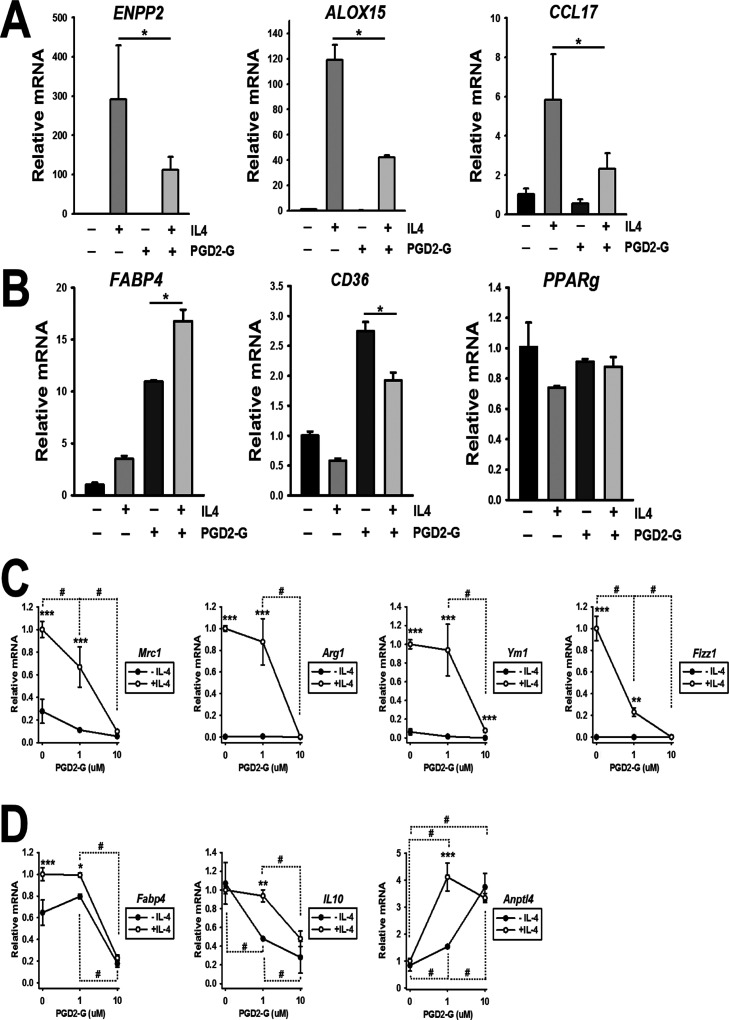
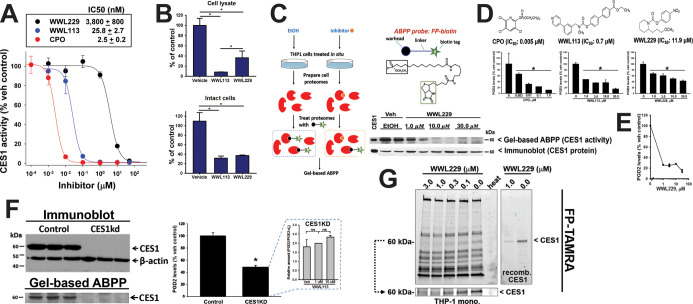
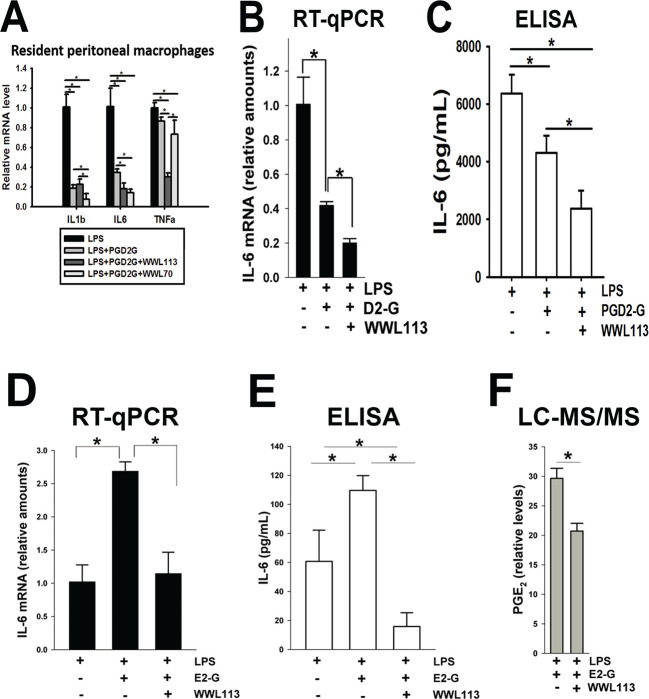
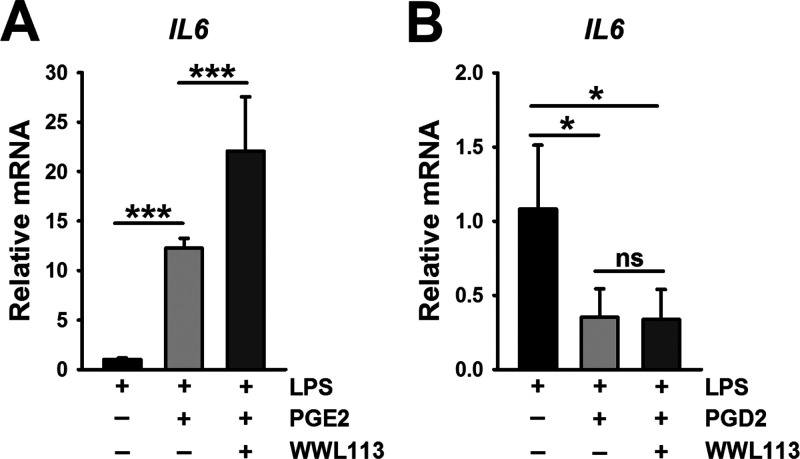
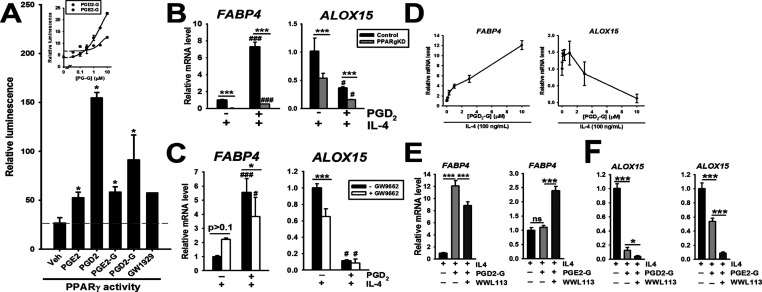
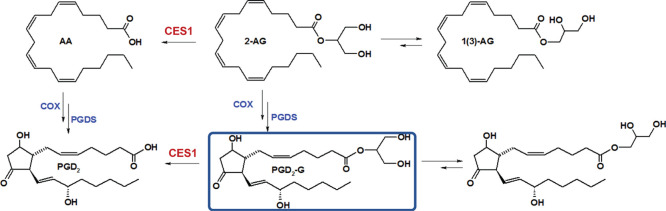
Human monocytic cells in blood have important roles in host defense and express the enzyme carboxylesterase 1 (CES1). This metabolic serine hydrolase plays a critical role in the metabolism of many molecules, including lipid mediators called prostaglandin glyceryl esters (PG-Gs), which are formed during cyclooxygenase-mediated oxygenation of the endocannabinoid 2-arachidonoylglycerol. Some PG-Gs have been shown to exhibit anti-inflammatory effects; however, they are unstable compounds, and their hydrolytic breakdown generates pro-inflammatory prostaglandins. We hypothesized that by blocking the ability of CES1 to hydrolyze PG-Gs in monocytes/macrophages, the beneficial effects of anti-inflammatory prostaglandin D-glyceryl ester (PGD-G) could be augmented. The goals of this study were to determine whether PGD-G is catabolized by CES1, evaluate the degree to which this metabolism is blocked by small-molecule inhibitors, and assess the immunomodulatory effects of PGD-G in macrophages. A human monocytic cell line (THP-1 cells) was pretreated with increasing concentrations of known small-molecule inhibitors that block CES1 activity [chlorpyrifos oxon (CPO), WWL229, or WWL113], followed by incubation with PGD-G (10 μM). Organic solvent extracts of the treated cells were analyzed by liquid chromatography with tandem mass spectrometry to assess levels of the hydrolysis product PGD. Further, THP-1 monocytes with normal CES1 expression (control cells) and "knocked-down" CES1 expression (CES1KD cells) were employed to confirm CES1's role in PGD-G catabolism. We found that CES1 has a prominent role in PGD-G hydrolysis in this cell line, accounting for about 50% of its hydrolytic metabolism, and that PGD-G could be stabilized by the inclusion of CES1 inhibitors. The inhibitor potency followed the rank order: CPO > WWL113 > WWL229. THP-1 macrophages co-treated with WWL113 and PGD-G prior to stimulation with lipopolysaccharide exhibited a more pronounced attenuation of pro-inflammatory cytokine levels (interleukin-6 and TNFα) than by PGD-G treatment alone. In contrast, prostaglandin E-glyceryl ester (PGE-G) had opposite effects compared to those of PGD-G, which appeared to be dependent on the hydrolysis of PGE-G to PGE. These results suggest that the anti-inflammatory effects induced by PGD-G can be further augmented by inactivating CES1 activity with specific small-molecule inhibitors, while pro-inflammatory effects of PGE-G are attenuated. Furthermore, PGD-G (and/or its downstream metabolites) was shown to activate the lipid-sensing receptor PPARγ, resulting in altered "alternative macrophage activation" response to the Th2 cytokine interleukin-4. These findings suggest that inhibition of CES1 and other enzymes that regulate the levels of pro-resolving mediators such as PGD-G in specific cellular niches might be a novel anti-inflammatory approach.
血液中的人类单核细胞在宿主防御中发挥重要作用,并表达羧酸酯酶1(CES1)。这种代谢性丝氨酸水解酶在许多分子的代谢中起关键作用,包括称为前列腺素甘油酯(PG-Gs)的脂质介质,它们是在内源性大麻素2-花生四烯酸甘油酯的环氧化酶介导的氧化过程中形成的。一些PG-Gs已被证明具有抗炎作用;然而,它们是不稳定的化合物,其水解分解会产生促炎前列腺素。我们推测,通过阻断CES1在单核细胞/巨噬细胞中水解PG-Gs的能力,可以增强抗炎前列腺素D-甘油酯(PGD-G)的有益作用。本研究的目的是确定PGD-G是否被CES1分解代谢,评估小分子抑制剂对这种代谢的阻断程度,并评估PGD-G在巨噬细胞中的免疫调节作用。用人单核细胞系(THP-1细胞)预先用浓度递增的已知小分子抑制剂处理,这些抑制剂可阻断CES1活性[毒死蜱氧磷(CPO)、WWL229或WWL113],然后与PGD-G(10μM)孵育。用液相色谱-串联质谱分析处理后细胞的有机溶剂提取物,以评估水解产物PGD的水平。此外,采用具有正常CES1表达的THP-1单核细胞(对照细胞)和CES1表达“敲低”的细胞(CES1KD细胞)来证实CES1在PGD-G分解代谢中的作用。我们发现CES1在该细胞系中PGD-G水解中起重要作用,约占其水解代谢的50%,并且通过加入CES1抑制剂可以使PGD-G稳定。抑制剂效力的顺序为:CPO>WWL113>WWL229。在用脂多糖刺激之前,用WWL113和PGD-G共同处理的THP-1巨噬细胞,与单独用PGD-G处理相比,促炎细胞因子水平(白细胞介素-6和肿瘤坏死因子α)的衰减更为明显。相比之下,前列腺素E-甘油酯(PGE-G)与PGD-G的作用相反,这似乎取决于PGE-G水解为PGE。这些结果表明,通过用特定的小分子抑制剂使CES1失活,可以进一步增强PGD-G诱导的抗炎作用,而PGE-G的促炎作用则减弱。此外,PGD-G(和/或其下游代谢产物)被证明可激活脂质感应受体PPARγ,从而改变对Th2细胞因子白细胞介素-4的“替代性巨噬细胞激活”反应。这些发现表明,在特定细胞微环境中抑制CES1和其他调节促分解介质(如PGD-G)水平的酶可能是一种新的抗炎方法。