Faculty of Dental Medicine, Hebrew University & Hadassah, Jerusalem, Israel.
Procter & Gamble Service GmbH, Kronberg, Germany.
Int J Paediatr Dent. 2021 Sep;31(5):657-663. doi: 10.1111/ipd.12753. Epub 2021 Feb 14.
Clinical investigations of electric toothbrushes in young children are limited.
To assess plaque reduction efficacy of an oscillating-rotating electric versus manual toothbrush in a paediatric population in primary and mixed dentitions.
In this randomised, single-brushing, 2-treatment, 4-period, replicate-use crossover study, subjects were divided into 2 age groups (3-6 years; 7-9 years) and assigned to a treatment sequence involving an Oral-B Kids electric brush and a manual brush control. Plaque was assessed pre- and post-brushing (Turesky Modified Quigley-Hein Plaque Index). Parents brushed the teeth of their children aged 3-6 years, whereas children aged 7-9 years brushed their own teeth under supervision. Plaque removal scores were analysed for brush differences in each age group separately using an analysis of covariance for crossover design.
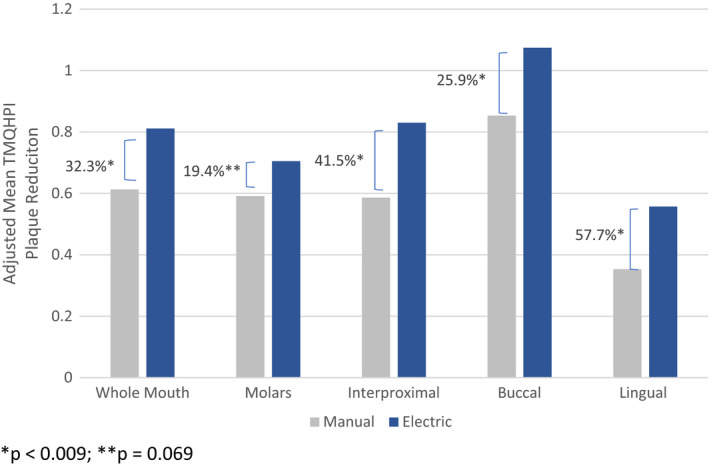
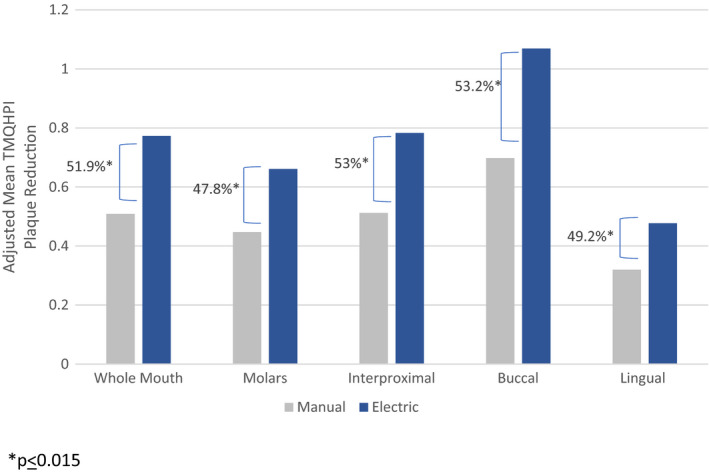
Forty-one children (n = 20, 3-6 years; n = 21, 7-9 years) completed the study. For the primary dentition in children 3-6 years, the electric brush reduced 32.3% more plaque than the manual brush (P = .005). For the mixed dentition in children 7-9 years, the electric brush reduced 51.9% more plaque than the manual brush (P < .001).
An electric toothbrush reduced significantly more plaque than a manual toothbrush in 2 paediatric age groups.
针对儿童电动牙刷的临床研究较为有限。
评估在混合牙列和乳牙列的儿童中,旋转震动式电动牙刷与手动牙刷相比在菌斑减少效果方面的差异。
在这项随机、单组刷牙、双处理、四周期、重复使用交叉研究中,受试者分为 2 个年龄组(3-6 岁;7-9 岁),并按照涉及 Oral-B Kids 电动牙刷和手动牙刷对照的处理顺序进行分组。在刷牙前(改良 Turesky 菌斑指数)和刷牙后评估菌斑。父母为 3-6 岁的孩子刷牙,而 7-9 岁的孩子在监督下自己刷牙。使用交叉设计的协方差分析,分别分析每个年龄组中牙刷差异的菌斑去除评分。
41 名儿童(n=20,3-6 岁;n=21,7-9 岁)完成了研究。对于 3-6 岁儿童的乳牙列,电动牙刷比手动牙刷减少了 32.3%的菌斑(P=.005)。对于 7-9 岁儿童的混合牙列,电动牙刷比手动牙刷减少了 51.9%的菌斑(P<.001)。
在 2 个儿童年龄组中,电动牙刷比手动牙刷显著减少了更多的菌斑。