Division of Biological Sciences, University of Montana, Missoula, MT, USA.
Department of Biology, Indiana University, Bloomington, IN, USA.
Mol Biol Evol. 2021 Apr 13;38(4):1460-1471. doi: 10.1093/molbev/msaa303.
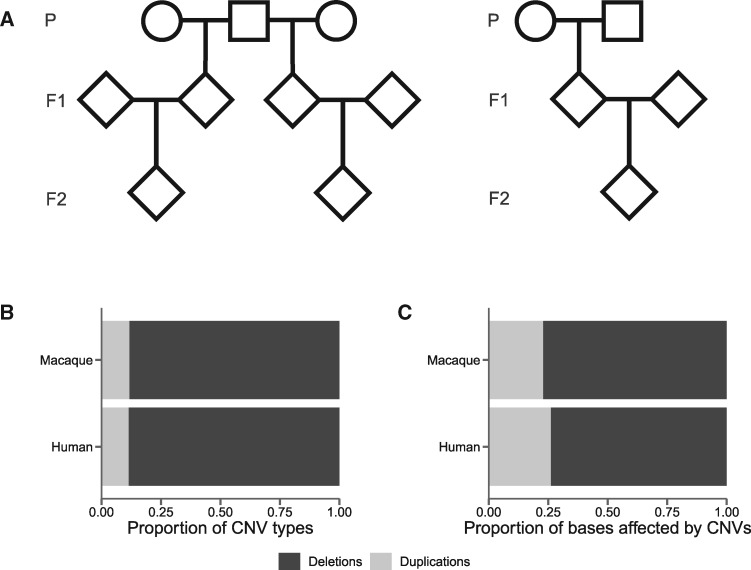
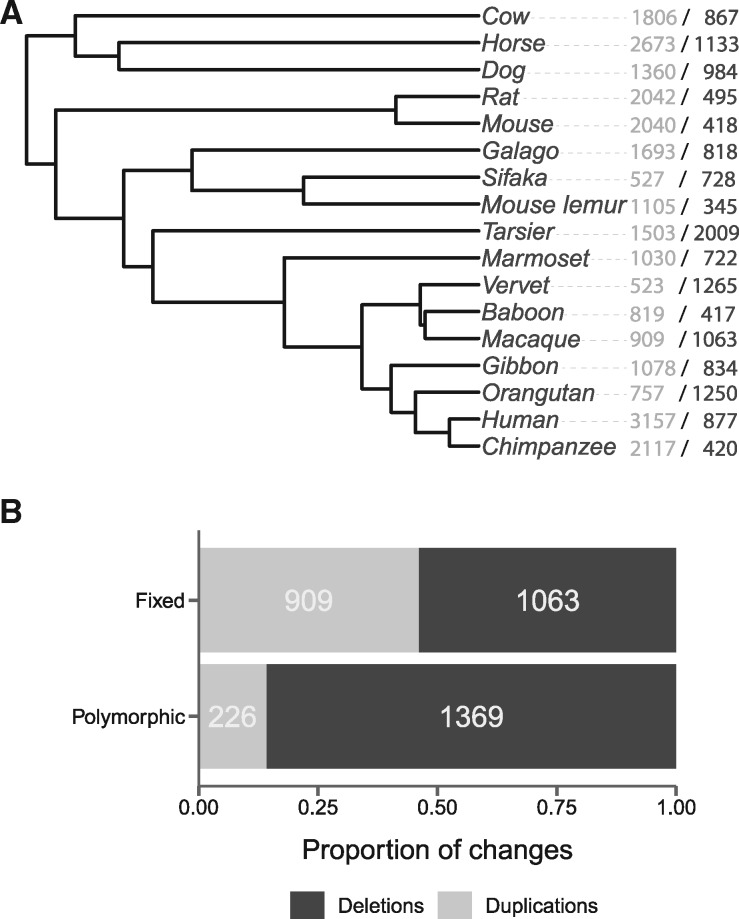
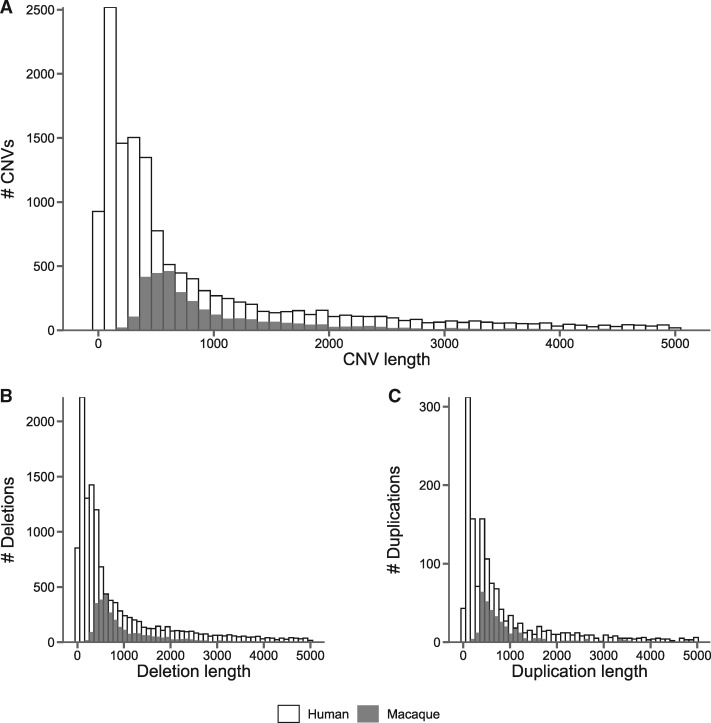
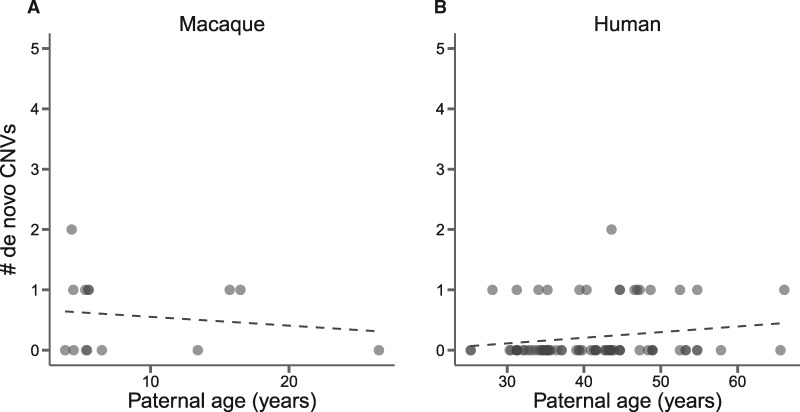
Mutations play a key role in the development of disease in an individual and the evolution of traits within species. Recent work in humans and other primates has clarified the origins and patterns of single-nucleotide variants, showing that most arise in the father's germline during spermatogenesis. It remains unknown whether larger mutations, such as deletions and duplications of hundreds or thousands of nucleotides, follow similar patterns. Such mutations lead to copy-number variation (CNV) within and between species, and can have profound effects by deleting or duplicating genes. Here, we analyze patterns of CNV mutations in 32 rhesus macaque individuals from 14 parent-offspring trios. We find the rate of CNV mutations per generation is low (less than one per genome) and we observe no correlation between parental age and the number of CNVs that are passed on to offspring. We also examine segregating CNVs within the rhesus macaque sample and compare them to a similar data set from humans, finding that both species have far more segregating deletions than duplications. We contrast this with long-term patterns of gene copy-number evolution between 17 mammals, where the proportion of deletions that become fixed along the macaque lineage is much smaller than the proportion of segregating deletions. These results suggest purifying selection acting on deletions, such that the majority of them are removed from the population over time. Rhesus macaques are an important biomedical model organism, so these results will aid in our understanding of this species and the disease models it supports.
突变在个体疾病的发展和物种内特征的进化中起着关键作用。最近在人类和其他灵长类动物中的研究阐明了单核苷酸变异的起源和模式,表明大多数变异发生在父亲的生殖细胞系在精子发生过程中。目前还不清楚是否存在更大的突变,例如数百或数千个核苷酸的缺失和重复,是否遵循类似的模式。这些突变导致物种内和物种间的拷贝数变异(CNV),并通过删除或重复基因产生深远的影响。在这里,我们分析了 14 对亲子三胞胎中的 32 只恒河猴个体中的 CNV 突变模式。我们发现,每代的 CNV 突变率很低(少于每个基因组一个),并且我们没有观察到父母年龄与传递给后代的 CNV 数量之间的相关性。我们还检查了恒河猴样本中的分离 CNV,并将其与来自人类的类似数据集进行比较,发现两个物种的分离缺失比重复都多得多。我们将这与 17 种哺乳动物之间的长期基因拷贝数进化模式进行对比,发现随着猕猴谱系的进化,固定的缺失比例远小于分离的缺失比例。这些结果表明,缺失受到了纯化选择的作用,随着时间的推移,它们中的大多数会从种群中消失。恒河猴是一种重要的生物医学模式生物,因此这些结果将有助于我们理解这个物种及其支持的疾病模型。