Department of Electronic Engineering, Chang Gung University, Taoyuan 333, Taiwan.
Department of Otolaryngology-Head and Neck Surgery, Chang Gung Memorial Hospital, Linkou 244, Taiwan.
Sensors (Basel). 2020 Nov 19;20(22):6640. doi: 10.3390/s20226640.
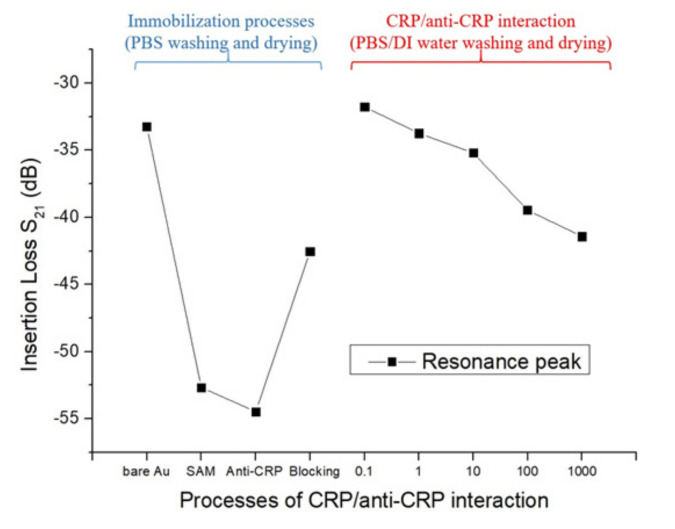
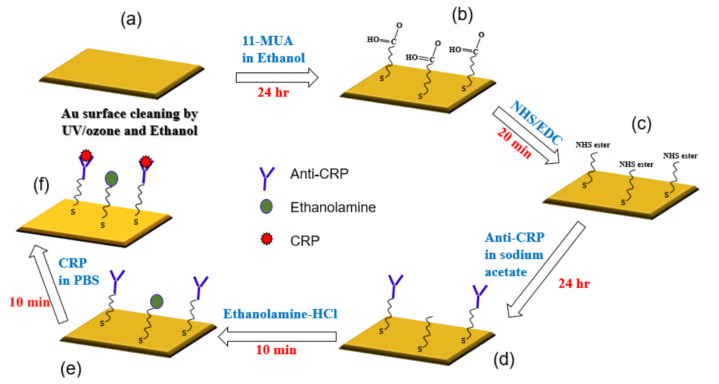
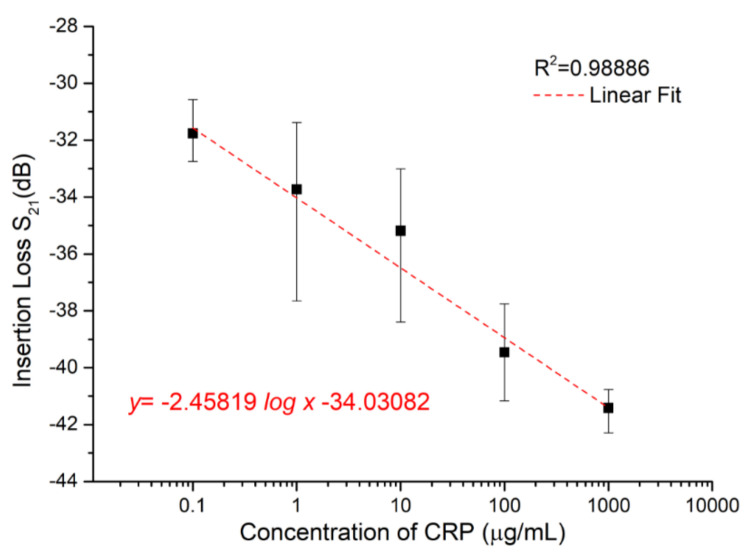
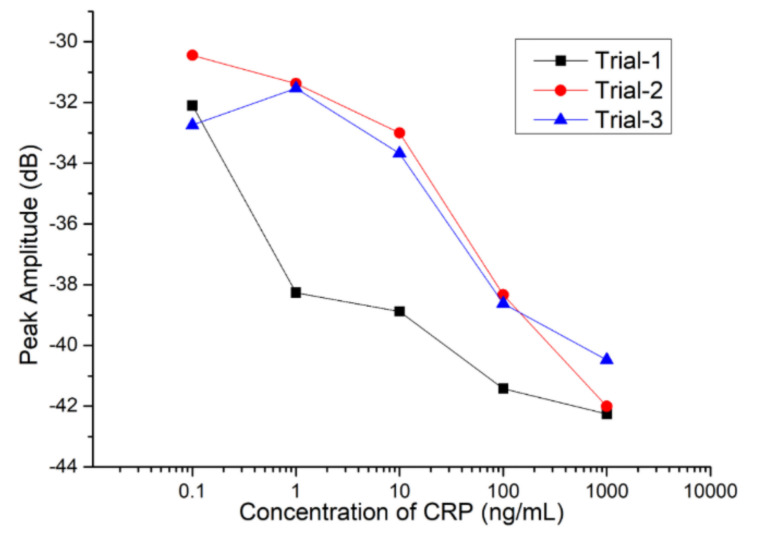
A surface acoustic wave (SAW) sensor was investigated for its application in C-reactive protein (CRP) detection. Piezoelectric lithium niobate (LiNbO) substrates were used to study their frequency response characteristics in a SAW sensor with a CRP sensing area. After the fabrication of the SAW sensor, the immobilization process was performed for CRP/anti-CRP interaction. The CRP/anti-CRP interaction can be detected as mass variations in the sensing area. These mass variations may produce changes in the amplitude of sensor response. It was clearly observed that a CRP concentration of 0.1 μg/mL can be detected in the proposed SAW sensor. A good fitting linear relationship between the detected insertion loss (amplitude) and the concentrations of CRP from 0.1 μg/mL to 1 mg/mL was obtained. The detected shifts in the amplitude of insertion loss in SAW sensors for different CRP concentrations may be useful in the diagnosis of risk of cardiovascular diseases.
研究了一种声表面波(SAW)传感器在 C-反应蛋白(CRP)检测中的应用。使用压电铌酸锂(LiNbO)衬底研究了具有 CRP 传感区域的 SAW 传感器的频率响应特性。在制造 SAW 传感器之后,进行了 CRP/抗-CRP 相互作用的固定化过程。CRP/抗-CRP 相互作用可以作为传感区域中的质量变化来检测。这些质量变化可能会导致传感器响应幅度的变化。可以清楚地观察到,在提出的 SAW 传感器中可以检测到浓度为 0.1 μg/mL 的 CRP。从 0.1 μg/mL 到 1 mg/mL 的 CRP 浓度下,检测到的插入损耗(幅度)与浓度之间存在良好的拟合线性关系。不同 CRP 浓度下 SAW 传感器的插入损耗幅度的检测到的偏移可能对心血管疾病风险的诊断有用。