Department of Neurosurgery, Medical Centre, University of Freiburg, Breisacher Str. 64, 79106, Freiburg im Breisgau, Germany.
Faculty of Medicine, University of Freiburg, Breisacher Str. 153, 79110, Freiburg im Breisgau, Germany.
BMC Med Imaging. 2020 Nov 23;20(1):123. doi: 10.1186/s12880-020-00522-y.
The revised 2016 WHO-Classification of CNS-tumours now integrates molecular information of glial brain tumours for accurate diagnosis as well as for the development of targeted therapies. In this prospective study, our aim is to investigate the predictive value of MR-spectroscopy in order to establish a solid preoperative molecular stratification algorithm of these tumours. We will process a 1H MR-spectroscopy sequence within a radiomics analytics pipeline.
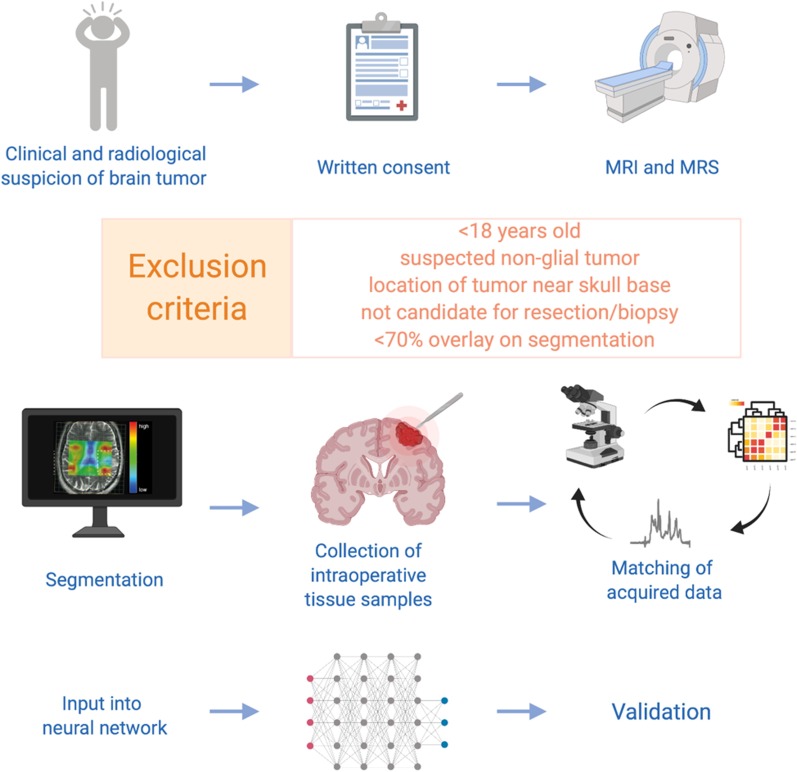
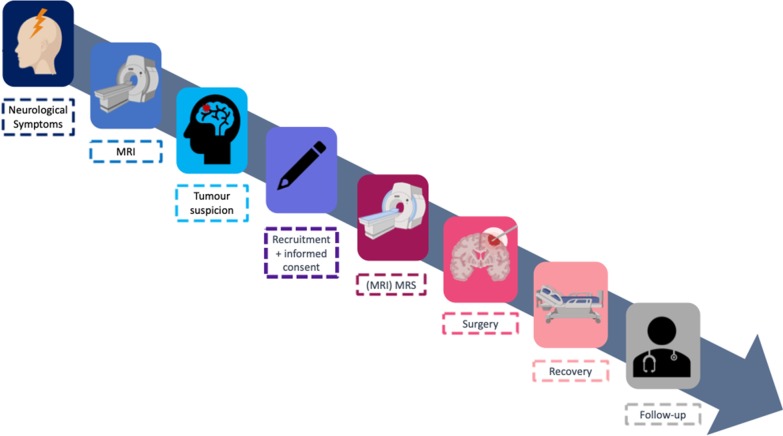
Patients treated at our institution with WHO-Grade II, III and IV gliomas will receive preoperative anatomical (T2- and T1-weighted imaging with and without contrast enhancement) and proton MR spectroscopy (MRS) by using chemical shift imaging (MRS) (5 × 5 × 15 mm voxel size). Tumour regions will be segmented and co-registered to corresponding spectroscopic voxels. Raw signals will be processed by a deep-learning approach for identifying patterns in metabolic data that provides information with respect to the histological diagnosis as well patient characteristics obtained and genomic data such as target sequencing and transcriptional data.
By imaging the metabolic profile of a glioma using a customized chemical shift 1H MR spectroscopy sequence and by processing the metabolic profiles with a machine learning tool we intend to non-invasively uncover the genetic signature of gliomas. This work-up will support surgical and oncological decisions to improve personalized tumour treatment.
This study was initially registered under another name and was later retrospectively registered under the current name at the German Clinical Trials Register (DRKS) under DRKS00019855.
新版 2016 年世卫组织中枢神经系统肿瘤分类现在整合了神经胶质脑肿瘤的分子信息,以实现准确诊断和靶向治疗的开发。在这项前瞻性研究中,我们的目的是研究磁共振波谱的预测价值,以便为这些肿瘤建立一个可靠的术前分子分层算法。我们将在放射组学分析管道中处理 1H 磁共振波谱序列。
在我们的机构中接受世卫组织 2 级、3 级和 4 级胶质瘤治疗的患者将接受术前解剖学(T2 加权和 T1 加权成像,有和没有对比增强)和质子磁共振波谱(MRS),使用化学位移成像(MRS)(5×5×15mm 体素大小)。肿瘤区域将被分割并与相应的光谱体素配准。原始信号将通过深度学习方法进行处理,以识别代谢数据中的模式,这些模式提供了与组织学诊断以及获得的患者特征和基因组数据(如靶向测序和转录组数据)相关的信息。
通过使用定制的化学位移 1H 磁共振波谱序列对胶质瘤的代谢谱进行成像,并使用机器学习工具处理代谢谱,我们旨在无创地揭示胶质瘤的遗传特征。这种方法将支持手术和肿瘤学决策,以改善个性化肿瘤治疗。
这项研究最初以另一个名称注册,后来在德国临床试验注册处(DRKS)以当前名称(DRKS00019855)进行了回顾性注册。