Department of Medical Biotechnology, Faculty of Advanced Medical Sciences, Tabriz University of Medical Sciences, Tabriz, Iran.
Solid Tumor Research Center, Cellular and Molecular Medicine Research Institute, Urmia University of Medical Sciences, P.O. Box: 1138, Shafa St, Ershad Blvd., 57147, Urmia, Iran.
J Exp Clin Cancer Res. 2020 Nov 23;39(1):258. doi: 10.1186/s13046-020-01781-x.
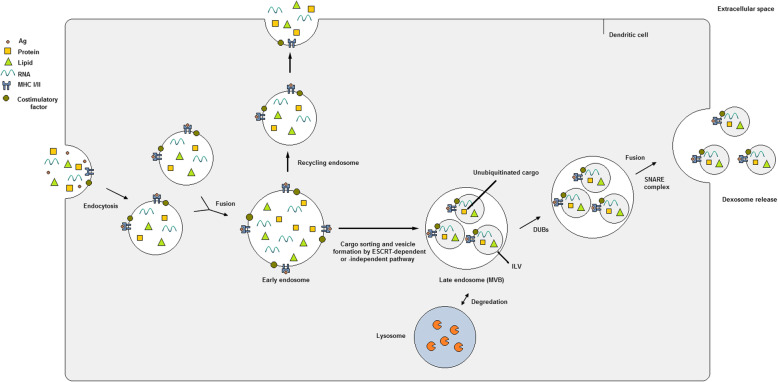
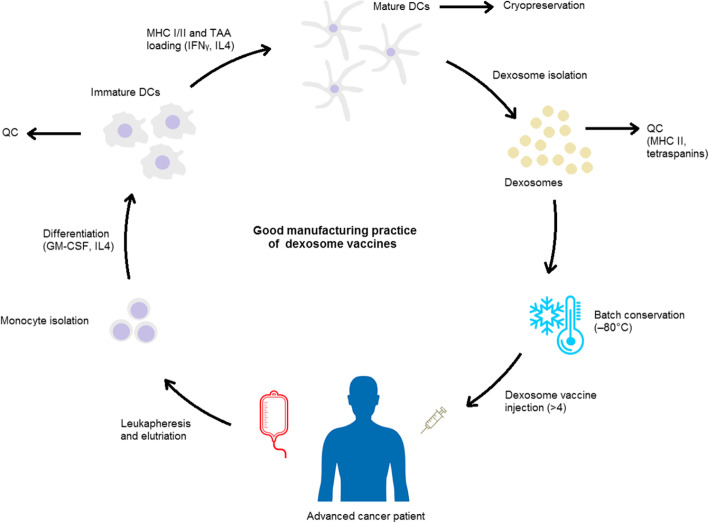
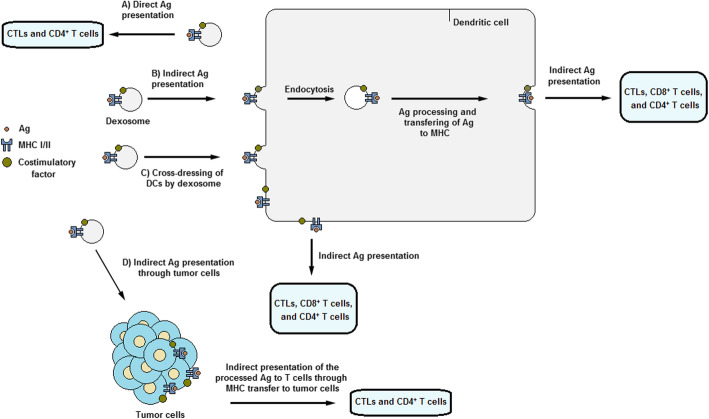
Dendritic cells (DCs) secrete vast quantities of exosomes termed as dexosomes. Dexosomes are symmetric nanoscale heat-stable vesicles that consist of a lipid bilayer displaying a characteristic series of lipid and protein molecules. They include tetraspanins and all established proteins for presenting antigenic material such as the major histocompatibility complex class I/II (MHC I/II) and CD1a, b, c, d proteins and CD86 costimulatory molecule. Dexosomes contribute to antigen-specific cellular immune responses by incorporating the MHC proteins with antigen molecules and transferring the antigen-MHC complexes and other associated molecules to naïve DCs. A variety of ex vivo and in vivo studies demonstrated that antigen-loaded dexosomes were able to initiate potent antitumor immunity. Human dexosomes can be easily prepared using monocyte-derived DCs isolated by leukapheresis of peripheral blood and treated ex vivo by cytokines and other factors. The feasibility of implementing dexosomes as therapeutic antitumor vaccines has been verified in two phase I and one phase II clinical trials in malignant melanoma and non small cell lung carcinoma patients. These studies proved the safety of dexosome administration and showed that dexosome vaccines have the capacity to trigger both the adaptive (T lymphocytes) and the innate (natural killer cells) immune cell recalls. In the current review, we will focus on the perspective of utilizing dexosome vaccines in the context of cancer immunotherapy.
树突状细胞 (DCs) 会分泌大量被称为外泌体的外泌体。外泌体是对称的纳米级热稳定囊泡,由显示特征性一系列脂质和蛋白质分子的脂质双层组成。它们包括四跨膜蛋白和所有已建立的用于呈递抗原物质的蛋白质,如主要组织相容性复合体 I/II (MHC I/II) 和 CD1a、b、c、d 蛋白和 CD86 共刺激分子。外泌体通过将 MHC 蛋白与抗原分子结合,并将抗原-MHC 复合物和其他相关分子转移到幼稚 DCs 中,从而促进抗原特异性细胞免疫反应。各种离体和体内研究表明,负载抗原的外泌体能够引发有效的抗肿瘤免疫。人外泌体可以使用通过外周血白细胞分离术分离的单核细胞衍生的 DCs 并通过细胞因子和其他因素离体处理来轻松制备。将外泌体作为治疗性抗肿瘤疫苗实施的可行性已在两项恶性黑色素瘤和非小细胞肺癌患者的 I 期和一项 II 期临床试验中得到验证。这些研究证明了外泌体给药的安全性,并表明外泌体疫苗具有触发适应性(T 淋巴细胞)和固有(自然杀伤细胞)免疫细胞回忆的能力。在当前的综述中,我们将重点关注利用外泌体疫苗进行癌症免疫治疗的前景。