Department of Tumor Immunology, Radboud Institute for Molecular Life Sciences, Nijmegen, the Netherlands.
Department of Medical Oncology, Radboud university medical centre, Nijmegen, the Netherlands.
J Immunother Cancer. 2019 Apr 18;7(1):109. doi: 10.1186/s40425-019-0580-6.
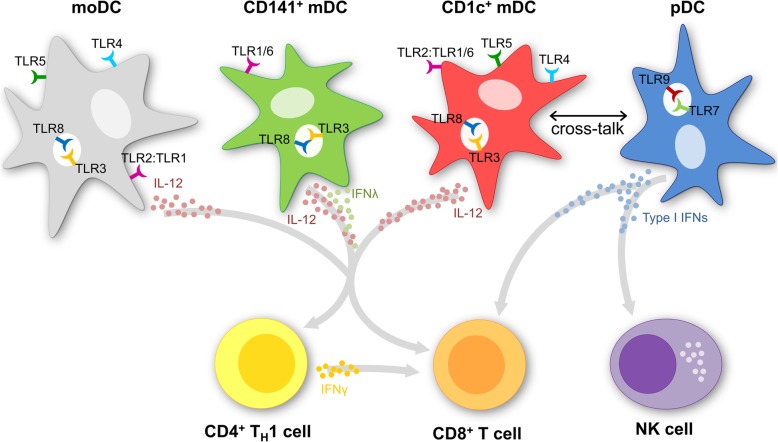
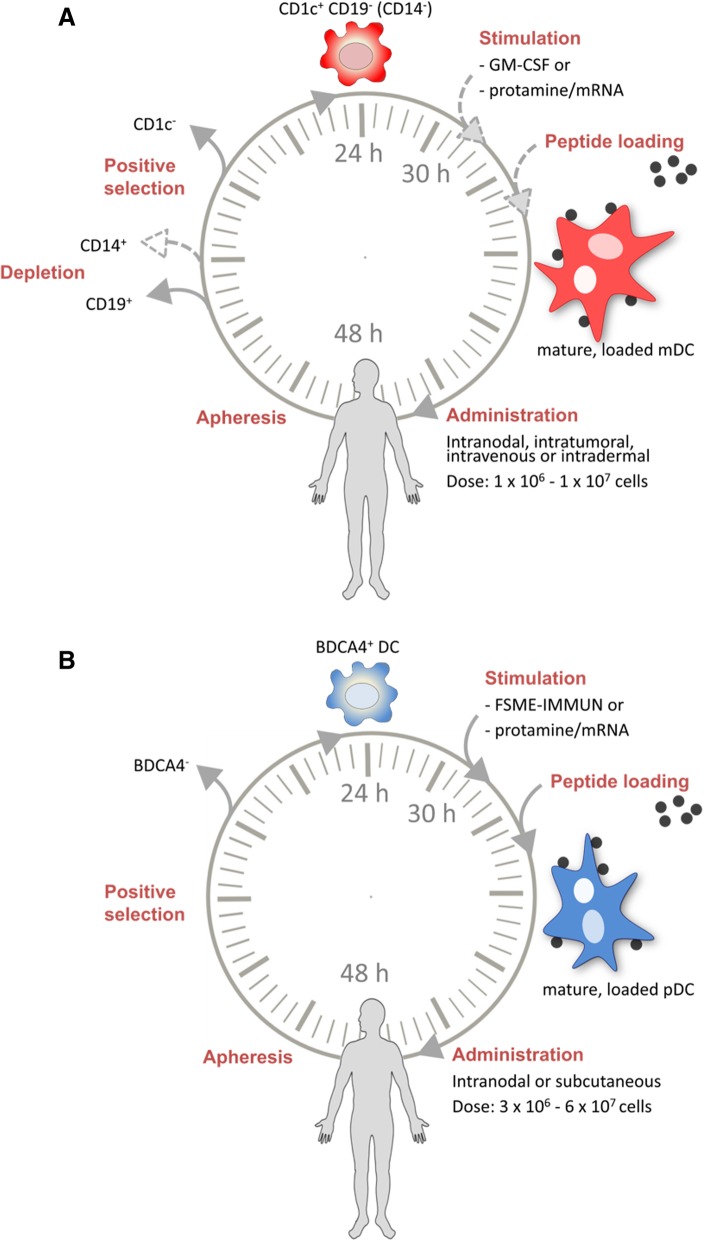
Dendritic cells (DCs) can initiate and direct adaptive immune responses. This ability is exploitable in DC vaccination strategies, in which DCs are educated ex vivo to present tumor antigens and are administered into the patient with the aim to induce a tumor-specific immune response. DC vaccination remains a promising approach with the potential to further improve cancer immunotherapy with little or no evidence of treatment-limiting toxicity. However, evidence for objective clinical antitumor activity of DC vaccination is currently limited, hampering the clinical implementation. One possible explanation for this is that the most commonly used monocyte-derived DCs may not be the best source for DC-based immunotherapy. The novel approach to use naturally circulating DCs may be an attractive alternative. In contrast to monocyte-derived DCs, naturally circulating DCs are relatively scarce but do not require extensive culture periods. Thereby, their functional capabilities are preserved, the reproducibility of clinical applications is increased, and the cells are not dysfunctional before injection. In human blood, at least three DC subsets can be distinguished, plasmacytoid DCs, CD141 and CD1c myeloid/conventional DCs, each with distinct functional characteristics. In completed clinical trials, either CD1c myeloid DCs or plasmacytoid DCs were administered and showed encouraging immunological and clinical outcomes. Currently, also the combination of CD1c myeloid and plasmacytoid DCs as well as the intratumoral use of CD1c myeloid DCs is under investigation in the clinic. Isolation and culture strategies for CD141 myeloid DCs are being developed. Here, we summarize and discuss recent clinical developments and future prospects of natural DC-based immunotherapy.
树突状细胞 (DCs) 可以启动和指导适应性免疫反应。这种能力在 DC 疫苗接种策略中是可利用的,在该策略中,DCs 在体外被教育以呈现肿瘤抗原,并被给予患者,目的是诱导针对肿瘤的免疫反应。DC 疫苗接种仍然是一种很有前途的方法,有可能进一步改善癌症免疫疗法,而几乎没有或没有证据表明存在治疗限制毒性。然而,目前 DC 疫苗接种的客观临床抗肿瘤活性的证据是有限的,这阻碍了临床实施。一个可能的解释是,最常用的单核细胞衍生 DCs 可能不是基于 DC 的免疫疗法的最佳来源。使用天然循环 DCs 的新方法可能是一个有吸引力的替代方法。与单核细胞衍生的 DCs 相比,天然循环的 DCs 相对较少,但不需要广泛的培养期。因此,它们的功能能力得以保留,临床应用的可重复性增加,并且在注射前细胞不会功能失调。在人类血液中,至少可以区分三种 DC 亚群,浆细胞样 DCs、CD141 和 CD1c 髓系/常规 DCs,每种亚群都具有不同的功能特征。在已完成的临床试验中,给予 CD1c 髓系 DCs 或浆细胞样 DCs 并显示出令人鼓舞的免疫和临床结果。目前,CD1c 髓系和浆细胞样 DCs 的联合以及 CD1c 髓系 DCs 的肿瘤内使用也正在临床中进行研究。用于 CD141 髓系 DCs 的分离和培养策略正在开发中。在这里,我们总结和讨论了基于天然 DC 的免疫疗法的最新临床进展和未来前景。