Randall Centre for Cell and Molecular Biophysics, King's College London, London SE1 1UL, United Kingdom.
Randall Centre for Cell and Molecular Biophysics, King's College London, London SE1 1UL, United Kingdom
Proc Natl Acad Sci U S A. 2020 Dec 8;117(49):31208-31218. doi: 10.1073/pnas.2012450117. Epub 2020 Nov 23.
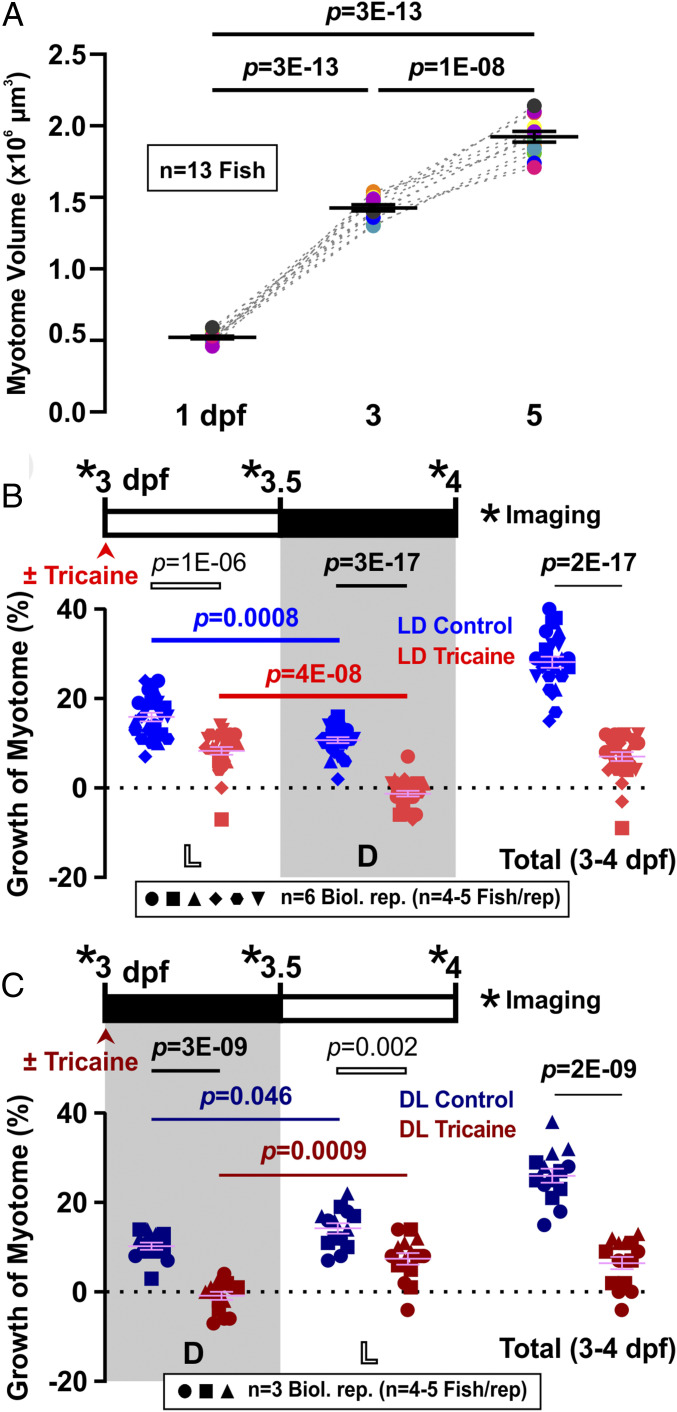
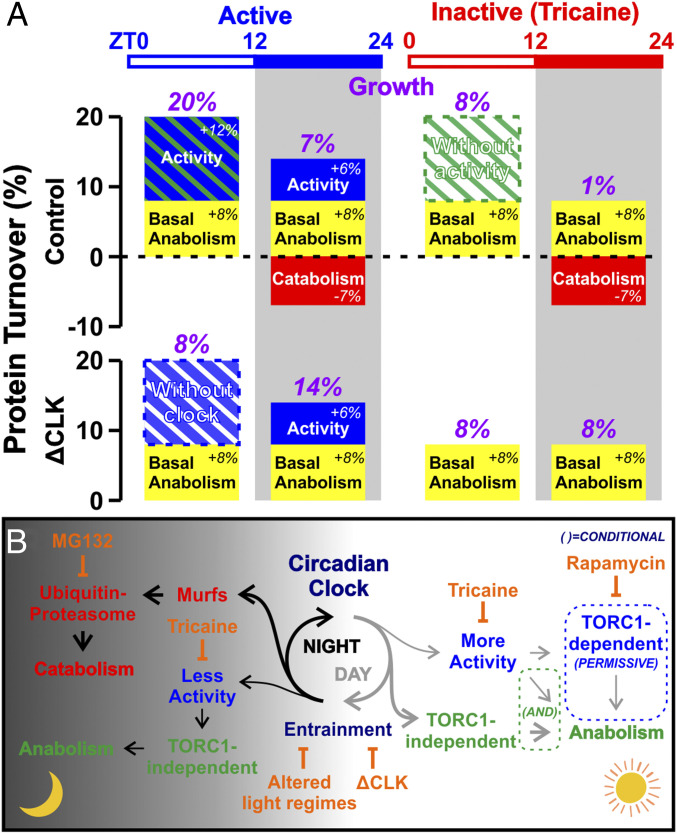
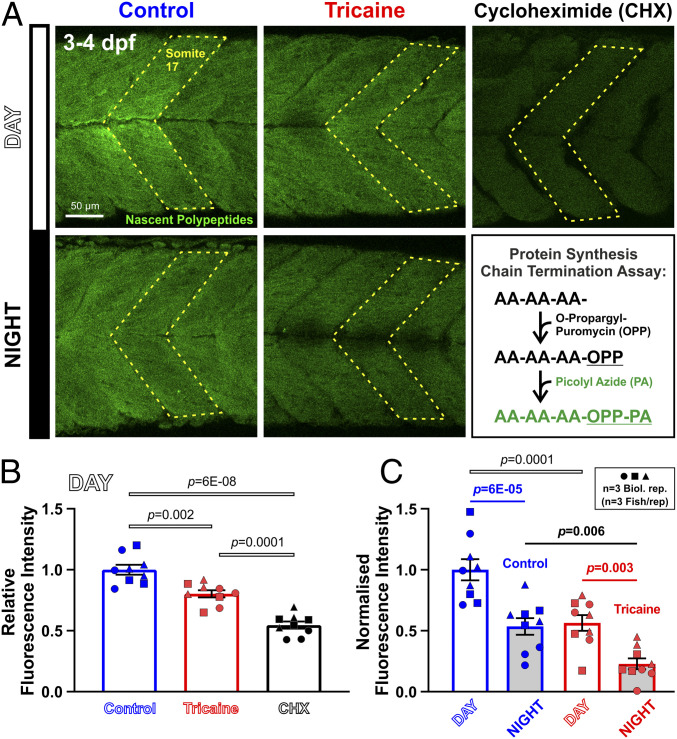
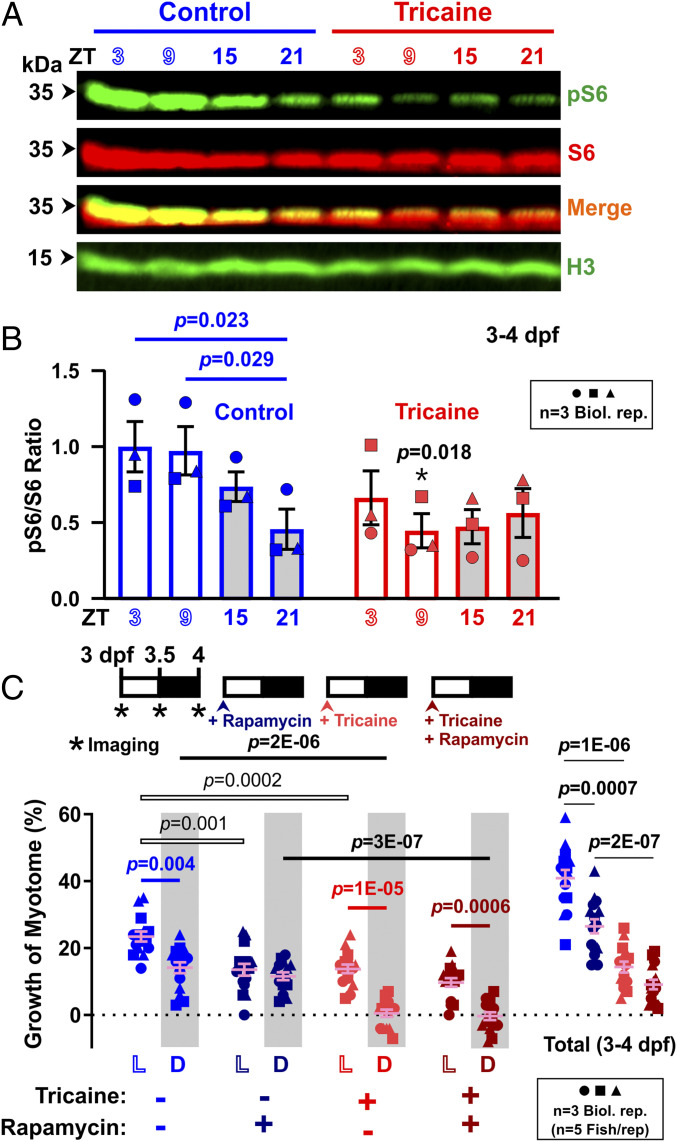
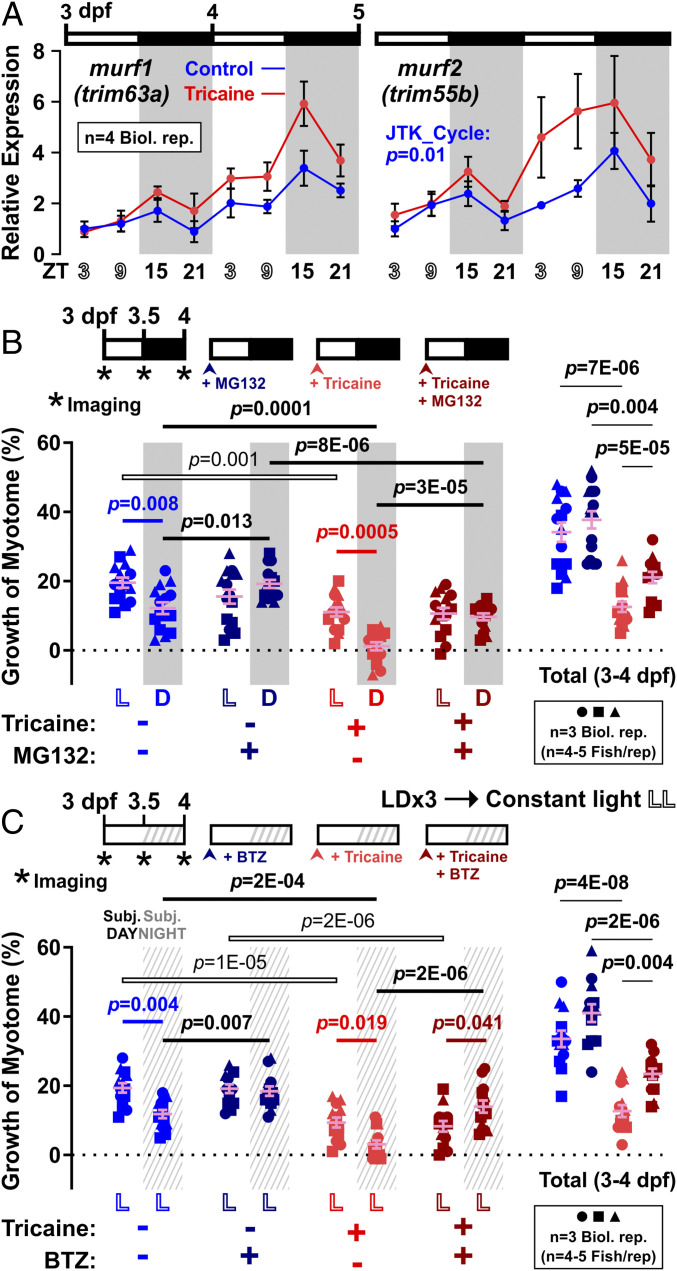
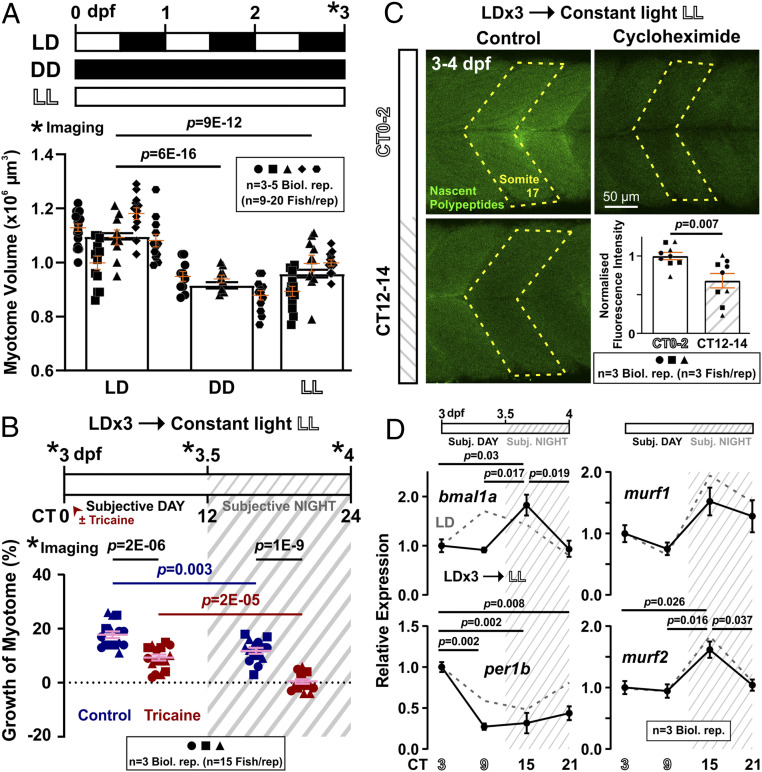
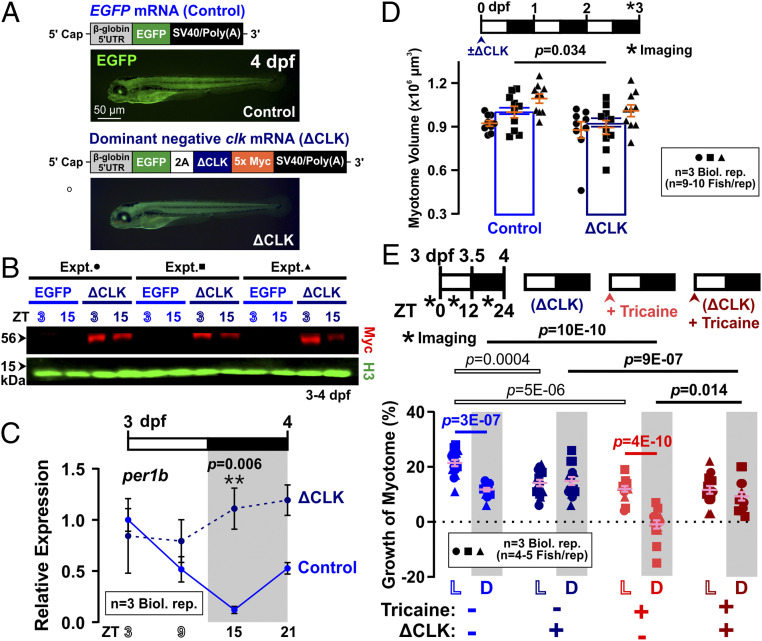
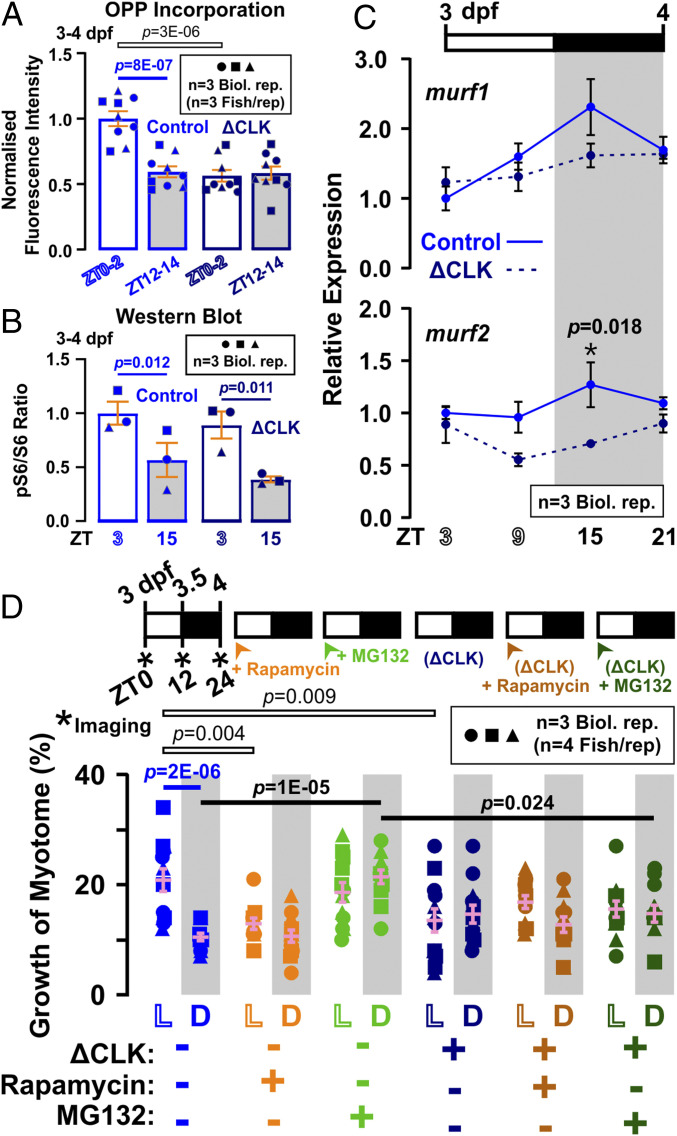
Muscle tissue shows diurnal variations in function, physiology, and metabolism. Whether such variations are dependent on the circadian clock per se or are secondary to circadian differences in physical activity and feeding pattern is unclear. By measuring muscle growth over 12-h periods in live prefeeding larval zebrafish, we show that muscle grows more during day than night. Expression of dominant negative CLOCK (ΔCLK), which inhibits molecular clock function, ablates circadian differences and reduces muscle growth. Inhibition of muscle contraction reduces growth in both day and night, but does not ablate the day/night difference. The circadian clock and physical activity are both required to promote higher muscle protein synthesis during the day compared to night, whereas markers of protein degradation, messenger RNAs, are higher at night. Proteasomal inhibitors increase muscle growth at night, irrespective of physical activity, but have no effect during the day. Although physical activity enhances TORC1 activity, and the TORC1 inhibitor rapamycin inhibits clock-driven daytime growth, no effect on muscle growth at night was detected. Importantly, day/night differences in 1) muscle growth, 2) protein synthesis, and 3) expression all persist in entrained larvae under free-running constant conditions, indicating circadian drive. Removal of circadian input by exposure to either permanent darkness or light leads to suboptimal muscle growth. We conclude that diurnal variations in muscle growth and metabolism are a circadian property that is independent of, but augmented by, physical activity, at least during development.
肌肉组织在功能、生理学和代谢方面表现出昼夜变化。这些变化是依赖于生物钟本身,还是由于昼夜之间的体力活动和进食模式的差异而产生的,目前尚不清楚。通过在活体预喂食的幼斑马鱼中测量 12 小时周期内的肌肉生长,我们发现肌肉在白天的生长速度比晚上快。表达显性负性 CLOCK(ΔCLK),抑制分子钟功能,消除了昼夜差异并减少了肌肉生长。抑制肌肉收缩会减少白天和晚上的生长,但不会消除昼夜差异。昼夜节律钟和体力活动对于促进白天比晚上更高的肌肉蛋白质合成都是必需的,而蛋白质降解的标志物,信使 RNA,在晚上更高。蛋白酶体抑制剂可增加夜间肌肉生长,而与体力活动无关,但白天无作用。尽管体力活动增强了 TORC1 活性,而 TORC1 抑制剂 rapamycin 抑制了时钟驱动的白天生长,但在夜间未检测到对肌肉生长的影响。重要的是,肌肉生长、蛋白质合成和表达的昼夜差异在自由运行的恒定条件下的被驯化的幼虫中仍然存在,表明存在昼夜驱动。通过暴露于永久黑暗或光照去除昼夜节律输入会导致肌肉生长不理想。我们得出结论,肌肉生长和代谢的昼夜变化是一种昼夜节律特性,它独立于体力活动,但至少在发育过程中会增强。