Department of Internal Medicine II, University of Yamanashi, Faculty of Medicine.
J Atheroscler Thromb. 2021 Nov 1;28(11):1133-1144. doi: 10.5551/jat.57562. Epub 2020 Nov 20.
To examine whether improvement in flow-mediated endothelium-dependent dilatation (FMD) of the brachial artery and brachial-ankle pulse wave velocity (baPWV) has an additive effect on achieving optimal goals of traditional risk factors to reduce cardiovascular risk in patients with coronary artery disease (CAD).
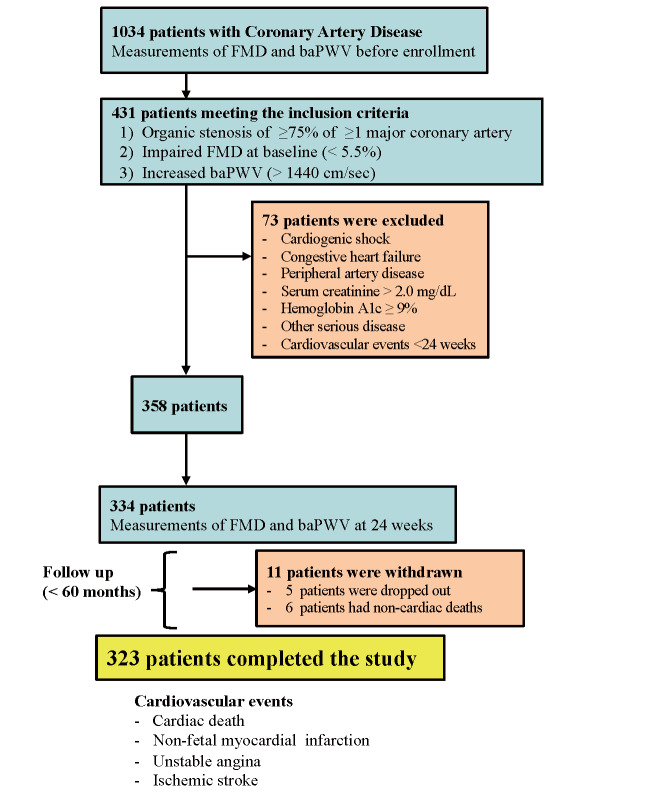
We assessed 323 patients with CAD and impaired vascular function, defined as an impaired FMD of the brachial artery (<5.5%) and increased baPWV (>1,440 cm/sec). After FMD and baPWV measurements at 24 weeks of optimal medical treatment (OMT), the study patients were followed up for <60 months or until a composite of cardiac death, nonfatal myocardial infarction (MI), unstable angina, or ischemic stroke occurs.
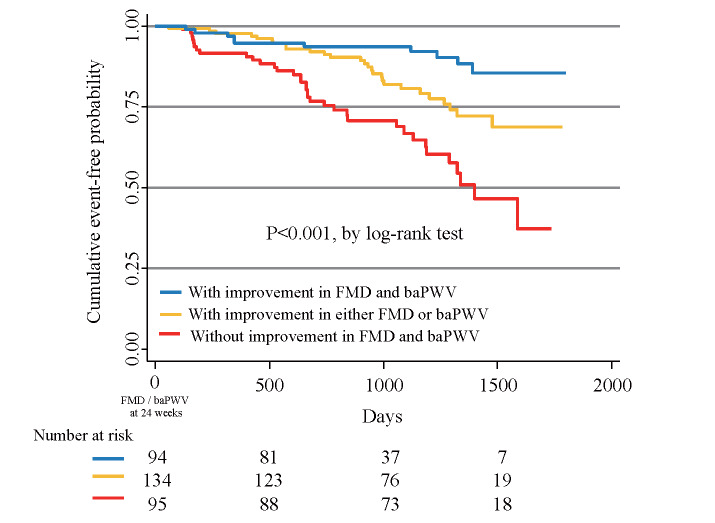
During the median follow-up period of 35 months, cardiovascular events occurred in 72 patients. Multivariate Cox hazards analysis showed that patients with an improvement in FMD and baPWV had the lowest probability of future cardiovascular events. In addition, the improvement in FMD and baPWV had a significant incremental effect on the predictive value of the achievement of optimal goals for blood pressure (BP), low-density lipoprotein cholesterol (LDL-C), and hemoglobin A1c (HbA1c) using net reclassification improvement (NRI) and integrated discrimination improvement (IDI).
The improvement in FMD and baPWV had additive effects on risk reduction of the achievement of the optimal goals of traditional risk factors in patients with CAD. Thus, serial measurements of FMD and baPWV may be useful for identifying CAD patients at residual risk for adverse cardiovascular events following OMT.
探讨肱动脉血流介导的内皮依赖性舒张功能(FMD)和肱踝脉搏波速度(baPWV)的改善是否对降低冠心病(CAD)患者传统危险因素的最佳目标具有附加效应,从而降低心血管风险。
我们评估了 323 例血管功能受损的 CAD 患者,定义为肱动脉 FMD 受损(<5.5%)和 baPWV 升高(>1440cm/sec)。在优化药物治疗(OMT)24 周时测量 FMD 和 baPWV 后,对研究患者进行了<60 个月或直至发生复合终点(包括心源性死亡、非致死性心肌梗死、不稳定型心绞痛或缺血性卒中)的随访。
在中位随访 35 个月期间,72 例患者发生心血管事件。多变量 Cox 风险分析显示,FMD 和 baPWV 改善的患者发生未来心血管事件的概率最低。此外,FMD 和 baPWV 的改善对血压(BP)、低密度脂蛋白胆固醇(LDL-C)和糖化血红蛋白 A1c(HbA1c)最佳目标达标预测值具有显著的增量效应,使用净重新分类改善(NRI)和综合判别改善(IDI)。
FMD 和 baPWV 的改善对降低 CAD 患者传统危险因素最佳目标达标率的风险具有附加效应。因此,FMD 和 baPWV 的连续测量可能有助于识别 OMT 后残余不良心血管事件风险的 CAD 患者。