Centre de Recherche des Cordeliers, INSERM, U1138, Paris, France.
Sorbonne Université, UPMC Univ Paris 06, 75005, Paris, France.
Sci Rep. 2020 Nov 23;10(1):20368. doi: 10.1038/s41598-020-74892-2.
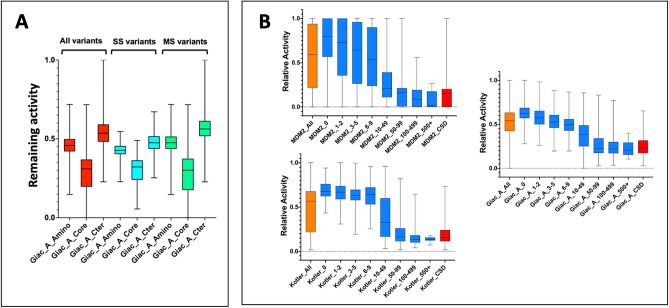
The diagnosis of somatic and germline TP53 mutations in human tumors or in individuals prone to various types of cancer has now reached the clinic. To increase the accuracy of the prediction of TP53 variant pathogenicity, we gathered functional data from three independent large-scale saturation mutagenesis screening studies with experimental data for more than 10,000 TP53 variants performed in different settings (yeast or mammalian) and with different readouts (transcription, growth arrest or apoptosis). Correlation analysis and multidimensional scaling showed excellent agreement between all these variables. Furthermore, we found that some missense mutations localized in TP53 exons led to impaired TP53 splicing as shown by an analysis of the TP53 expression data from the cancer genome atlas. With the increasing availability of genomic, transcriptomic and proteomic data, it is essential to employ both protein and RNA prediction to accurately define variant pathogenicity.
现在,在人类肿瘤或易患各种类型癌症的个体中,体细胞和种系 TP53 突变的诊断已经进入临床应用。为了提高 TP53 变体致病性预测的准确性,我们汇集了来自三个独立的大规模饱和诱变筛选研究的功能数据,这些研究在不同的环境(酵母或哺乳动物)和不同的读出(转录、生长停滞或凋亡)中进行了超过 10000 个 TP53 变体的实验数据。相关性分析和多维尺度分析显示,所有这些变量之间具有极好的一致性。此外,我们发现一些位于 TP53 外显子中的错义突变导致 TP53 剪接受损,这可以通过对癌症基因组图谱中的 TP53 表达数据进行分析来证明。随着基因组、转录组和蛋白质组数据的日益普及,有必要同时进行蛋白质和 RNA 预测,以准确确定变体的致病性。