State Key Laboratory for Conservation and Utilization of Subtropical Agro-Bioresources, College of Agriculture, South China Agricultural University, Guangzhou 510642, China.
Scientific Observing and Experimental Station of Crop Cultivation in South China, Ministry of Agriculture and Rural Affairs, Guangzhou 510642, China.
Biomolecules. 2020 Nov 21;10(11):1582. doi: 10.3390/biom10111582.
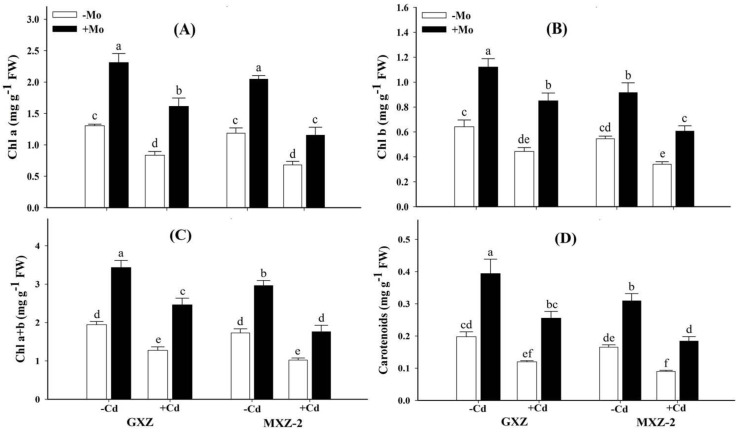
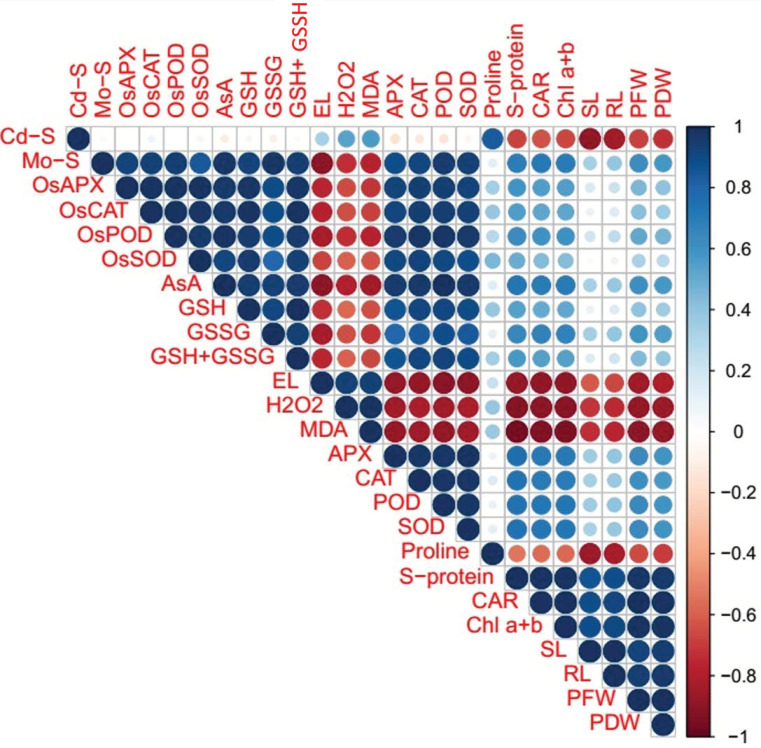
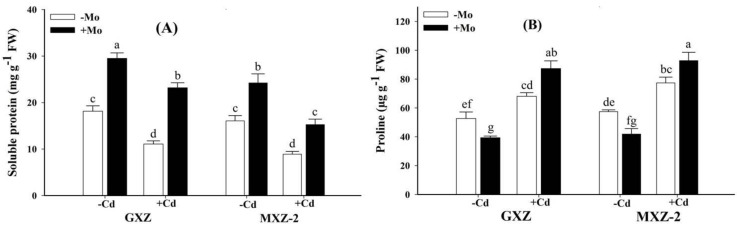
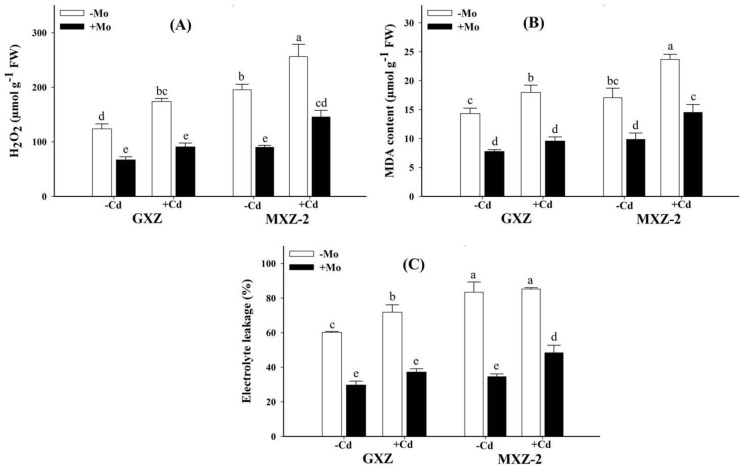
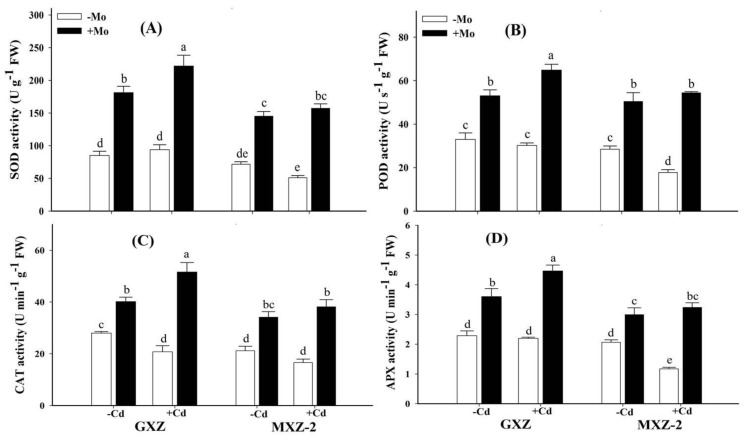
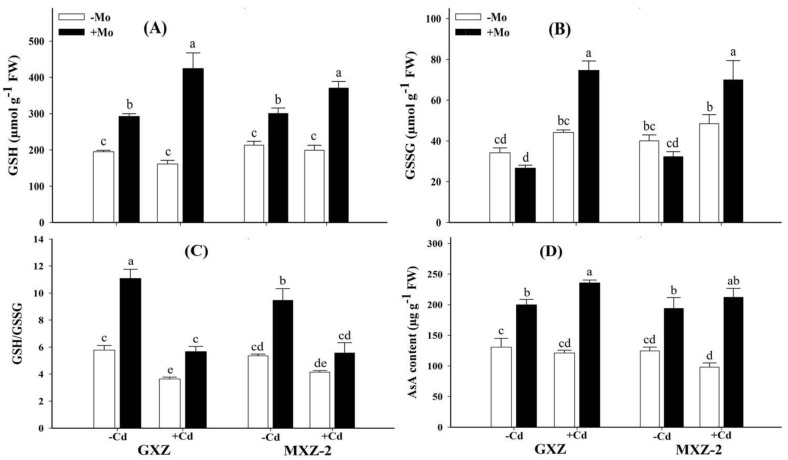
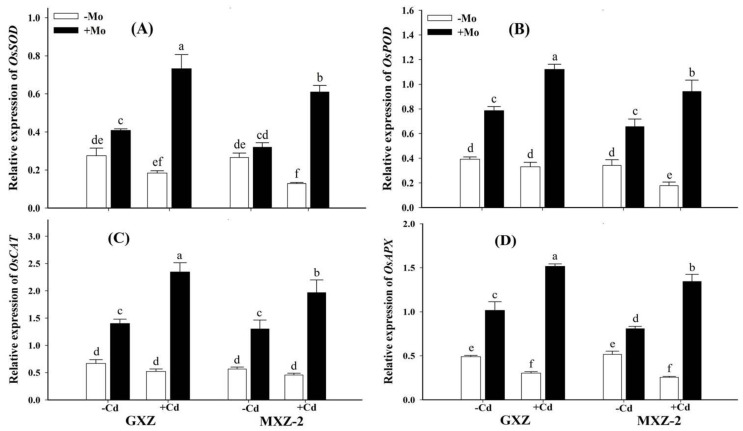
Increasing evidence shows that cadmium (Cd) toxicity causes severe perturbations on growth performance, physio-biochemical and molecular processes in crop plants. Molybdenum (Mo), an essential trace element, plays key roles in oxidative stress tolerance of higher plants. Hence, the present study has been conducted to investigate the possible role of Mo in alleviating Cd-induced inhibitions in two fragrant rice cultivars namely Guixiangzhan (GXZ) and Meixiangzhan-2 (MXZ-2). The results revealed that Mo application enhanced the plant dry biomass by 73.24% in GXZ and 58.09% in MXZ-2 under Cd stress conditions, suggesting that Mo supplementation alleviated Cd-induced toxicity effects in fragrant rice. The enhanced Cd-tolerance in fragrant rice plants prompted by Mo application could be ascribed to its ability to regulate Cd uptake and reduce Cd-induced oxidative stress as evident by lower hydrogen peroxide levels, electrolyte leakage and malondialdehyde contents in Cd-stressed plants. The ameliorative role of Mo against Cd-toxicity also reflected through its protection to the photosynthetic pigments, proline and soluble protein. Mo also induced antioxidant defense systems via maintaining higher contents of glutathione and ascorbate as well as enhancing the ROS-detoxifying enzymes such as catalase, peroxidase, superoxide dismutase and ascorbate peroxidase activities and up-regulating transcript abundance in both fragrant rice cultivars under Cd stress. Conclusively, Mo-mediated modulation of Cd toxicity in fragrant rice was through restricting Cd uptake, maintaining photosynthetic performance and alleviating oxidative damages via the strong anti-oxidative defense systems; however, GXZ cultivar is comparatively more Cd tolerant and Mo-efficient as evident from the less growth inhibition and biomass reduction as well as enhanced Mo-induced Cd stress tolerance and less oxidative damage than MXZ-2 fragrant rice cultivar.
越来越多的证据表明,镉(Cd)毒性会严重干扰作物生长性能、生理生化和分子过程。钼(Mo)作为一种必需的微量元素,在高等植物的氧化应激耐受中起着关键作用。因此,本研究旨在探讨钼在缓解两种香稻品种桂香占(GXZ)和美香占 2 号(MXZ-2)中 Cd 诱导抑制方面的可能作用。结果表明,在 Cd 胁迫条件下,钼的应用使 GXZ 的植株干生物量增加了 73.24%,MXZ-2 的增加了 58.09%,表明钼的补充缓解了香稻中 Cd 诱导的毒性作用。钼应用诱导香稻对 Cd 胁迫的耐受性增强,可能归因于其调节 Cd 吸收和减轻 Cd 诱导的氧化应激的能力,如 Cd 胁迫植株中过氧化氢水平、电解质渗漏和丙二醛含量降低。钼对 Cd 毒性的缓解作用还体现在其对光合色素、脯氨酸和可溶性蛋白的保护作用上。钼还通过维持较高的谷胱甘肽和抗坏血酸含量以及增强超氧化物歧化酶、过氧化氢酶、过氧化物酶和抗坏血酸过氧化物酶等 ROS 解毒酶的活性,并上调两种香稻品种在 Cd 胁迫下的转录丰度,诱导抗氧化防御系统。总之,钼通过限制 Cd 的吸收、维持光合作用性能以及通过强大的抗氧化防御系统减轻氧化损伤来调节香稻中的 Cd 毒性;然而,GXZ 品种比 MXZ-2 品种更能耐受 Cd 和 Mo,因为它的生长抑制和生物量减少较少,而 Mo 诱导的 Cd 胁迫耐受性增强和氧化损伤减少。