Wong Katie, Owen-Smith Amanda, Caskey Fergus, MacNeill Stephanie, Tomson Charles R V, Dor Frank J M F, Ben-Shlomo Yoav, Bouacida Soumeya, Idowu Dela, Bailey Pippa
Bristol Medical School: Population Health Sciences, University of Bristol, Bristol BS8 2PS, UK.
Southmead Hospital, North Bristol NHS Trust, Bristol BS10 5NB, UK.
J Clin Med. 2020 Nov 21;9(11):3751. doi: 10.3390/jcm9113751.
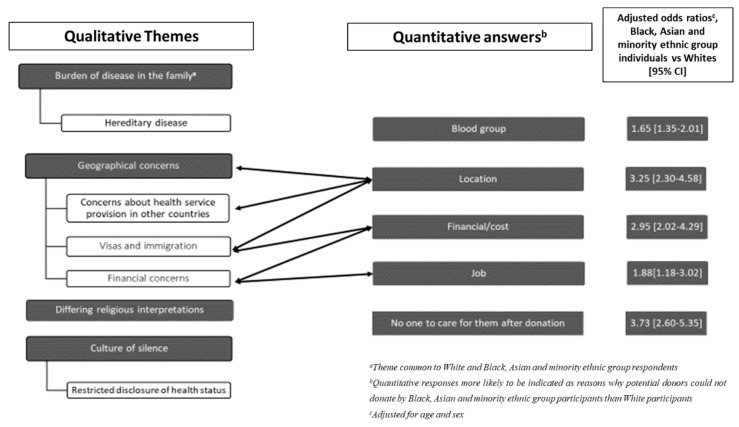
There is ethnic inequity in access to living-donor kidney transplants in the UK. This study asked kidney patients from Black, Asian and minority ethnic groups why members of their family were not able to be living kidney donors. Responses were compared with responses from White individuals. This questionnaire-based mixed-methods study included adults transplanted between 1/4/13-31/3/17 at 14 UK hospitals. Participants were asked to indicate why relatives could not donate, selecting all options applicable from: Age; Health; Weight; Location; Financial/Cost; Job; Blood group; No-one to care for them after donation. A box entitled 'Other-please give details' was provided for free-text entries. Multivariable logistic regression was used to analyse the association between the likelihood of selecting each reason for non-donation and the participant's self-reported ethnicity. Qualitative responses were analysed using inductive thematic analysis. In total, 1240 questionnaires were returned (40% response). There was strong evidence that Black, Asian and minority ethnic group individuals were more likely than White people to indicate that family members lived too far away to donate (adjusted odds ratio (aOR) = 3.25, 95% Confidence Interval (CI) 2.30-4.58), were prevented from donating by financial concerns (aOR = 2.95, 95% CI 2.02-4.29), were unable to take time off work (aOR = 1.88, 95% CI 1.18-3.02), were "not the right blood group" (aOR = 1.65, 95% CI 1.35-2.01), or had no-one to care for them post-donation (aOR = 3.73, 95% CI 2.60-5.35). Four qualitative themes were identified from responses from Black, Asian and minority ethnic group participants: 'Burden of disease within the family'; 'Differing religious interpretations'; 'Geographical concerns'; and 'A culture of silence'. Patients perceive barriers to living kidney donation in the UK Black, Asian and minority ethnic population. If confirmed, these could be targeted by interventions to redress the observed ethnic inequity.
在英国,活体肾移植的获取存在种族不平等现象。本研究询问了来自黑人、亚洲人和少数族裔群体的肾病患者,其家庭成员为何无法成为活体肾供体。并将这些回答与白人个体的回答进行了比较。这项基于问卷的混合方法研究纳入了2013年4月1日至2017年3月31日期间在英国14家医院接受移植的成年人。参与者被要求指出亲属不能捐赠的原因,从以下选项中选择所有适用的选项:年龄;健康状况;体重;地理位置;经济/成本;工作;血型;捐赠后无人照顾。提供了一个名为“其他 - 请详细说明”的框用于自由文本输入。使用多变量逻辑回归分析选择每种不捐赠原因的可能性与参与者自我报告的种族之间的关联。使用归纳主题分析对定性回答进行分析。总共返回了1240份问卷(回复率为40%)。有强有力的证据表明,黑人、亚洲人和少数族裔群体的个体比白人更有可能指出家庭成员住得太远无法捐赠(调整后的优势比(aOR)= 3.25,95%置信区间(CI)2.30 - 4.58),因经济担忧而无法捐赠(aOR = 2.95,95% CI 2.02 - 4.29),无法请假(aOR = 1.88,95% CI 1.18 - 3.02),“血型不合适”(aOR = 1.65,95% CI 1.35 - 2.01),或者捐赠后无人照顾(aOR = 3.73,95% CI 2.60 - 5.35)。从黑人、亚洲人和少数族裔群体参与者的回答中确定了四个定性主题:“家庭中的疾病负担”;“不同的宗教解释”;“地理方面的担忧”;以及“沉默文化”。英国黑人、亚洲人和少数族裔人群中的患者认为活体肾捐赠存在障碍。如果得到证实,这些障碍可以通过干预措施来解决,以纠正所观察到的种族不平等现象。