Department of Biology, MyoKardia, Inc., Brisbane, California, USA.
Department of Biology, MyoKardia, Inc., Brisbane, California, USA.
J Biol Chem. 2021 Jan-Jun;296:100114. doi: 10.1074/jbc.RA120.016506. Epub 2020 Dec 3.
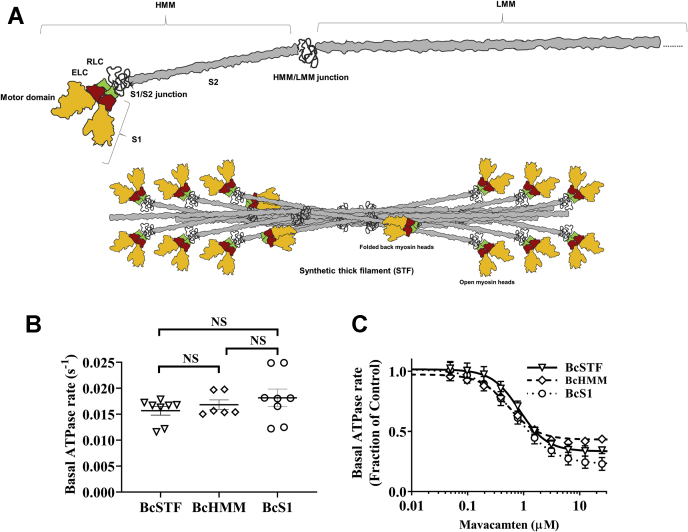
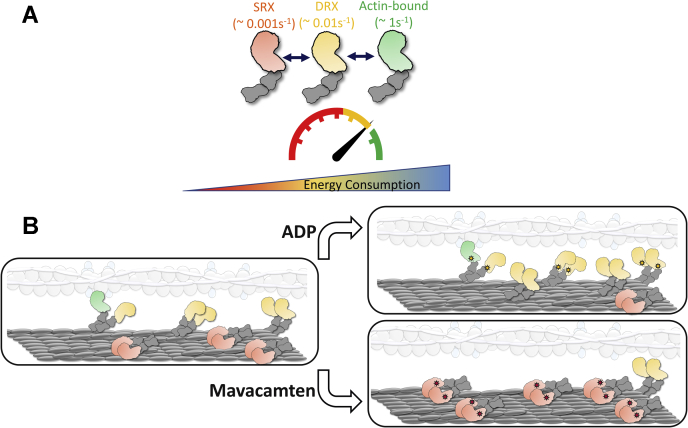
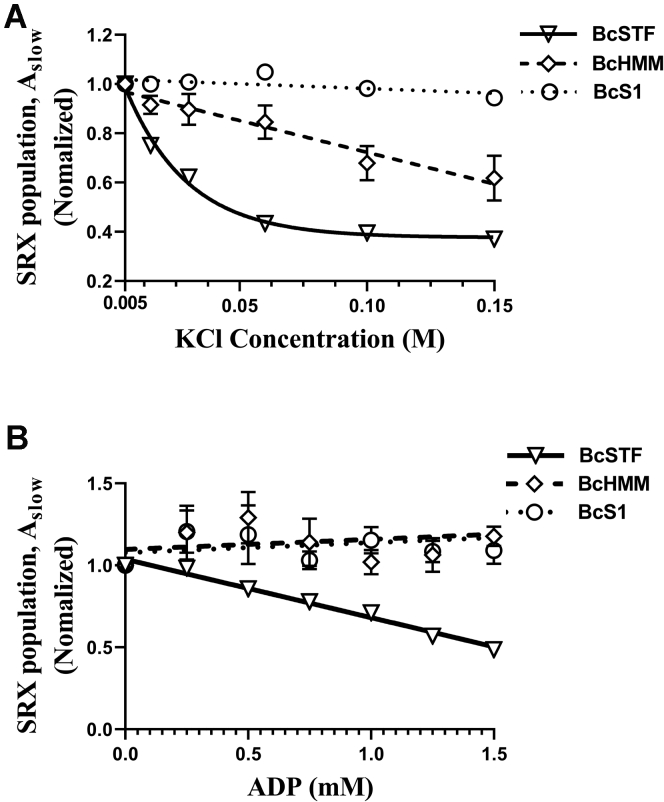
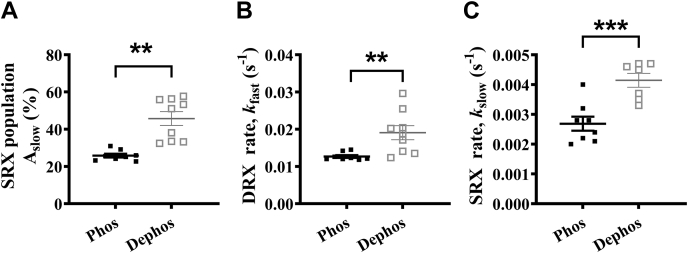
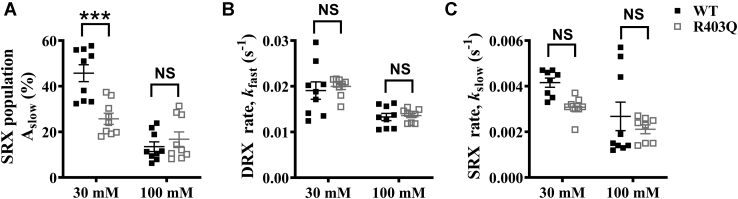
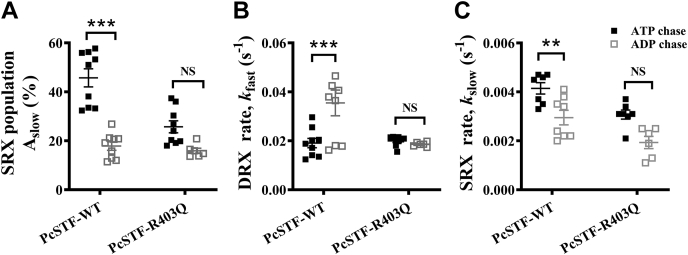
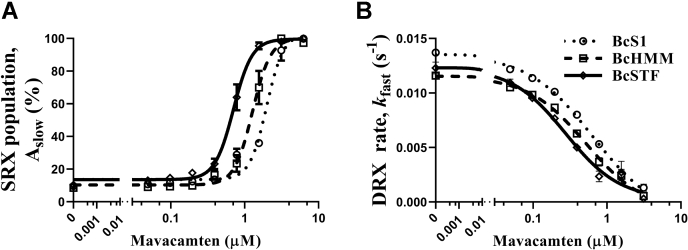
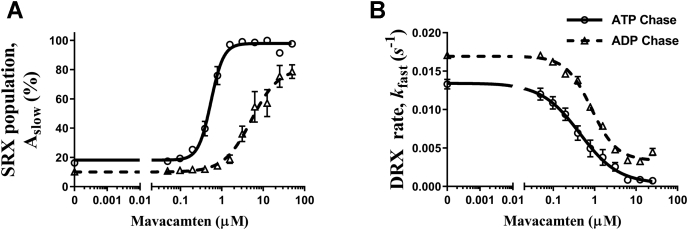
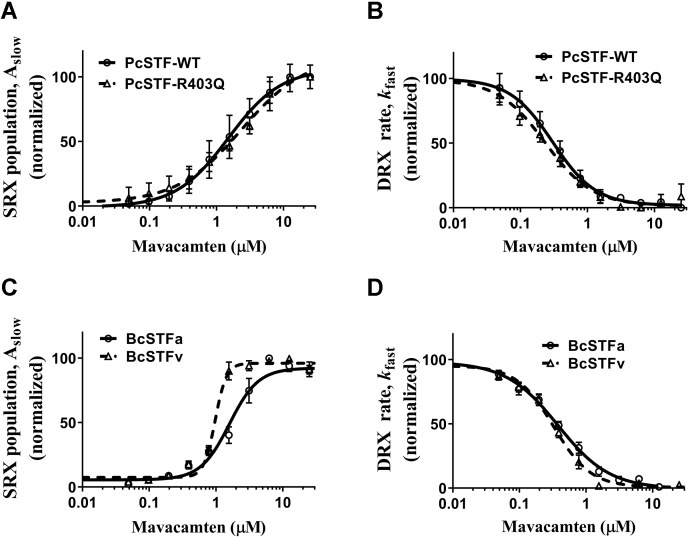
A hallmark feature of myosin-II is that it can spontaneously self-assemble into bipolar synthetic thick filaments (STFs) in low-ionic-strength buffers, thereby serving as a reconstituted in vitro model for muscle thick filaments. Although these STFs have been extensively used for structural characterization, their functional evaluation has been limited. In this report, we show that myosins in STFs mirror the more electrostatic and cooperative interactions that underlie the energy-sparing super-relaxed (SRX) state, which are not seen using shorter myosin subfragments, heavy meromyosin (HMM) and myosin subfragment 1 (S1). Using these STFs, we show several pathophysiological insults in hypertrophic cardiomyopathy, including the R403Q myosin mutation, phosphorylation of myosin light chains, and an increased ADP:ATP ratio, destabilize the SRX population. Furthermore, WT myosin containing STFs, but not S1, HMM, or STFs-containing R403Q myosin, recapitulated the ADP-induced destabilization of the SRX state. Studies involving a clinical-stage small-molecule inhibitor, mavacamten, showed that it is more effective in not only increasing myosin SRX population in STFs than in S1 or HMM but also in increasing myosin SRX population equally well in STFs made of healthy and disease-causing R403Q myosin. Importantly, we also found that pathophysiological perturbations such as elevated ADP concentration weakens mavacamten's ability to increase the myosin SRX population, suggesting that mavacamten-bound myosin heads are not permanently protected in the SRX state but can be recruited into action. These findings collectively emphasize that STFs serve as a valuable tool to provide novel insights into the myosin SRX state in healthy, diseased, and therapeutic conditions.
肌球蛋白-II 的一个显著特点是,它可以在低离子强度缓冲液中自发组装成双极合成粗肌丝 (STFs),从而成为肌肉粗肌丝的重建体外模型。尽管这些 STFs 已被广泛用于结构特征描述,但它们的功能评估受到限制。在本报告中,我们表明 STFs 中的肌球蛋白反映了更静电和协作的相互作用,这些相互作用是使用较短的肌球蛋白亚片段、重酶解肌球蛋白 (HMM) 和肌球蛋白亚片段 1 (S1) 所看不到的。使用这些 STFs,我们展示了肥厚型心肌病中的几种病理生理损伤,包括 R403Q 肌球蛋白突变、肌球蛋白轻链磷酸化和 ADP:ATP 比值增加,会使 SRX 群体不稳定。此外,含有 WT 肌球蛋白的 STFs,但不是 S1、HMM 或含有 R403Q 肌球蛋白的 STFs,可重现 ADP 诱导的 SRX 状态不稳定。涉及临床阶段小分子抑制剂 mavacamten 的研究表明,它不仅在增加 STFs 中的肌球蛋白 SRX 群体方面比 S1 或 HMM 更有效,而且在增加由健康和致病 R403Q 肌球蛋白制成的 STFs 中的肌球蛋白 SRX 群体方面同样有效。重要的是,我们还发现,生理病理扰动,如升高的 ADP 浓度,会削弱 mavacamten 增加肌球蛋白 SRX 群体的能力,这表明与 mavacamten 结合的肌球蛋白头部在 SRX 状态下不是永久受到保护的,但可以被招募到作用中。这些发现共同强调了 STFs 是一种有价值的工具,可以为健康、患病和治疗条件下的肌球蛋白 SRX 状态提供新的见解。