School of Biological Sciences, University of Edinburgh, Edinburgh, EH9 3FF, UK.
Centre for Synthetic and Systems Biology, University of Edinburgh, Edinburgh, EH9 3FF, UK.
Nat Commun. 2020 Nov 24;11(1):5961. doi: 10.1038/s41467-020-19552-9.
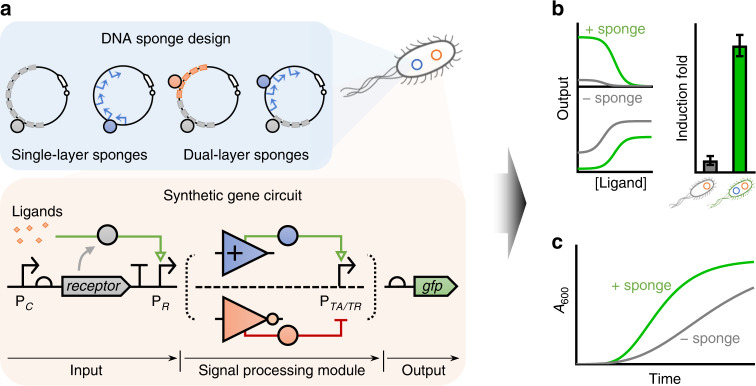
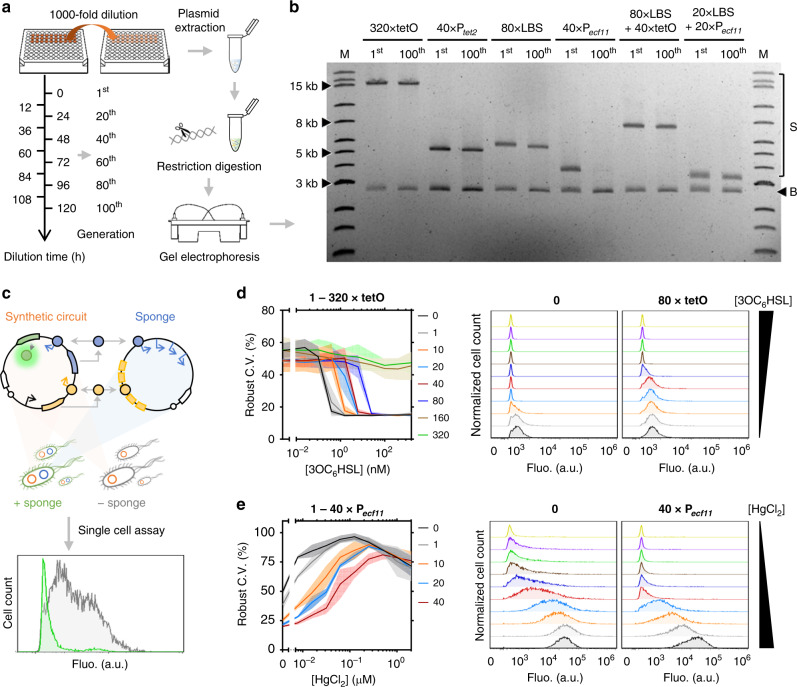
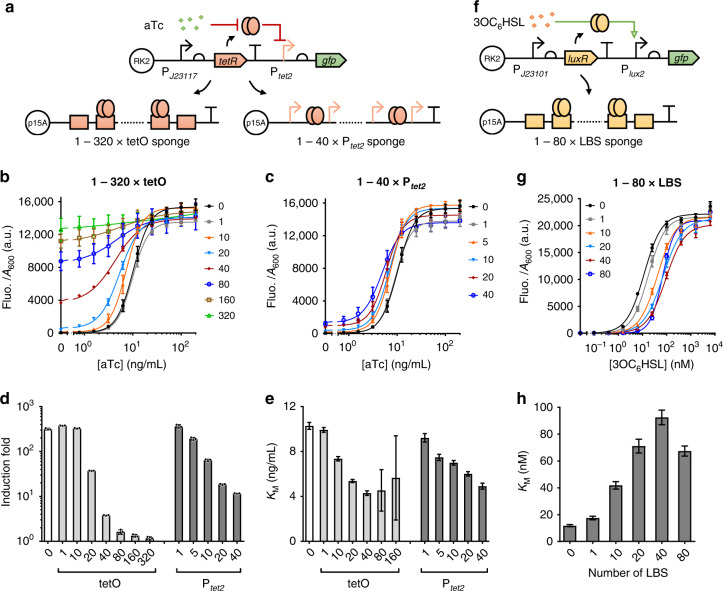
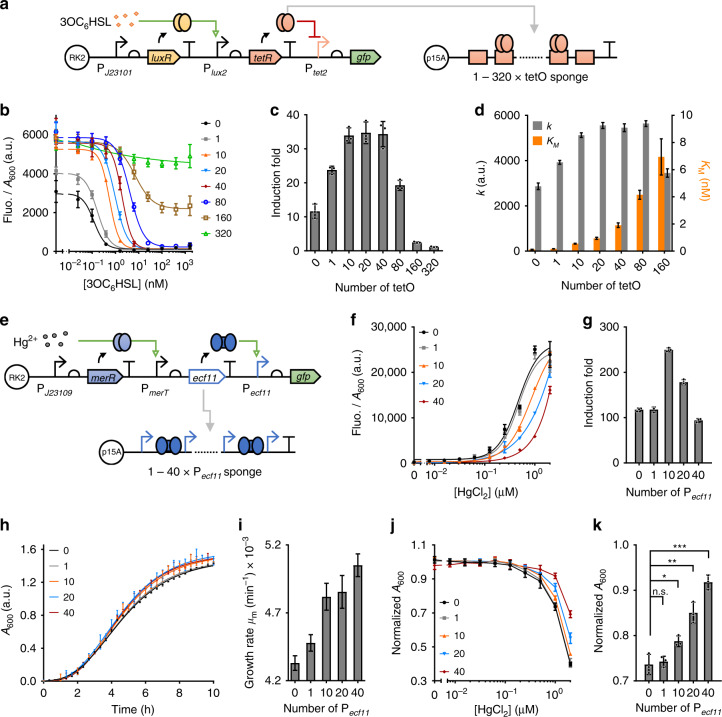
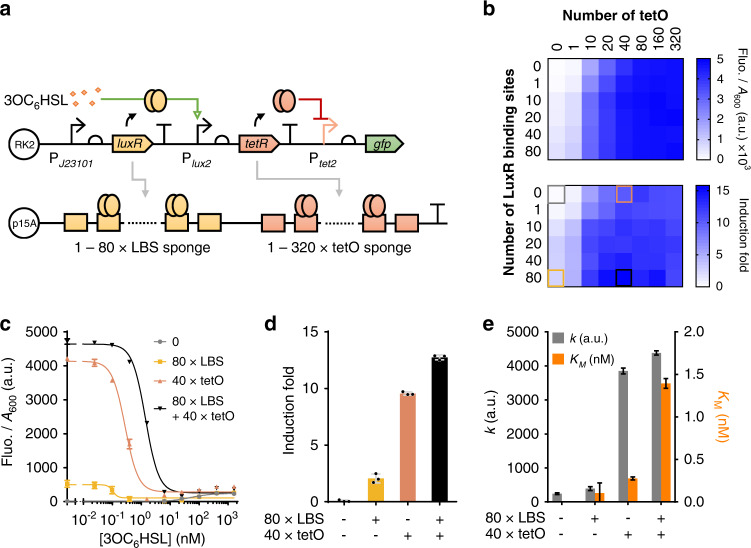
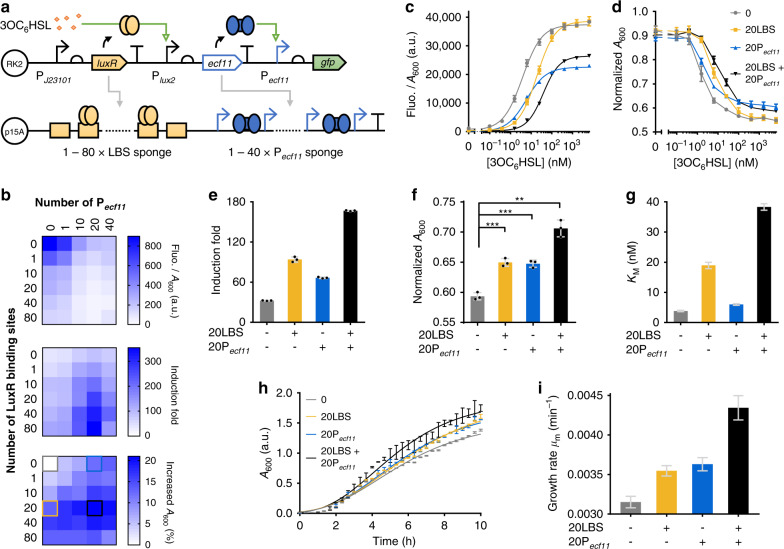
Versatile tools for gene expression regulation are vital for engineering gene networks of increasing scales and complexity with bespoke responses. Here, we investigate and repurpose a ubiquitous, indirect gene regulation mechanism from nature, which uses decoy protein-binding DNA sites, named DNA sponge, to modulate target gene expression in Escherichia coli. We show that synthetic DNA sponges can be designed to reshape the response profiles of gene circuits, lending multifaceted tuning capacities including reducing basal leakage by >20-fold, increasing system output amplitude by >130-fold and dynamic range by >70-fold, and mitigating host growth inhibition by >20%. Further, multi-layer DNA sponges for decoying multiple regulatory proteins provide an additive tuning effect on the responses of layered circuits compared to single-layer sponges. Our work shows synthetic DNA sponges offer a simple yet generalizable route to systematically engineer the performance of synthetic gene circuits, expanding the current toolkit for gene regulation with broad potential applications.
多功能的基因表达调控工具对于工程化具有特定响应的大规模和复杂程度不断增加的基因网络至关重要。在这里,我们研究并重新利用了一种普遍存在的、间接的基因调控机制,该机制利用诱饵蛋白结合 DNA 位点(称为 DNA 海绵)来调节大肠杆菌中的靶基因表达。我们表明,可以设计合成 DNA 海绵来重塑基因回路的响应特征,赋予多方面的调谐能力,包括将基础泄漏降低 20 倍以上,将系统输出幅度提高 130 倍以上,动态范围提高 70 倍以上,以及将宿主生长抑制减轻 20%以上。此外,用于诱饵多个调控蛋白的多层 DNA 海绵与单层海绵相比,对分层回路的响应具有附加的调谐效果。我们的工作表明,合成 DNA 海绵为系统地工程化合成基因回路的性能提供了一种简单但可推广的途径,扩展了基因调控的现有工具包,具有广泛的潜在应用。