Bondonno Nicola P, Murray Kevin, Cassidy Aedin, Bondonno Catherine P, Lewis Joshua R, Croft Kevin D, Kyrø Cecilie, Gislason Gunnar, Torp-Pedersen Christian, Scalbert Augustin, Tjønneland Anne, Hodgson Jonathan M, Dalgaard Frederik
School of Medical and Health Sciences, Edith Cowan University, Perth, Western Australia, Australia.
School of Biomedical Sciences, University of Western Australia, Perth, Western Australia, Australia.
Am J Clin Nutr. 2021 Jan 4;113(1):187-199. doi: 10.1093/ajcn/nqaa300.
The role of nutrition in the primary prevention of peripheral artery disease (PAD), the third leading cause of atherosclerotic cardiovascular disease, is undetermined. Flavonoids may attenuate atherosclerosis and therefore persons who consume flavonoid-rich foods may have a lower risk of developing PAD.
We aimed to examine the association between flavonoid intake and PAD hospitalizations and investigate if the association differs according to established risk factors for PAD.
Baseline data from 55,647 participants of the Danish Diet, Cancer, and Health Study without PAD, recruited from 1993 to 1997, were cross-linked with Danish nationwide registries. Flavonoid intake was calculated from FFQs using the Phenol-Explorer database. Associations were examined using multivariable-adjusted restricted cubic splines based on Cox proportional hazards models.
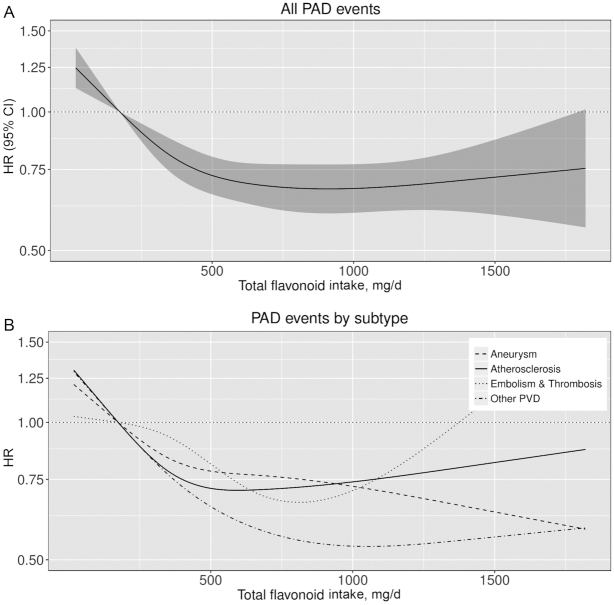
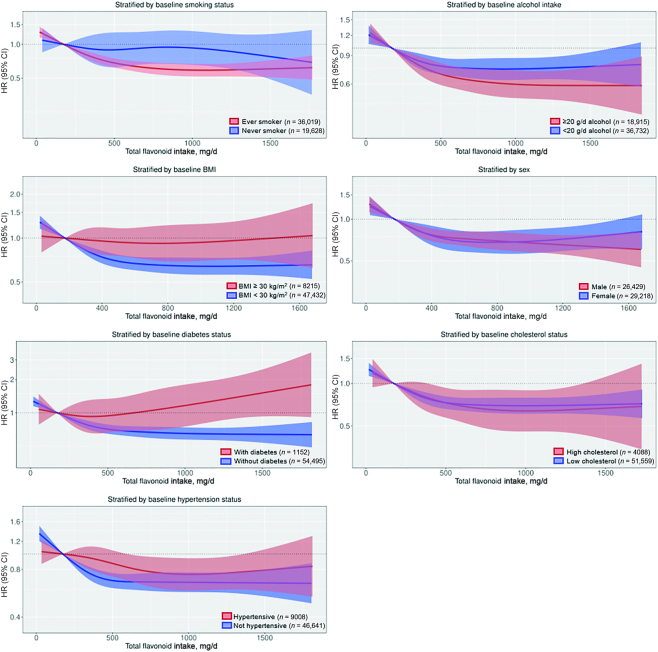
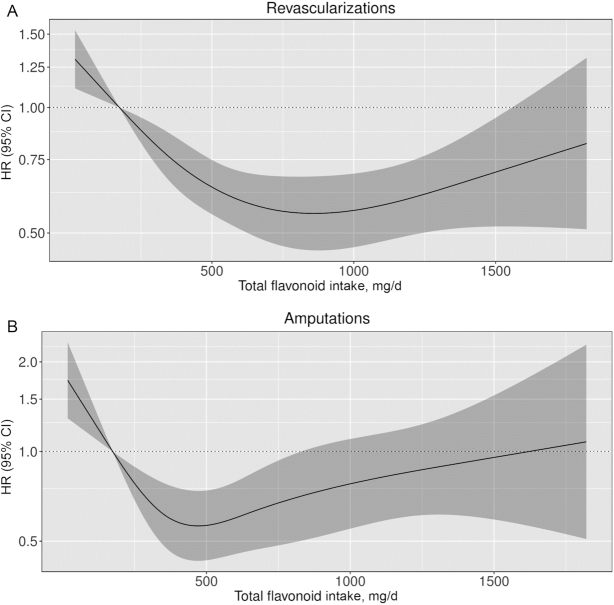
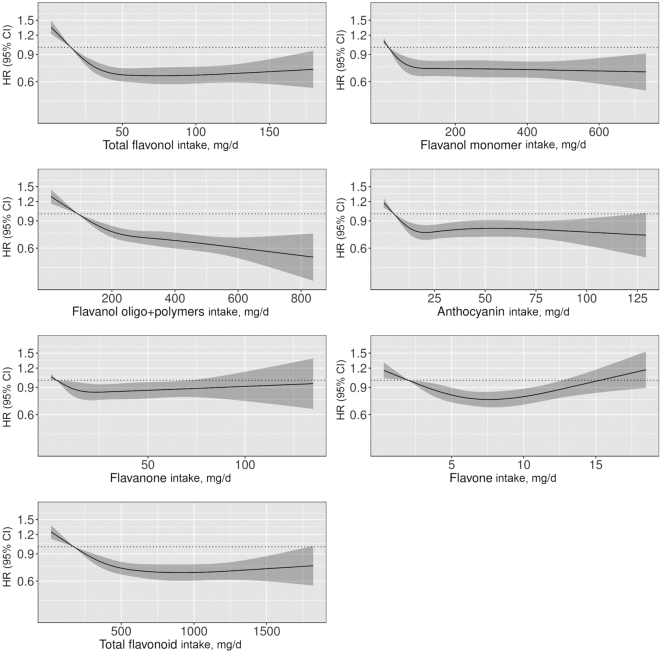
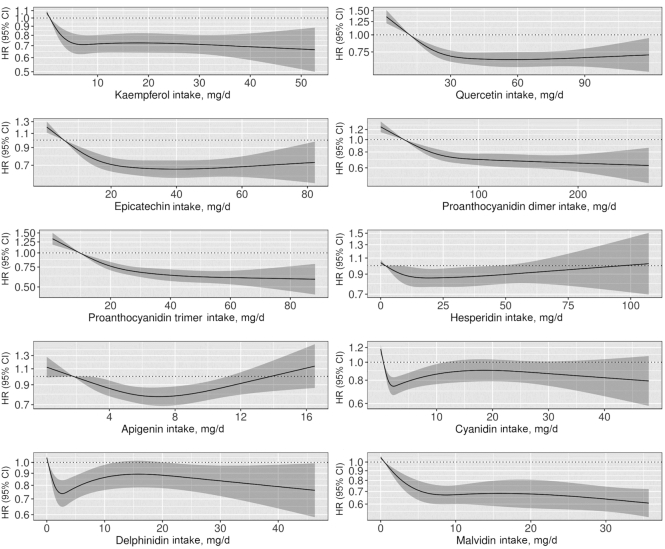
After a median [IQR] follow-up time of 21 [20-22] y, 2131 participants had been hospitalized for any PAD. The association between total flavonoid intake and total PAD hospitalizations was nonlinear, reaching a plateau at ∼750-1000 mg/d. Compared with the median flavonoid intake in quintile 1 (174 mg/d), an intake of 1000 mg/d was associated with a 32% lower risk of any PAD hospitalization (HR: 0.68; 95% CI: 0.60, 0.77), a 26% lower risk of atherosclerosis (HR: 0.74; 95% CI: 0.62, 0.88), a 28% lower risk of an aneurysm (HR: 0.72; 95% CI: 0.59, 0.88), and a 47% lower risk of a hospitalization for other peripheral vascular disease (HR: 0.53; 95% CI: 0.42, 0.67). A higher total flavonoid intake was also significantly associated with a lower incidence of revascularization or endovascular surgery and lower extremity amputation. The association between total flavonoid intake and PAD hospitalizations differed according to baseline smoking status, alcohol intake, BMI, and diabetes status.
Ensuring the adequate consumption of flavonoid-rich foods, particularly in subpopulations prone to the development of atherosclerosis, may be a key strategy to lower the risk of PAD.
营养在周围动脉疾病(PAD)的一级预防中的作用尚未确定,PAD是动脉粥样硬化性心血管疾病的第三大主要病因。黄酮类化合物可能会减轻动脉粥样硬化,因此食用富含黄酮类化合物食物的人患PAD的风险可能较低。
我们旨在研究黄酮类化合物摄入量与PAD住院之间的关联,并调查这种关联是否因已确定的PAD危险因素而有所不同。
1993年至1997年招募的丹麦饮食、癌症和健康研究中55647名无PAD参与者的基线数据与丹麦全国登记处进行了交叉链接。使用酚类物质探索者数据库从食物频率问卷中计算黄酮类化合物的摄入量。基于Cox比例风险模型,使用多变量调整的受限立方样条来检验关联。
在中位[四分位间距]随访时间21[20 - 22]年之后,2131名参与者因任何PAD住院。总黄酮类化合物摄入量与PAD总住院之间的关联是非线性的,在约750 - 1000毫克/天时达到平稳状态。与第1五分位数的中位黄酮类化合物摄入量(174毫克/天)相比,1000毫克/天的摄入量与任何PAD住院风险降低32%相关(风险比:0.68;95%置信区间:0.60,0.77),动脉粥样硬化风险降低26%(风险比:0.74;95%置信区间:0.62,0.88),动脉瘤风险降低28%(风险比:0.72;95%置信区间:0.59,0.88),以及其他周围血管疾病住院风险降低47%(风险比:0.53;95%置信区间:0.42,0.67)。较高的总黄酮类化合物摄入量还与血运重建或血管内手术以及下肢截肢的较低发生率显著相关。总黄酮类化合物摄入量与PAD住院之间的关联因基线吸烟状况、酒精摄入量、体重指数和糖尿病状况而异。
确保充足摄入富含黄酮类化合物的食物,特别是在易发生动脉粥样硬化的亚人群中,可能是降低PAD风险的关键策略。