Epidemiology and Biostatistics, Dornsife School of Public Health, Drexel University, Philadelphia, Pennsylvania, USA
Li Ka Shing Knowledge Institute, Unity Health Toronto, Toronto, Ontario, Canada.
BMJ Glob Health. 2020 Nov;5(11). doi: 10.1136/bmjgh-2020-003471.
Despite the rapid growth of research on transgender (trans) health globally, the extent of research on trans men and other transmasculine persons assigned the female sex at birth remains unclear. We, therefore, conducted a scoping review on trans men's health in low-income and middle-income countries (LMICs).
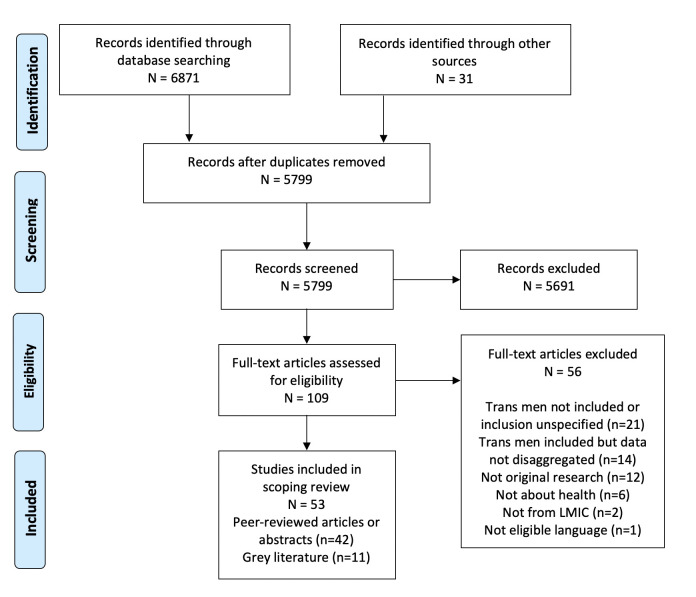
The review included peer-reviewed articles and conference abstracts, and grey literature published from 1 January 1999 to 5 July 2019 in English, French, Hindi or Spanish and reporting original quantitative and/or qualitative data on the health of trans men or transmasculine persons living in LMIC. Studies were excluded if they did not disaggregate data for trans men or if they only described surgical techniques or laboratory values.
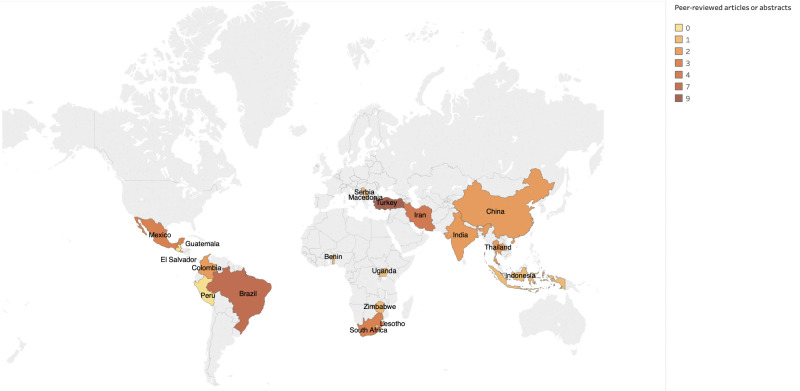
We included 53 studies (42 peer-reviewed and 11 grey literature) from 19 LMIC. Most were conducted in higher-middle-income countries (n=12) and in Latin America (n=16, 30.2%), the Middle East (n=14, 26.4%) or Sub-Saharan Africa (n=12, 22.6%) and published in 2014 or later (n=44, 83.0%). Approximately half of studies used quantitative methods (52.8%, n=28), of which 64.3% (n=18) had fewer than 50 participants and 14.2% (n=4) had over 150. Across study designs, social determinants of health and gender-affirming care were the most commonly represented domains (49.1% and 47.1% of studies respectively), with common themes including gender-based violence, coercion and discrimination as well as unprescribed hormone use. Other domains represented included mental health (32.1%), sexual and reproductive health (24.5%), general healthcare access (18.9%), physical health (9.4%) and substance use (9.4%).
Greater inclusion and disaggregation of trans men and transmasculine persons in global health research is needed to support sex- and gender-based analyses of trans health. Community-based research approaches and theoretically driven research may help to increase the relevance and rigour of such research. Funders should invest in research on trans men's health in LMIC.
尽管全球关于跨性别者(跨性别)健康的研究迅速增长,但对出生时被指定为女性的跨男性和其他跨性别男性的研究程度仍不清楚。因此,我们对中低收入国家(LMIC)的跨男性健康进行了范围界定审查。
该审查包括同行评议的文章和会议摘要,以及 1999 年 1 月 1 日至 2019 年 7 月 5 日期间以英文、法语、印地语或西班牙语发表的灰色文献,报告了生活在 LMIC 的跨男性或跨性别男性的健康的原始定量和/或定性数据。如果研究没有为跨男性进行数据分类,或者仅描述了手术技术或实验室值,则将其排除在外。
我们纳入了来自 19 个 LMIC 的 53 项研究(42 项同行评议和 11 项灰色文献)。大多数研究在中高收入国家(n=12)和拉丁美洲(n=16,30.2%)、中东(n=14,26.4%)或撒哈拉以南非洲(n=12,22.6%)进行,发表于 2014 年或之后(n=44,83.0%)。大约一半的研究使用了定量方法(52.8%,n=28),其中 64.3%(n=18)的参与者少于 50 人,14.2%(n=4)的参与者超过 150 人。在研究设计中,健康的社会决定因素和性别肯定护理是最常代表的领域(分别为 49.1%和 47.1%的研究),共同主题包括基于性别的暴力、胁迫和歧视以及未经处方的激素使用。其他领域包括心理健康(32.1%)、性和生殖健康(24.5%)、一般医疗保健获取(18.9%)、身体健康(9.4%)和物质使用(9.4%)。
需要在全球健康研究中更大程度地纳入和分类跨性别男性和跨性别男性,以支持跨性别健康的性别和基于性别的分析。基于社区的研究方法和理论驱动的研究可能有助于提高此类研究的相关性和严谨性。资助者应投资于 LMIC 中跨男性健康的研究。