Department of Epidemiology and Biostatistics, Drexel University Dornsife School of Public Health, Philadelphia, Pennsylvania, United States of America.
Department of Epidemiology and Biostatistics, Schulich School of Medicine and Dentistry, Western University, London, Ontario, Canada.
PLoS One. 2024 Mar 11;19(3):e0299373. doi: 10.1371/journal.pone.0299373. eCollection 2024.
Transgender and gender diverse (trans) health research has grown rapidly, highlighting the need to characterize the scientific evidence base. We conducted a systematic review of peer-reviewed research on disease burden and correlates in trans adolescents and adults over a 20-month period to identify knowledge gaps and assess methodological characteristics including measurement of gender identity, community engagement, and study quality.
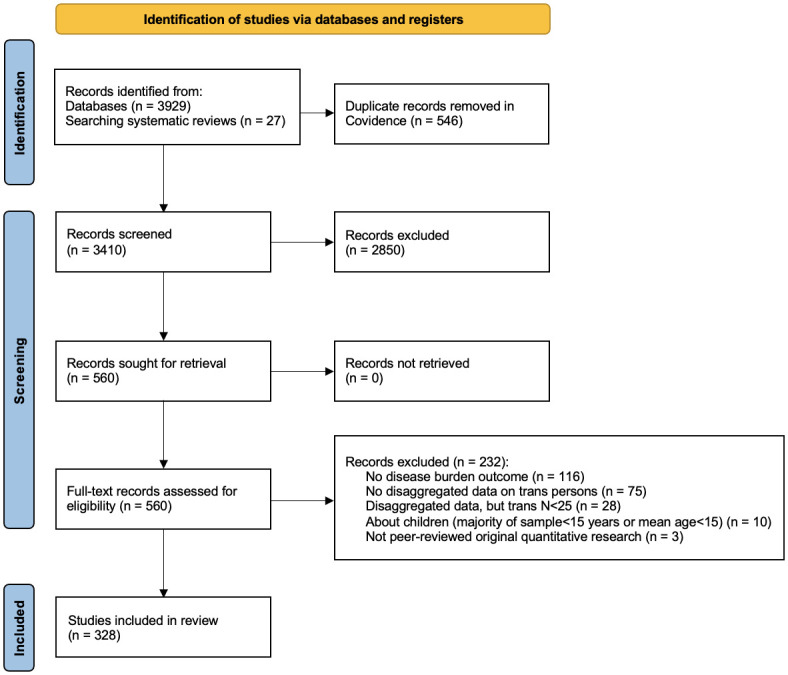
DATA SOURCES, ELIGIBILITY CRITERIA, AND SYNTHESIS METHODS: We searched seven databases using terms related to (a) transgender populations and (b) health or disease. Eligible studies were in English, French, or Spanish and reported original quantitative data on mental health or substance use conditions, infectious diseases, or non-communicable conditions in at least 25 trans individuals aged 15+. Quality assessment was performed in duplicate on a 10% sample of articles and findings were summarized using narrative synthesis.
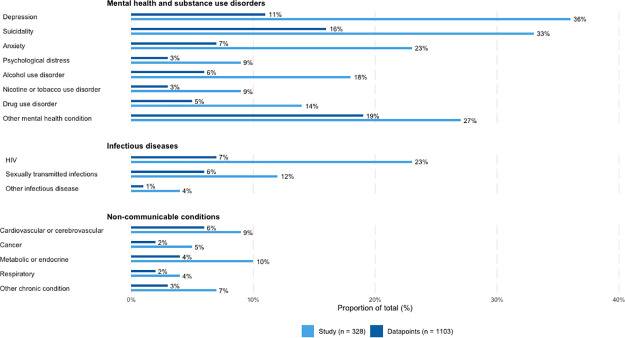
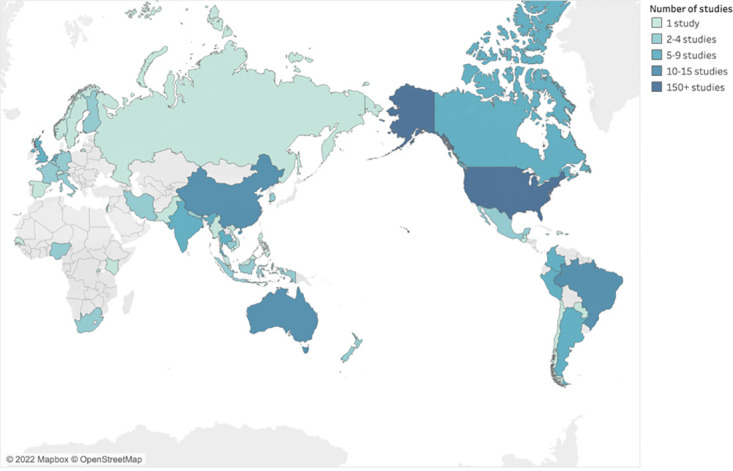
The 328 included studies were conducted in 45 countries, with most from North America (54%) and limited research from South Asia (3%), Sub-Saharan Africa (3%), and the Middle East and North Africa (2%). Most studies used cross-sectional designs (73%) and convenience sampling (65%). Only 30% of studies reported any form of community engagement. Mental health and substance use disorders were the most studied area (77% of studies) and non-communicable conditions the least (16%). Available data indicated that trans populations experience high disease burden with considerable heterogeneity within and across settings. Of 39 articles assessed for quality, 80% were rated as fair, 18% as poor, and 3% as good quality.
Geographic, gender-specific, and topical gaps remain in trans health, but we found more research from African countries, with transmasculine people, and on non-communicable conditions than previous syntheses. Areas for growth in trans health research include community engagement, non-binary health, chronic and age-related conditions, and health determinants.
PROSPERO CRD42021234043.
跨性别和性别多样化(跨性别)健康研究迅速发展,突出了描述科学证据基础的必要性。我们在 20 个月的时间内对跨性别青少年和成年人的疾病负担和相关因素进行了系统的综述,以确定知识空白,并评估包括性别认同测量、社区参与和研究质量在内的方法学特征。
数据来源、入选标准和综合方法:我们使用与(a)跨性别人群和(b)健康或疾病相关的术语,在七个数据库中进行了搜索。符合条件的研究为英语、法语或西班牙语,报告了至少 25 名年龄在 15 岁以上的跨性别个体的心理健康或物质使用状况、传染病或非传染性疾病的原始定量数据。对 10%的文章进行了双重质量评估,并使用叙述性综合法总结了研究结果。
328 项纳入的研究在 45 个国家进行,其中大多数来自北美(54%),南亚(3%)、撒哈拉以南非洲(3%)和中东和北非(2%)的研究有限。大多数研究采用横断面设计(73%)和便利抽样(65%)。只有 30%的研究报告了任何形式的社区参与。心理健康和物质使用障碍是研究最多的领域(77%的研究),非传染性疾病是研究最少的领域(16%)。现有数据表明,跨性别群体的疾病负担很高,且在不同环境中存在相当大的异质性。在 39 篇评估质量的文章中,80%被评为一般,18%被评为差,3%被评为好。
跨性别健康领域仍存在地理、性别特定和专题方面的差距,但我们发现来自非洲国家、跨男性化人群以及非传染性疾病的研究比以前的综述更多。跨性别健康研究的增长领域包括社区参与、非二元健康、慢性和与年龄相关的疾病以及健康决定因素。
PROSPERO CRD42021234043。