Department of Public Health Sciences, Queen's University, Kingston, ON, Canada.
Department of Community Health Sciences, University of Calgary, Calgary, AB, Canada.
Sci Rep. 2020 Nov 25;10(1):20561. doi: 10.1038/s41598-020-76294-w.
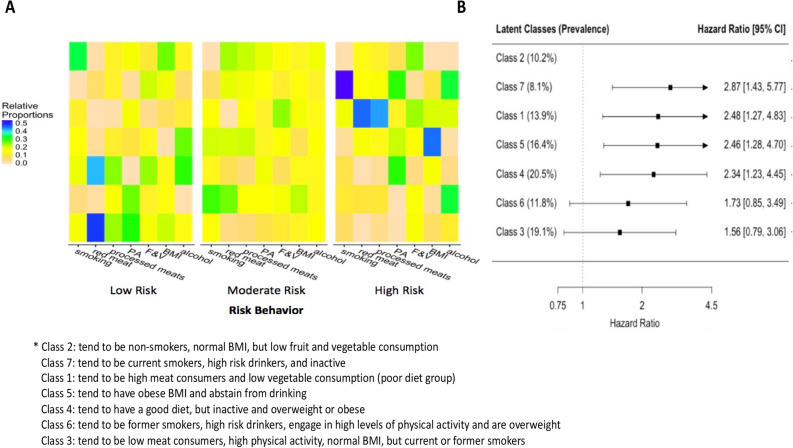
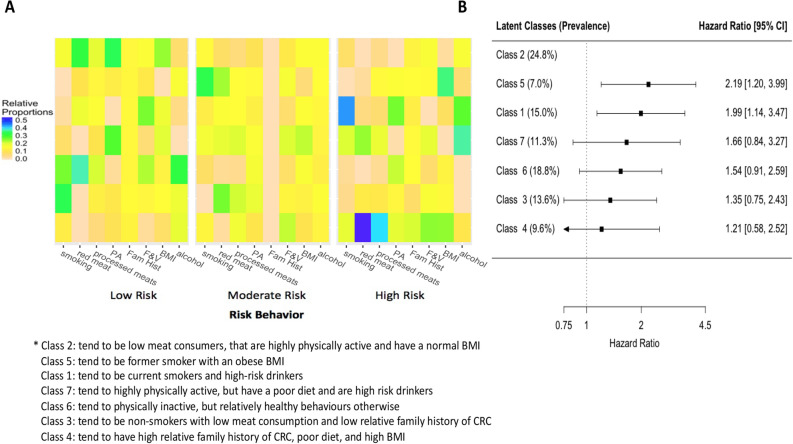
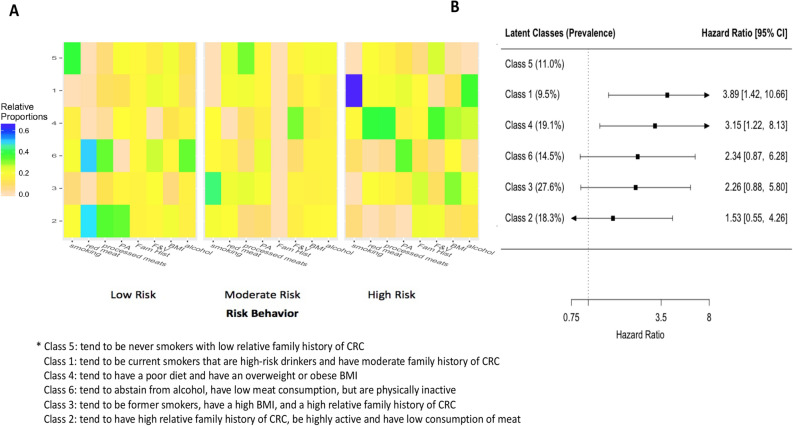
The objective of this study was to identify distinct clusters of individuals that exhibit unique patterns of modifiable lifestyle-related behaviours and to determine how these patterns are associated with the risk of developing colorectal cancer (CRC). The study consisted of 26,460 participants and 267 CRC cases from Alberta's Tomorrow Project. Exploratory latent class analysis of risk behaviours (obesity, physical inactivity, meat consumption, smoking, alcohol consumption, and fruit and vegetable consumption) and Cox proportional hazard models were utilized. Seven unique behavioural groups were identified, where the risk of CRC was 2.34 to 2.87 times greater for high risk groups compared to the low risk group. Sex-specific models identified higher risk groups among men (Hazard Ratios [HRs]: 3.15 to 3.89) than among women (HRs: 1.99 to 2.19). Targeting groups defined by clustering of behaviours could potentially lead to more effective prevention of CRC on a population level.
本研究旨在确定具有独特可改变生活方式相关行为模式的个体的不同聚类,并确定这些模式与结直肠癌(CRC)发病风险的关系。该研究纳入了来自艾伯塔省明天计划的 26460 名参与者和 267 例 CRC 病例。采用探索性潜在类别分析风险行为(肥胖、身体活动不足、肉类消费、吸烟、饮酒以及水果和蔬菜摄入)和 Cox 比例风险模型。确定了 7 个独特的行为组,与低风险组相比,高风险组 CRC 的发病风险高 2.34 至 2.87 倍。在男性中,特定于性别的模型确定了更高的风险组(危险比 [HR]:3.15 至 3.89),而在女性中则为(HR:1.99 至 2.19)。针对行为聚类定义的群体可能会在人群层面上更有效地预防 CRC。