Department of Computer Science, University of Twente, Drienerlolaan 5, 7522 NB, Enschede, The Netherlands.
Sci Rep. 2020 Nov 25;10(1):20550. doi: 10.1038/s41598-020-77536-7.
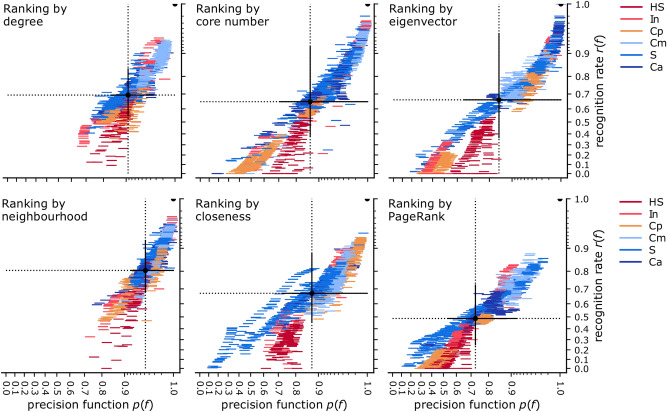
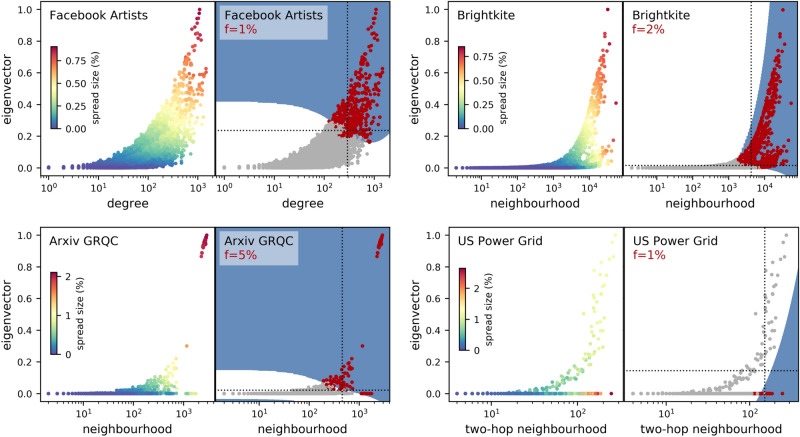
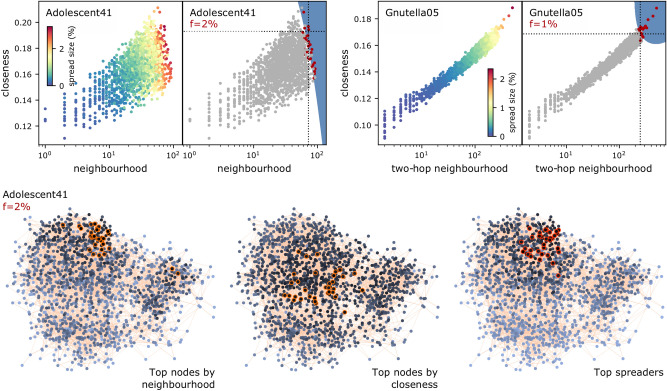
Information flow, opinion, and epidemics spread over structured networks. When using node centrality indicators to predict which nodes will be among the top influencers or superspreaders, no single centrality is a consistently good ranker across networks. We show that statistical classifiers using two or more centralities are instead consistently predictive over many diverse, static real-world topologies. Certain pairs of centralities cooperate particularly well in drawing the statistical boundary between the superspreaders and the rest: a local centrality measuring the size of a node's neighbourhood gains from the addition of a global centrality such as the eigenvector centrality, closeness, or the core number. Intuitively, this is because a local centrality may rank highly nodes which are located in locally dense, but globally peripheral regions of the network. The additional global centrality indicator guides the prediction towards more central regions. The superspreaders usually jointly maximise the values of both centralities. As a result of the interplay between centrality indicators, training classifiers with seven classical indicators leads to a nearly maximum average precision function (0.995) across the networks in this study.
信息流动、观点和传染病在结构网络上传播。当使用节点中心性指标来预测哪些节点将成为顶级影响者或超级传播者时,没有一个单一的中心性指标在所有网络中都是一致的优秀排名指标。我们表明,使用两个或更多中心性指标的统计分类器在许多不同的静态现实拓扑中具有一致的预测能力。某些中心性对指标对的组合在绘制超级传播者和其他节点之间的统计边界方面特别有效:衡量节点邻居大小的局部中心性指标从附加全局中心性指标(如特征向量中心性、接近度或核心数)中获益。直观地说,这是因为局部中心性可能会对位于网络局部密集但全局外围区域的节点进行高度排名。附加的全局中心性指标指标将预测引导到更中心的区域。超级传播者通常会共同最大化这两个中心性的数值。由于中心性指标之间的相互作用,使用七个经典指标对分类器进行训练,导致在本研究中的网络中,平均精度函数(0.995)接近最大值。