Singapore Eye Research Institute, Singapore National Eye Centre, Singapore, Singapore.
Duke-NUS Medical School, National University of Singapore, Singapore, Singapore.
Eye (Lond). 2021 Oct;35(10):2793-2801. doi: 10.1038/s41433-020-01315-x. Epub 2020 Nov 25.
BACKGROUND/OBJECTIVE: Some clinicians may be forced to temporarily extend treatment intervals in neovascular age-related macular degeneration (nAMD) eyes with frequent retreatments to reduce the number of visits during the COVID-19 pandemic. To provide an indication of what these outcomes may be, we studied eyes with active lesions with unplanned treatment interval extensions before the pandemic occurred.
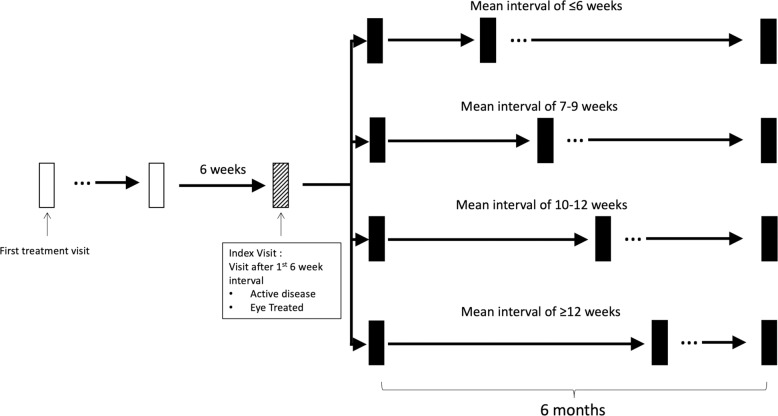
We compared eyes with active disease despite ≤6 weekly injections whose next injection was extended to ≥7 weeks and those whose intervals were not extended. We identified 1559 (16%) of 9602 eyes from the Fight Retinal Blindness! (FRB!) registry (2013 and 2018) that fit this criteria. Eyes were further stratified into four groups by the mean interval over the following 6 months: (1) ≤6 weeks (81%), (2) 7-9 weeks (9%), (3) 10-12 weeks (5%) and (4) >12 weeks (5%).
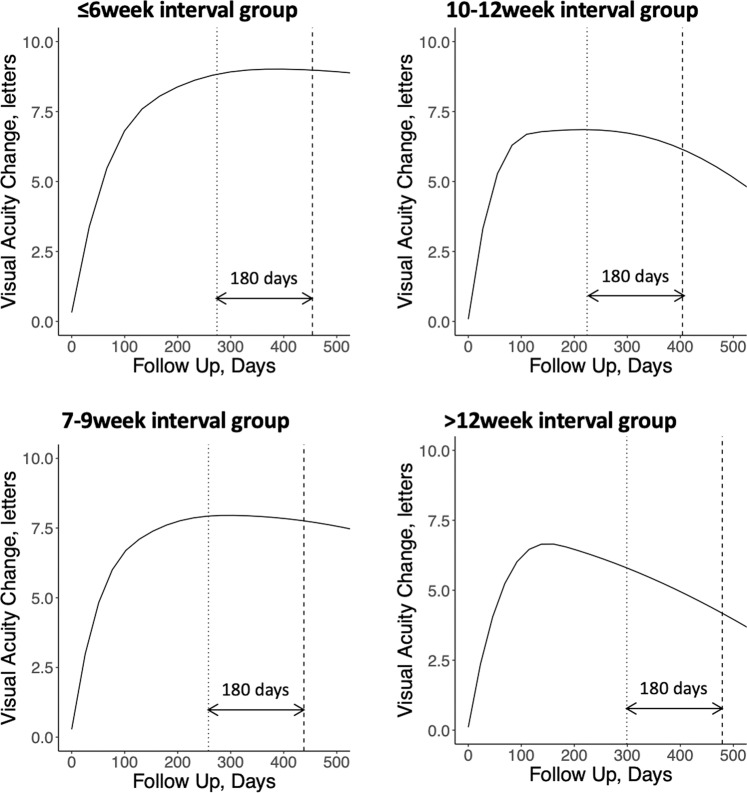
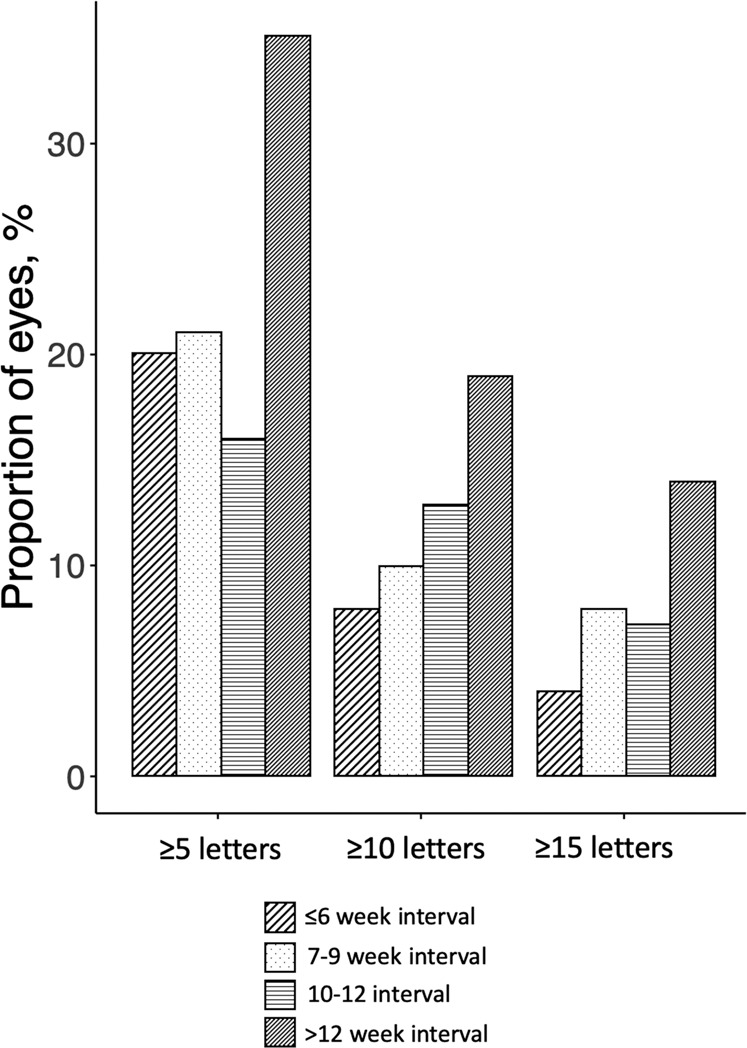
There was a significant loss in VA in eyes extended to >12 weeks compared to the non-extended group (adjusted VA change, mean (95% CI): ≤6 weeks, 0.4 (-1.5 to 2.2), versus >12 weeks, -4.7 (-7.4 to -2.1), letters, p = 0.03 and a threefold increase in relative risk of losing ≥15 letters (absolute risk (14% versus 4%, p < 0.01)).
Mean VA remained stable for 6 months in eyes requiring frequent treatment despite retreatment interval extension up to 10-12 weeks. There was a significant short-term risk to vision when retreatment interval was extended beyond 12 weeks, hence extensions to this level should be considered cautiously. These data may be useful for physicians who are considering reducing visits to mitigate the risk of COVID-19.
背景/目的:在 COVID-19 大流行期间,为了减少就诊次数,一些临床医生可能被迫暂时延长新生血管性年龄相关性黄斑变性(nAMD)患者的治疗间隔,这些患者需要频繁进行治疗。为了了解这些结果可能是什么,我们研究了大流行发生前病变活跃但未计划延长治疗间隔的患者的眼睛。
我们比较了疾病活跃但下一次注射已延长至≥7 周的眼和未延长注射间隔的眼。我们从 Fight Retinal Blindness!(FRB!)登记处(2013 年和 2018 年)中确定了符合这一标准的 9602 只眼中的 1559 只(16%)。根据接下来 6 个月的平均间隔,这些眼进一步分为 4 组:(1)≤6 周(81%)、(2)7-9 周(9%)、(3)10-12 周(5%)和(4)>12 周(5%)。
与未延长组相比,延长至>12 周的眼的视力显著下降(调整后的视力变化,平均值(95%CI):≤6 周,0.4(-1.5 至 2.2),>12 周,-4.7(-7.4 至-2.1),字母,p=0.03),并且丧失≥15 个字母的相对风险增加了三倍(绝对风险(14%对 4%),p<0.01)。
尽管治疗间隔延长至 10-12 周,但需要频繁治疗的眼在 6 个月内平均视力仍保持稳定。当再次治疗间隔延长超过 12 周时,视力会出现显著的短期风险,因此应谨慎考虑将间隔延长至这一水平。这些数据可能对考虑减少就诊次数以降低 COVID-19 风险的医生有用。