Oncology Department, The Third People's Hospital of Hubei Province, Affiliated Hospital of Jianghan University, Wuhan, China.
Front Immunol. 2020 Nov 9;11:595207. doi: 10.3389/fimmu.2020.595207. eCollection 2020.
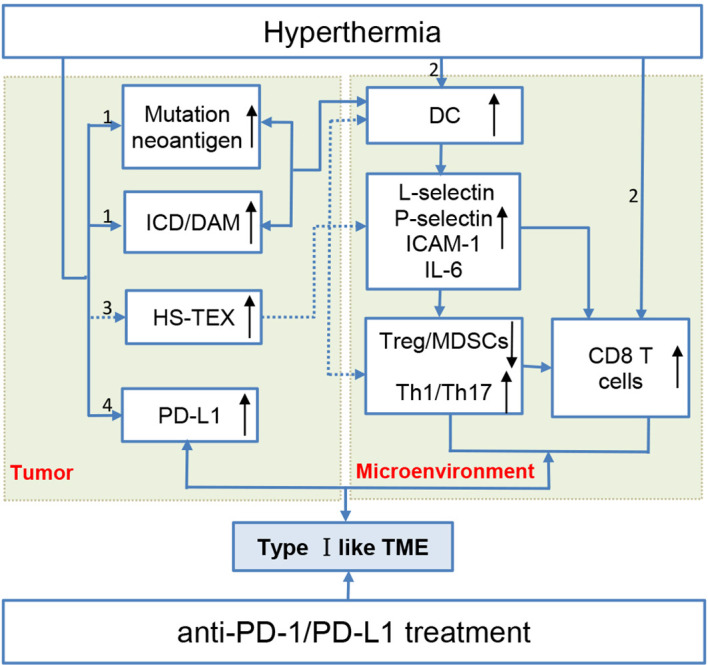
Immune checkpoint inhibitors (ICIs) have ushered in a new era of cancer therapy; however, ICIs are only effective in selective patients. The efficacy of ICIs is closely related to the tumor microenvironment. Fever for a long time was thought to directly regulate the immune response, and artificial "fever" from hyperthermia modulates the tumor immune microenvironment by providing danger signals with heat shock proteins (HSPs) as well as subsequent activation of immune systems. Encouraging results have been achieved in preclinical studies focused on potential synergetic effects by combining hyperthermia with ICIs. In this review, we summarized a cluster of immune-related factors that not only make hyperthermia a treatment capable of defending against cancer but also make hyperthermia a reliable treatment that creates a type I-like tumor microenvironment (overexpression of PD-L1 and enrichment of tumor infiltrating lymphocytes) in complementary for the enhancement of the ICIs. Then we reviewed recent preclinical data of the combination regimens involving hyperthermia and ICIs that demonstrated the combined efficacy and illustrated possible approaches to further boost the effectiveness of this combination.
免疫检查点抑制剂(ICIs)开创了癌症治疗的新时代;然而,ICIs 仅对选择性患者有效。ICIs 的疗效与肿瘤微环境密切相关。长期发热被认为直接调节免疫反应,而热疗提供热休克蛋白(HSPs)作为危险信号以及随后激活免疫系统所产生的人工“发热”,调节肿瘤免疫微环境。在集中研究通过将热疗与 ICI 联合使用的潜在协同作用的临床前研究中,已经取得了令人鼓舞的结果。在这篇综述中,我们总结了一组免疫相关因素,这些因素不仅使热疗成为一种能够抵抗癌症的治疗方法,而且还使热疗成为一种可靠的治疗方法,通过增强 ICI 来创造出 I 型样肿瘤微环境(过度表达 PD-L1 和富集肿瘤浸润淋巴细胞)。然后,我们回顾了涉及热疗和 ICI 的联合方案的最新临床前数据,这些数据显示了联合治疗的效果,并说明了进一步提高这种联合治疗效果的可能方法。