Sass Rachelle, Finlay Juli, Rossum Krista, Soroka Kaytlynn V, McCormick Michael, Desjarlais Arlene, Vorster Hans, Fontaine George, Ferreira Da Silva Priscila, James Matthew, Sood Manish M, Tong Allison, Pannu Neesh, Tennankore Karthik, Thompson Stephanie, Tonelli Marcello, Bohm Clara
Max Rady College of Medicine, University of Manitoba, Winnipeg, Canada.
Chronic Disease Innovation Centre, Seven Oaks General Hospital, Winnipeg, MB, Canada.
Can J Kidney Health Dis. 2020 Nov 12;7:2054358120970715. doi: 10.1177/2054358120970715. eCollection 2020.
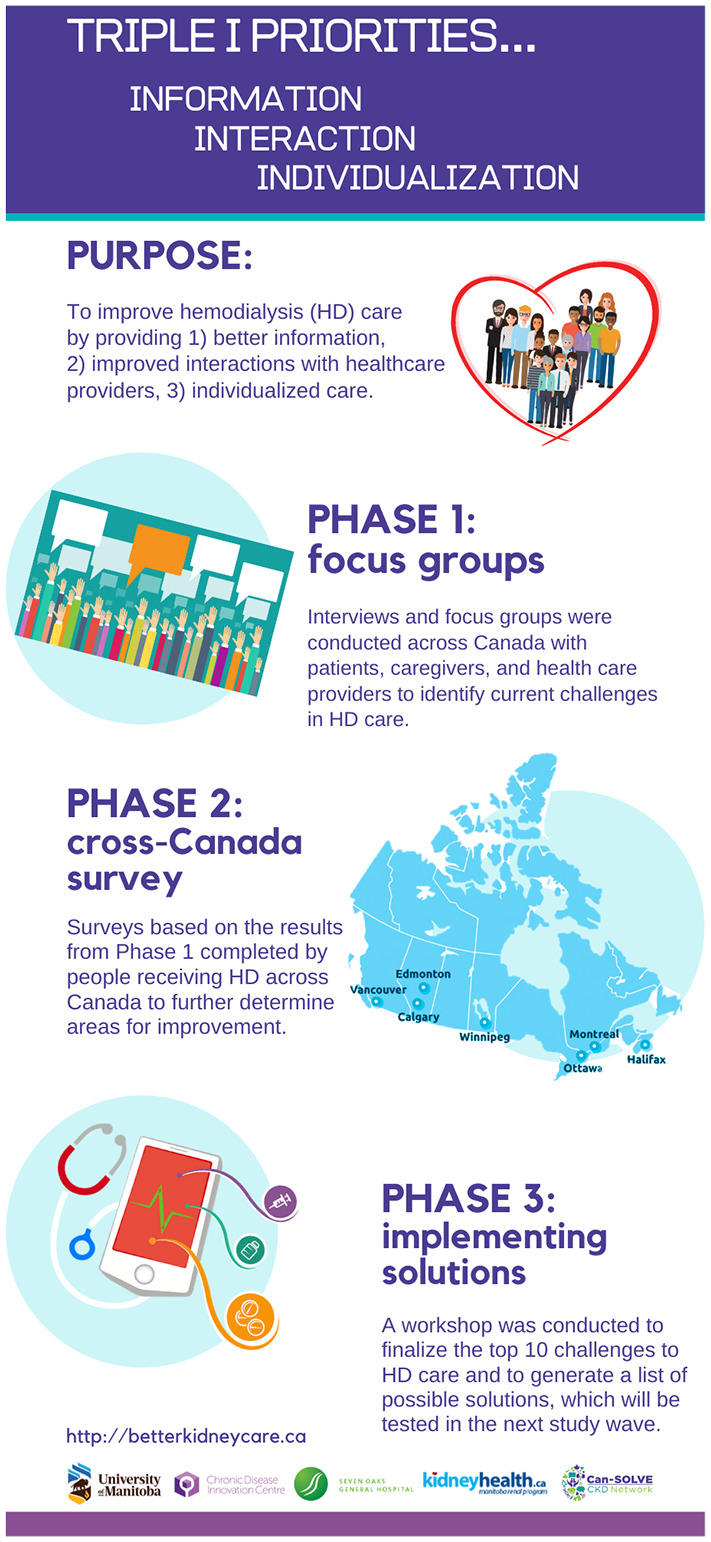
Clinical settings often make it challenging for patients with kidney failure to receive individualized hemodialysis (HD) care. Individualization refers to care that reflects an individual's specific circumstances, values, and preferences.
This study aimed to describe patient, caregiver, and health care professional perspectives regarding challenges and solutions to individualization of care in people receiving in-center HD.
In this multicentre qualitative study, we conducted focus groups with individuals receiving in-center HD and their caregivers and semi-structured interviews with health care providers from May 2017 to August 2018.
Hemodialysis programs in 5 cities: Calgary, Edmonton, Winnipeg, Ottawa, and Halifax.
Individuals receiving in-center HD for more than 6 months, aged 18 years or older, and able to communicate in English were eligible to participate, as well as their caregivers. Health care providers with HD experience were recruited using a purposive approach and snowball sampling.
Two sequential methods of qualitative data collection were undertaken: (1) focus groups and interviews with HD patients and caregivers, which informed (2) individual interviews with health care providers. A qualitative descriptive methodology guided focus groups and interviews. Data from all focus groups and interviews were analyzed using conventional content analysis.
Among 82 patients/caregivers and 31 health care providers, we identified 4 main themes: session set-up, transportation and parking, socioeconomic and emotional well-being, and HD treatment location and scheduling. Particular challenges faced were as follows: (1) session set-up: lack of preferred supplies, machine and HD access set-up, call buttons, bed/chair discomfort, needling options, privacy in the unit, and self-care; (2) transportation and parking: lack of reliable/punctual service, and high costs; (3) socioeconomic and emotional well-being: employment aid, finances, nutrition, lack of support programs, and individualization of treatment goals; and (4) HD treatment location and scheduling: patient displacement from their usual spot, short notice of changes to dialysis time and location, lack of flexibility, and shortages of HD spots.
Uncertain applicability to non-English speaking individuals, those receiving HD outside large urban centers, and those residing outside of Canada.
Participants identified challenges to individualization of in-center HD care, primarily regarding patient comfort and safety during HD sessions, affordable and reliable transportation to and from HD sessions, increased financial burden as a result of changes in functional and employment status with HD, individualization of treatment goals, and flexibility in treatment schedule and self-care. These findings will inform future studies aimed at improving patient-centered HD care.
临床环境常常使肾衰竭患者难以获得个性化的血液透析(HD)护理。个性化护理是指反映个人具体情况、价值观和偏好的护理。
本研究旨在描述患者、护理人员和医疗保健专业人员对于接受中心血液透析患者护理个性化方面的挑战及解决方案的看法。
在这项多中心定性研究中,我们于2017年5月至2018年8月对接受中心血液透析的患者及其护理人员进行了焦点小组访谈,并对医疗保健提供者进行了半结构化访谈。
五个城市的血液透析项目:卡尔加里、埃德蒙顿、温尼伯、渥太华和哈利法克斯。
接受中心血液透析超过6个月、年龄在18岁及以上且能用英语交流的患者及其护理人员有资格参与。采用目的抽样法和滚雪球抽样法招募有血液透析经验的医疗保健提供者。
采用两种定性数据收集的顺序方法:(1)对血液透析患者及其护理人员进行焦点小组访谈和访谈,这为(2)对医疗保健提供者进行个人访谈提供了信息。定性描述方法指导焦点小组访谈和访谈。使用常规内容分析法对所有焦点小组访谈和访谈的数据进行分析。
在82名患者/护理人员和31名医疗保健提供者中,我们确定了4个主要主题:治疗安排、交通和停车、社会经济和情感福祉以及血液透析治疗地点和时间表。面临的具体挑战如下:(1)治疗安排:缺乏首选用品、机器和血液透析通路设置、呼叫按钮、床/椅不适、针刺选择、病房隐私和自我护理;(2)交通和停车:缺乏可靠/准时的服务以及成本高昂;(3)社会经济和情感福祉:就业援助、财务、营养、缺乏支持项目以及治疗目标的个性化;(4)血液透析治疗地点和时间表:患者从其惯常位置被替换、透析时间和地点的变更通知提前期短、缺乏灵活性以及血液透析位置短缺。
对于非英语使用者、在大城市中心以外接受血液透析的人以及居住在加拿大以外的人,适用性不确定。
参与者确定了中心血液透析护理个性化方面的挑战,主要涉及血液透析治疗期间患者的舒适度和安全性、往返血液透析治疗的经济实惠且可靠的交通、由于血液透析导致的功能和就业状况变化而增加的经济负担、治疗目标的个性化以及治疗时间表和自我护理的灵活性。这些发现将为未来旨在改善以患者为中心的血液透析护理的研究提供信息。