Scheiwiller Maya, Oeschger Elias S, Gkantidis Nikolaos
Department of Orthodontics and Dentofacial Orthopedics, University of Bern, Bern, Switzerland.
PeerJ. 2020 Nov 17;8:e10367. doi: 10.7717/peerj.10367. eCollection 2020.
The number of teeth in the human dentition is of interest both from developmental and evolutionary aspects. The present case-control study focused on the formation of third molars in modern humans aiming to shed more light on the most variable tooth class in the dentition.
For this reason, we investigated third molar formation in a sample of 303 individuals with agenesis of teeth other than third molars (agenesis group) and compared it to a sex and age matched control group of 303 individuals without agenesis of teeth other than third molars.
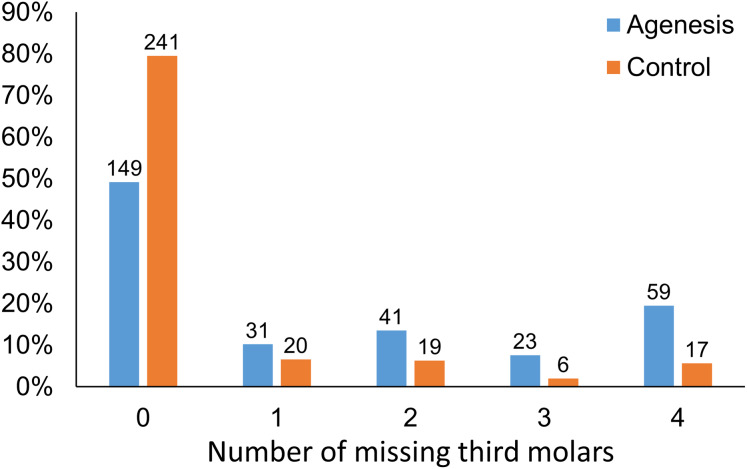
The prevalence of third molar agenesis in the agenesis group was 50.8%, which is significantly higher than the 20.5% in the control group ( < 0.001). The chance of a missing third molar in the agenesis group was increased by 38.3% ( < 0.001), after controlling for the agenesis in other teeth factor. When considering the amount of missing third molars per individual, a clear tendency towards more missing third molars was evident in the agenesis group compared to the control group. The frequency of bilaterally missing third molars in the agenesis group was 29% in the maxilla, as well as in the mandible, which is about three times higher than the frequency of unilaterally missing third molars ( < 0.001). In the control group, bilaterally missing third molars occurred in 8.6% in the maxilla and 8.9% in the mandible.
The present results indicate that genetic factors involved in tooth agenesis affect also the dentition as a whole. Furthermore, the third molars are more vulnerable to factors involved in agenesis of other teeth and they are more often affected as a whole. These findings seem to be associated with the evolutionary trend in humans towards reduced molar number.
人类牙列中的牙齿数量从发育和进化角度来看都备受关注。本病例对照研究聚焦于现代人类第三磨牙的形成,旨在更深入了解牙列中最具变异性的牙齿类别。
因此,我们调查了303例除第三磨牙外存在牙齿缺失(牙齿缺失组)个体的第三磨牙形成情况,并将其与303例除第三磨牙外无牙齿缺失的性别和年龄匹配对照组进行比较。
牙齿缺失组中第三磨牙缺失的患病率为50.8%,显著高于对照组的20.5%(<0.001)。在控制其他牙齿缺失因素后,牙齿缺失组中第三磨牙缺失的几率增加了38.3%(<0.001)。当考虑个体缺失第三磨牙的数量时,与对照组相比,牙齿缺失组中明显存在更多第三磨牙缺失的倾向。牙齿缺失组中上颌和下颌双侧缺失第三磨牙的频率均为29%,约为单侧缺失第三磨牙频率的三倍(<0.001)。在对照组中,上颌双侧缺失第三磨牙的发生率为8.6%,下颌为8.9%。
目前的结果表明,涉及牙齿缺失的遗传因素也会影响整个牙列。此外,第三磨牙更容易受到其他牙齿缺失相关因素的影响,并且它们整体上更常受到影响。这些发现似乎与人类磨牙数量减少的进化趋势相关。