Department of Traditional Chinese Medicine, the First Affiliated Hospital of Medical School of Xi'an Jiaotong University, Xi'an, Shaanxi, 710061, People's Republic of China.
Department of Medical Oncology, the First Affiliated Hospital of Medical School of Xi'an Jiaotong University, Xi'an, Shaanxi, 710061, People's Republic of China.
BMC Cancer. 2020 Nov 26;20(1):1158. doi: 10.1186/s12885-020-07633-3.
Human CD133+ hematopoietic progenitor cells (HPCs) are a specific subset of cells that can regulate tumor malignancy. However, the mechanism by which CD133+ HPCs affect the malignancy of human breast cancer has not been reported.
CD133+ HPCs were isolated and purified from human umbilical cord blood (UCB). We used in vitro culture of MCF-7 and MDA-MB-231 cell lines, and MCF-7 and MDA-MB-231 cells in nude mice to evaluate whether CD133+ HPCs affected the apoptosis, proliferation, invasion and epithelial mesenchymal transition EMT of breast cancer cells.
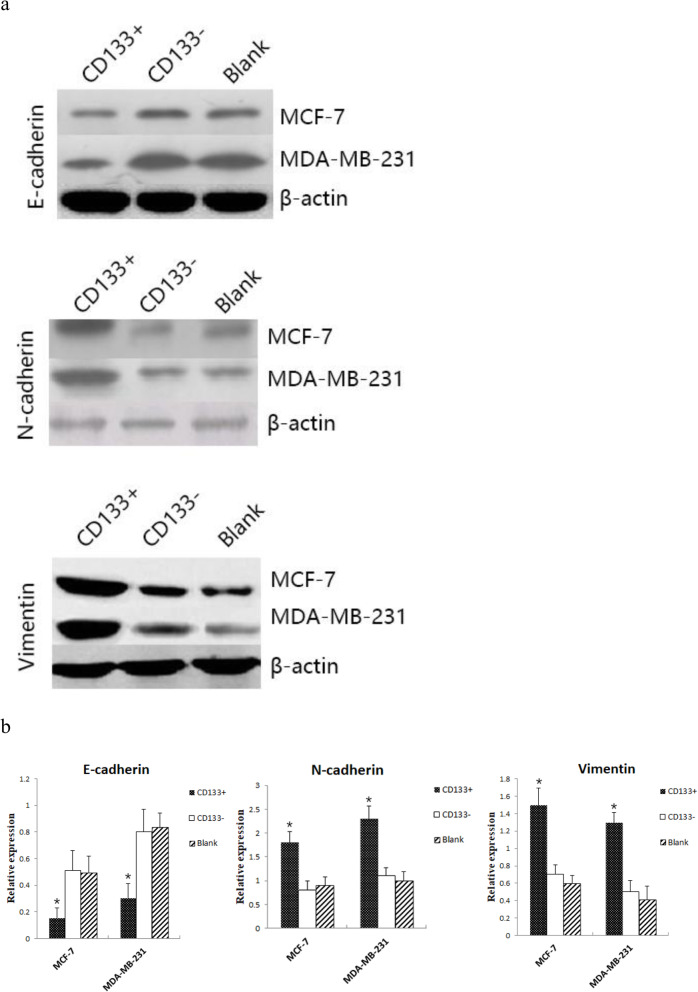
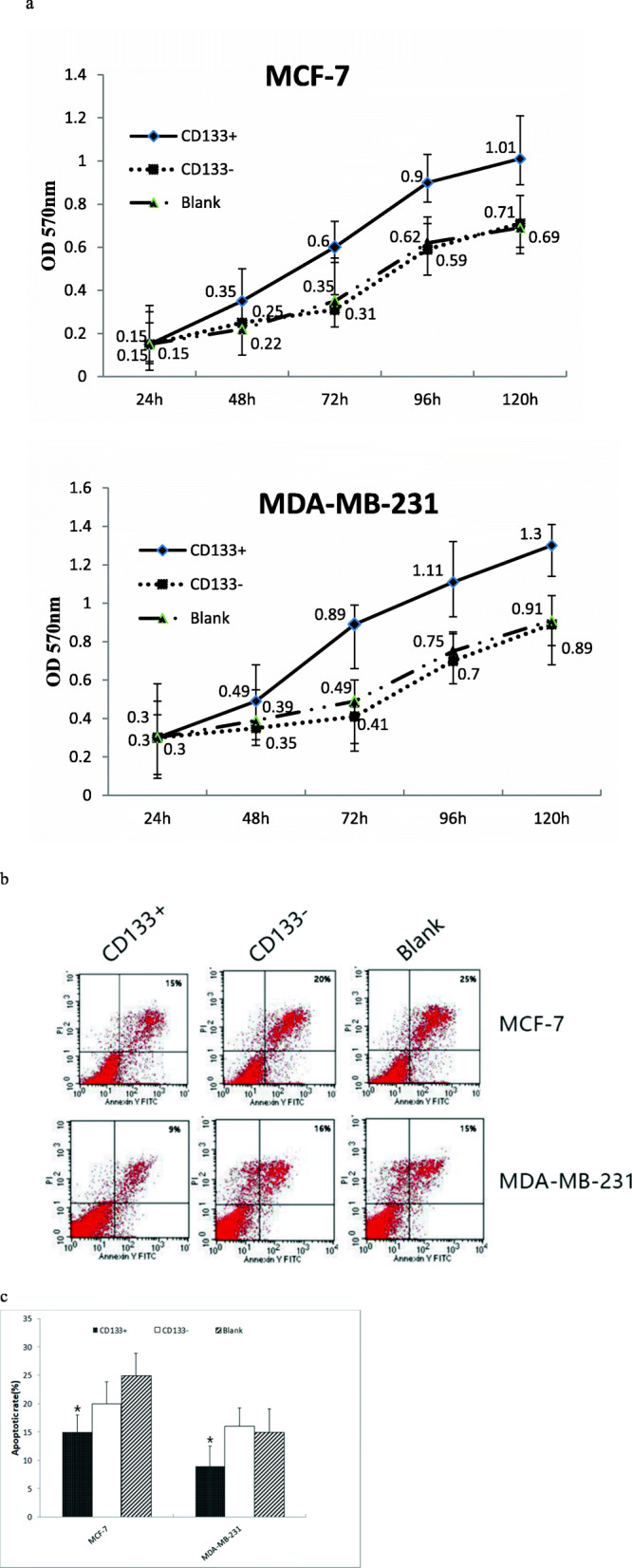
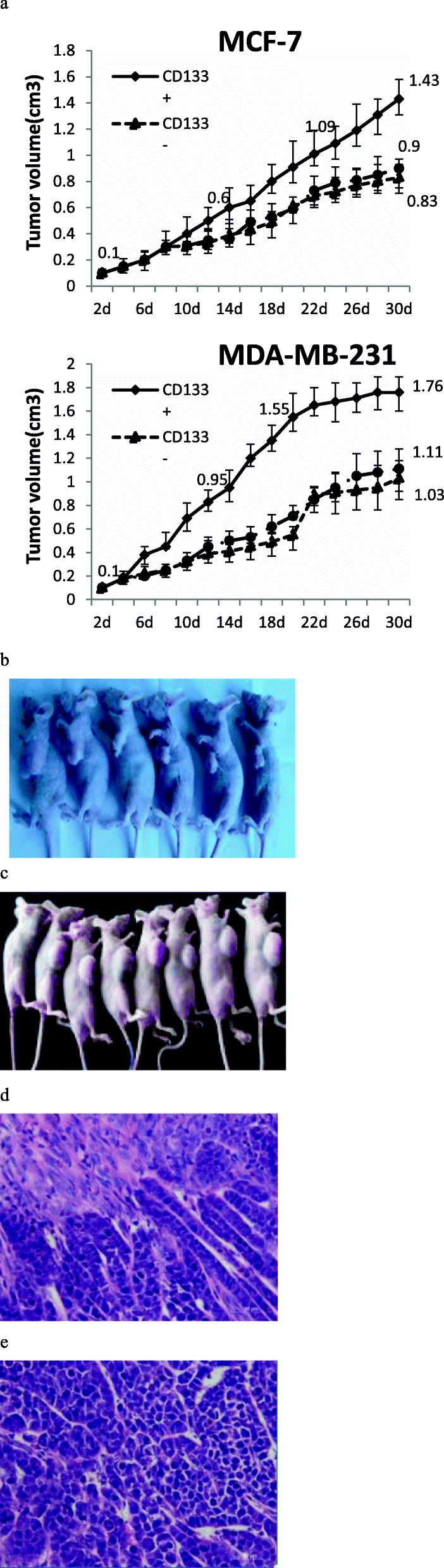
Co-culture with CD133+ HPCs, but not UCB CD133- cells, promoted the proliferation of human breast cancer MCF-7 and MDA-MB-231 cells, accompanied by reducing in vitro spontaneous apoptosis. Co-administration of these two lines with CD133+ HPCs significantly enhanced the growth of implanted breast cancer in vivo. Furthermore, co-culture with CD133+ HPCs, enhanced the invasion of breast cancer cells, N-cadherin and Vimentin expression, but reduced E-cadherin expression in breast cancer cells.
Our study demonstrated that CD133+ HPCs enhance the malignancy of breast cancer cells by attenuating spontaneous apoptosis and promoting the process of epithelial mesenchymal transition. These findings may provide new insights into the role of human CD133+ HPCs in breast cancer pathogenesis. Therefore, CD133+ HPCs may be a new therapeutic target for inhibiting the progression of breast cancer.
人类 CD133+ 造血祖细胞(HPC)是一种能够调节肿瘤恶性程度的特定细胞亚群。然而,CD133+ HPC 影响人类乳腺癌恶性程度的机制尚未报道。
从人脐血(UCB)中分离和纯化 CD133+ HPC。我们使用 MCF-7 和 MDA-MB-231 细胞系的体外培养以及裸鼠中的 MCF-7 和 MDA-MB-231 细胞,来评估 CD133+ HPC 是否影响乳腺癌细胞的凋亡、增殖、侵袭和上皮间质转化(EMT)。
与 CD133+ HPC 共培养,但不是 UCB CD133-细胞共培养,促进了人乳腺癌 MCF-7 和 MDA-MB-231 细胞的增殖,同时减少了体外自发凋亡。这两条细胞系与 CD133+ HPC 共给药明显增强了体内植入乳腺癌的生长。此外,与 CD133+ HPC 共培养增强了乳腺癌细胞的侵袭能力,增加了 N-钙粘蛋白和波形蛋白的表达,同时降低了乳腺癌细胞中 E-钙粘蛋白的表达。
我们的研究表明,CD133+ HPC 通过减弱自发凋亡和促进上皮间质转化过程来增强乳腺癌细胞的恶性程度。这些发现可能为人类 CD133+ HPC 在乳腺癌发病机制中的作用提供新的见解。因此,CD133+ HPC 可能成为抑制乳腺癌进展的新治疗靶点。