Department of Population Health Sciences, Weill Cornell Medicine, New York, NY, USA.
Division of Behavioral Sciences and Community Health, UConn Health, Farmington, CT, USA.
Transl Psychiatry. 2020 Nov 26;10(1):413. doi: 10.1038/s41398-020-01100-0.
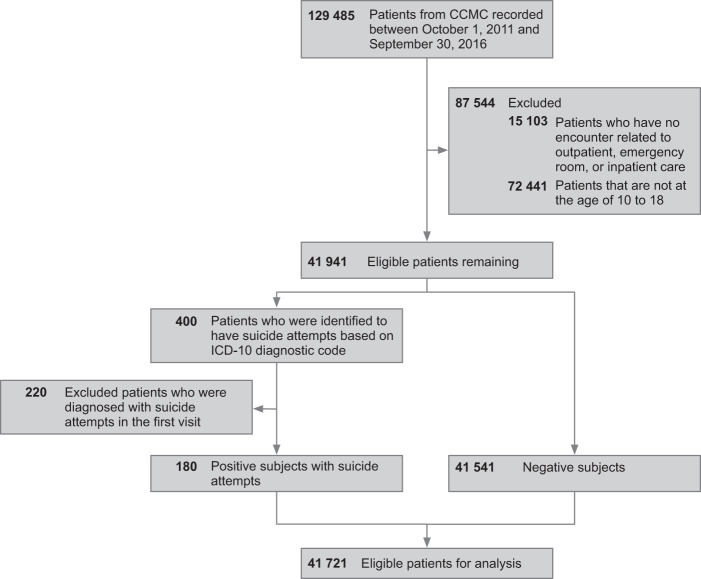
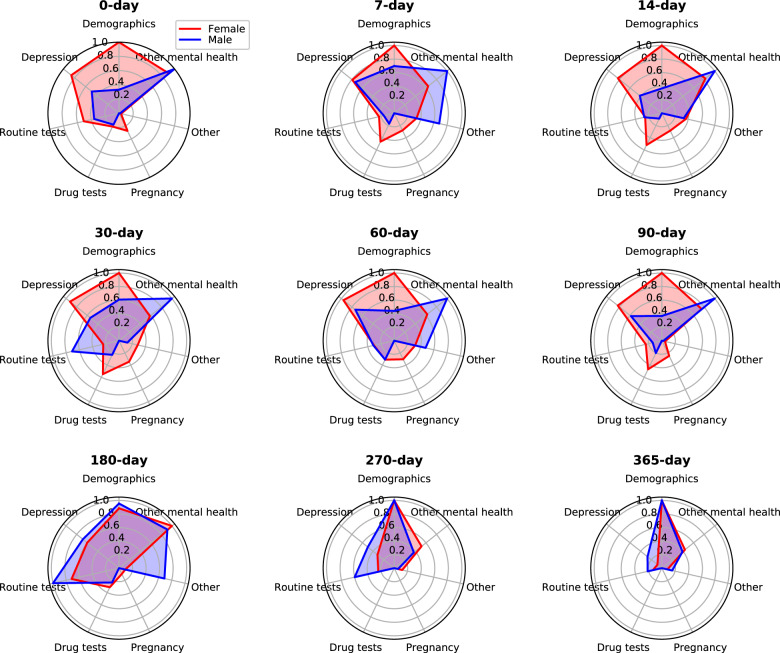
Accurate prediction of suicide risk among children and adolescents within an actionable time frame is an important but challenging task. Very few studies have comprehensively considered the clinical risk factors available to produce quantifiable risk scores for estimation of short- and long-term suicide risk for pediatric population. In this paper, we built machine learning models for predicting suicidal behavior among children and adolescents based on their longitudinal clinical records, and determining short- and long-term risk factors. This retrospective study used deidentified structured electronic health records (EHR) from the Connecticut Children's Medical Center covering the period from 1 October 2011 to 30 September 2016. Clinical records of 41,721 young patients (10-18 years old) were included for analysis. Candidate predictors included demographics, diagnosis, laboratory tests, and medications. Different prediction windows ranging from 0 to 365 days were adopted. For each prediction window, candidate predictors were first screened by univariate statistical tests, and then a predictive model was built via a sequential forward feature selection procedure. We grouped the selected predictors and estimated their contributions to risk prediction at different prediction window lengths. The developed predictive models predicted suicidal behavior across all prediction windows with AUCs varying from 0.81 to 0.86. For all prediction windows, the models detected 53-62% of suicide-positive subjects with 90% specificity. The models performed better with shorter prediction windows and predictor importance varied across prediction windows, illustrating short- and long-term risks. Our findings demonstrated that routinely collected EHRs can be used to create accurate predictive models for suicide risk among children and adolescents.
准确预测儿童和青少年在可操作时间范围内的自杀风险是一项重要但具有挑战性的任务。很少有研究全面考虑了现有的临床风险因素,以产生可量化的风险评分,用于估计儿科人群的短期和长期自杀风险。在本文中,我们基于儿童和青少年的纵向临床记录构建了用于预测自杀行为的机器学习模型,并确定了短期和长期风险因素。这项回顾性研究使用了康涅狄格儿童医疗中心的匿名结构化电子健康记录(EHR),涵盖了 2011 年 10 月 1 日至 2016 年 9 月 30 日的时间段。共分析了 41721 名年轻患者(10-18 岁)的临床记录。候选预测因子包括人口统计学数据、诊断、实验室检查和药物。采用了从 0 到 365 天的不同预测窗口。对于每个预测窗口,首先通过单变量统计检验筛选候选预测因子,然后通过逐步向前特征选择过程构建预测模型。我们对选定的预测因子进行分组,并估计它们在不同预测窗口长度下对风险预测的贡献。开发的预测模型在所有预测窗口中预测自杀行为的 AUC 从 0.81 到 0.86 不等。对于所有预测窗口,模型检测到 53-62%的自杀阳性患者,特异性为 90%。模型在较短的预测窗口表现更好,预测窗口之间的预测因子重要性也有所不同,说明了短期和长期风险。我们的研究结果表明,常规收集的 EHR 可用于为儿童和青少年的自杀风险创建准确的预测模型。