Soleimani Mohammad, Tabatabaei Seyed Ali, Mohammadi S Saeed, Valipour Niloufar, Mirzaei Arash
Ocular Trauma and Emergency Department, Eye Research Center, Farabi eye hospital, Tehran University of Medical Sciences, Tehran, Iran.
J Ophthalmic Inflamm Infect. 2020 Nov 27;10(1):35. doi: 10.1186/s12348-020-00227-x.
To report characteristics of microbial keratitis in pediatric patients under five years.
Patients with infectious keratitis under the age of 5 years were included in this retrospective cross-sectional study for ten years. All patients were admitted and corneal scraping was performed in 81 children. Fortified empiric antibiotic eye drops including cefazolin (50 mg/cc) and amikacin (20 mg/cc) were started and the antibiotic regimen was continued or changed according to culture results. In the case of fungal keratitis, topical voriconazole (10 mg/cc) or natamycin (50 mg/cc) and topical chloramphenicol (5 mg/cc) were started. A tectonic procedure was done when corneal thinning or perforation was present.
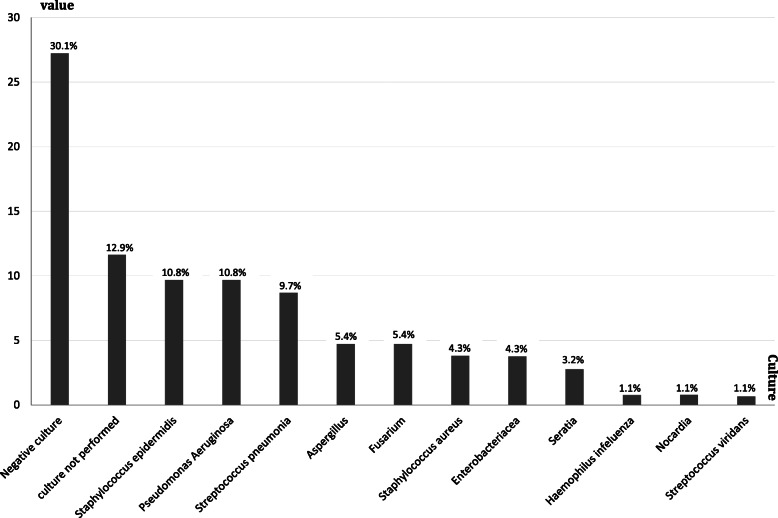
Ninety-Three Patients between 1 to 60 months with a mean age of 33 ± 18 months old with corneal ulcer were included in the study. The most common risk factor was trauma (40.9%) followed by contact lens use (8.6%). Cultures were negative for microbial growth in 28 (30.1%) patients. The most common pathogens were S. epidermidis (10.8%) and P. aeruginosa (10.8%). Fluoroquinolone antibiotics (ciprofloxacin; 93.8% sensitivity) were the most potent antibiotic against bacterial pathogens. Forty-one patients underwent tectonic procedures, which the most common ones were cyanoacrylate glue 18.3% followed by keratoplasty 16.1%.
This study emphasizes the role of trauma as the primary cause and S. epidermidis as the most frequent microorganism in pediatric keratitis; according to antibiogram results and poor cooperation of patients under five years, monotherapy with fluoroquinolones could be a good regimen in small non-central lesions without thinning.
报告5岁以下儿童微生物性角膜炎的特征。
本回顾性横断面研究纳入了10年间5岁以下的感染性角膜炎患者。所有患者均入院治疗,81名儿童进行了角膜刮片检查。开始使用强化经验性抗生素滴眼液,包括头孢唑林(50mg/cc)和阿米卡星(20mg/cc),并根据培养结果继续或更改抗生素治疗方案。对于真菌性角膜炎,开始局部使用伏立康唑(10mg/cc)或那他霉素(50mg/cc)以及局部使用氯霉素(5mg/cc)。当出现角膜变薄或穿孔时,进行结构性手术。
本研究纳入了93例年龄在1至60个月、平均年龄为33±18个月的角膜溃疡患者。最常见的危险因素是外伤(40.9%),其次是佩戴隐形眼镜(8.6%)。28例(30.1%)患者的培养结果显示微生物生长阴性。最常见的病原体是表皮葡萄球菌(10.8%)和铜绿假单胞菌(10.8%)。氟喹诺酮类抗生素(环丙沙星;敏感性为93.8%)是对抗细菌病原体最有效的抗生素。41例患者接受了结构性手术,最常见的是氰基丙烯酸酯胶水封堵术(18.3%),其次是角膜移植术(16.1%)。
本研究强调了外伤作为小儿角膜炎主要病因的作用,以及表皮葡萄球菌作为最常见微生物的地位;根据药敏试验结果以及5岁以下患者配合度差的情况,对于无变薄的小面积非中央性病变,氟喹诺酮类药物单药治疗可能是一种不错的治疗方案。