Department of Biochemistry & Biomedical Sciences, Michael G. DeGroote Institute for Infectious Disease Research, McMaster University, Hamilton, ON, Canada.
Department of Chemistry & Chemical Biology, Michael G. DeGroote Institute for Infectious Disease Research, McMaster University, Hamilton, ON, Canada.
Nat Commun. 2020 Nov 27;11(1):6058. doi: 10.1038/s41467-020-19986-1.
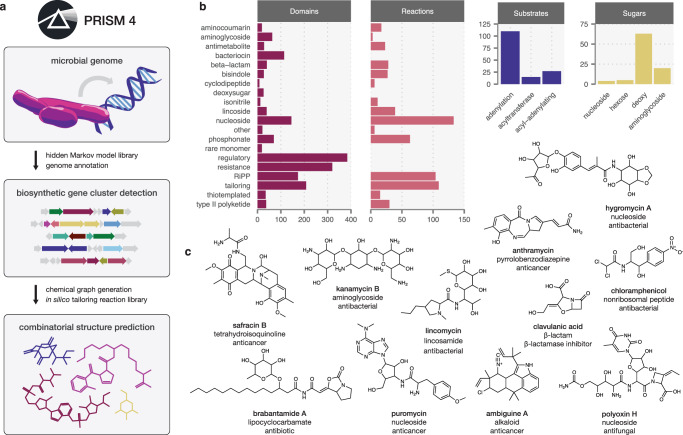
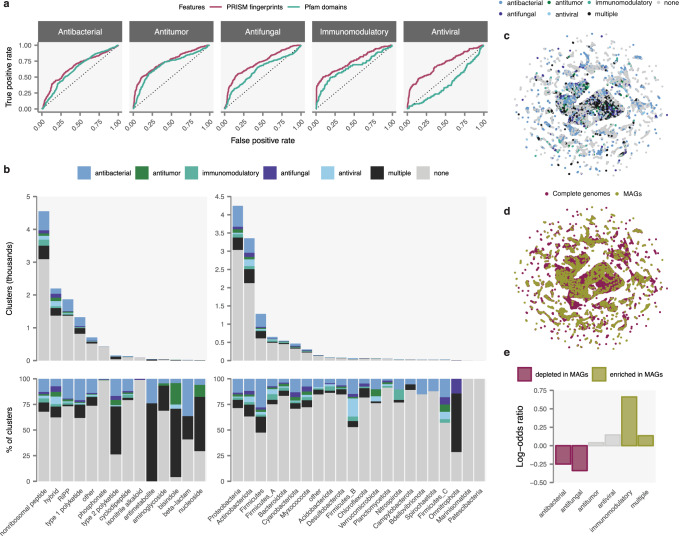
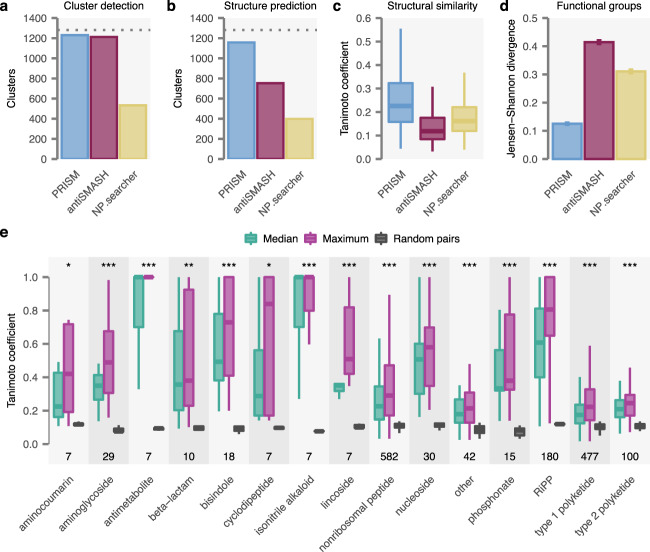
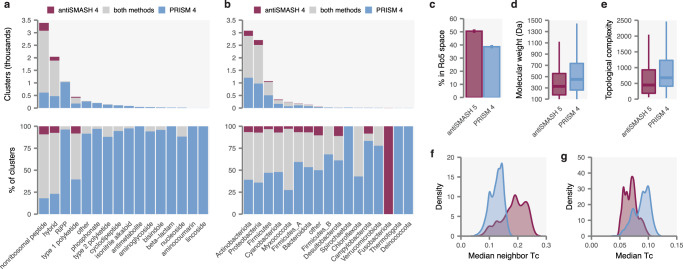
Novel antibiotics are urgently needed to address the looming global crisis of antibiotic resistance. Historically, the primary source of clinically used antibiotics has been microbial secondary metabolism. Microbial genome sequencing has revealed a plethora of uncharacterized natural antibiotics that remain to be discovered. However, the isolation of these molecules is hindered by the challenge of linking sequence information to the chemical structures of the encoded molecules. Here, we present PRISM 4, a comprehensive platform for prediction of the chemical structures of genomically encoded antibiotics, including all classes of bacterial antibiotics currently in clinical use. The accuracy of chemical structure prediction enables the development of machine-learning methods to predict the likely biological activity of encoded molecules. We apply PRISM 4 to chart secondary metabolite biosynthesis in a collection of over 10,000 bacterial genomes from both cultured isolates and metagenomic datasets, revealing thousands of encoded antibiotics. PRISM 4 is freely available as an interactive web application at http://prism.adapsyn.com .
新型抗生素的研发迫在眉睫,以应对抗生素耐药性这一迫在眉睫的全球性危机。从历史上看,临床上使用的抗生素主要来源于微生物的次级代谢产物。微生物基因组测序揭示了大量尚未被发现的未被描述的天然抗生素。然而,由于难以将序列信息与编码分子的化学结构联系起来,这些分子的分离受到了阻碍。在这里,我们介绍了 PRISM 4,这是一个用于预测基因组编码抗生素化学结构的综合平台,包括目前临床使用的所有类型的细菌抗生素。化学结构预测的准确性使得开发机器学习方法来预测编码分子可能的生物活性成为可能。我们将 PRISM 4 应用于一个由超过 10000 个细菌基因组组成的集合,这些基因组来自培养分离物和宏基因组数据集,揭示了数千种编码抗生素。PRISM 4 可作为交互式网络应用程序免费使用,网址为 http://prism.adapsyn.com 。