Department of Neuroscience, Erasmus MC, Westzeedijk 353, 3015 AA, Rotterdam, the Netherlands.
Netherlands Institute for Neuroscience, Royal Dutch Academy of Arts & Science, 1105 BA, Amsterdam, the Netherlands.
Nat Commun. 2020 Nov 27;11(1):6050. doi: 10.1038/s41467-020-19960-x.
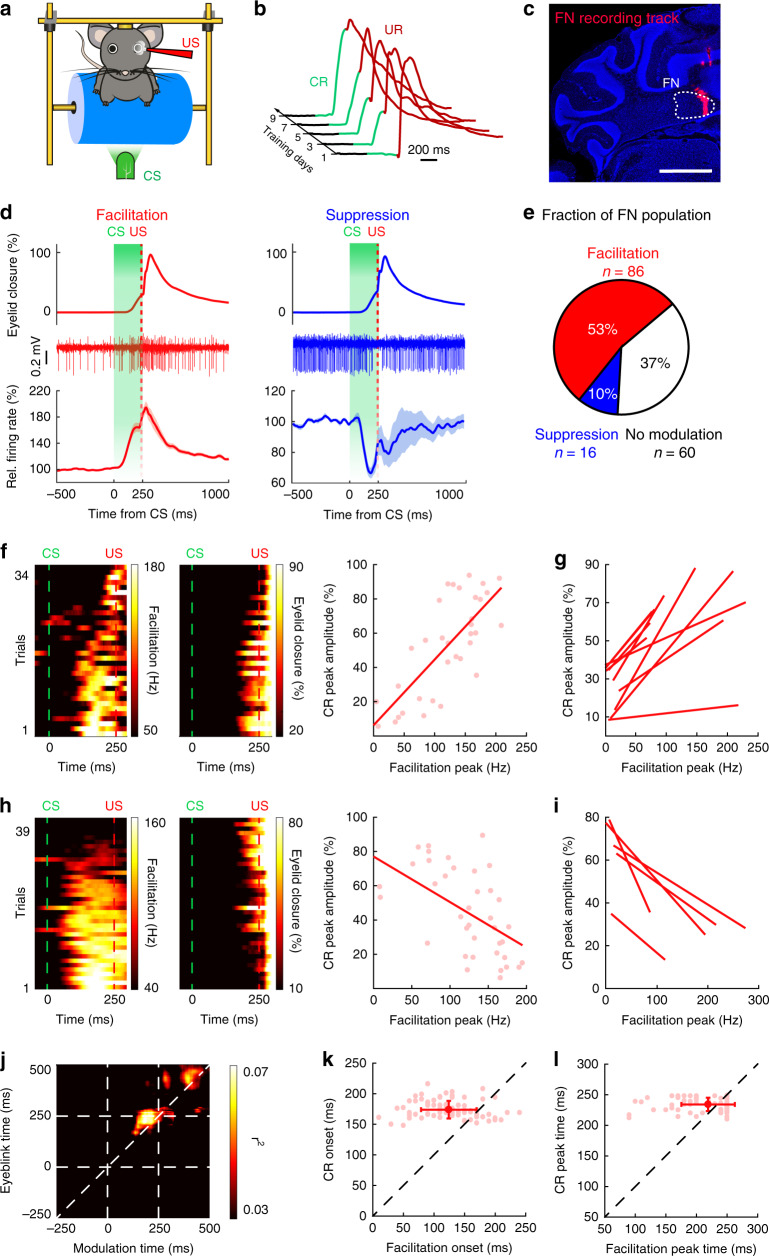
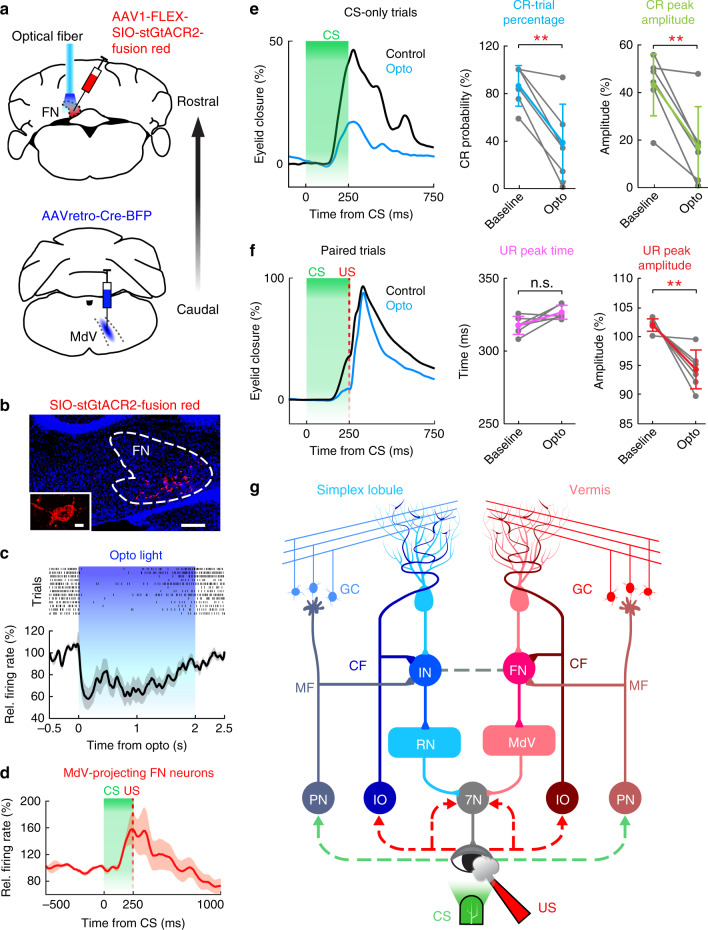
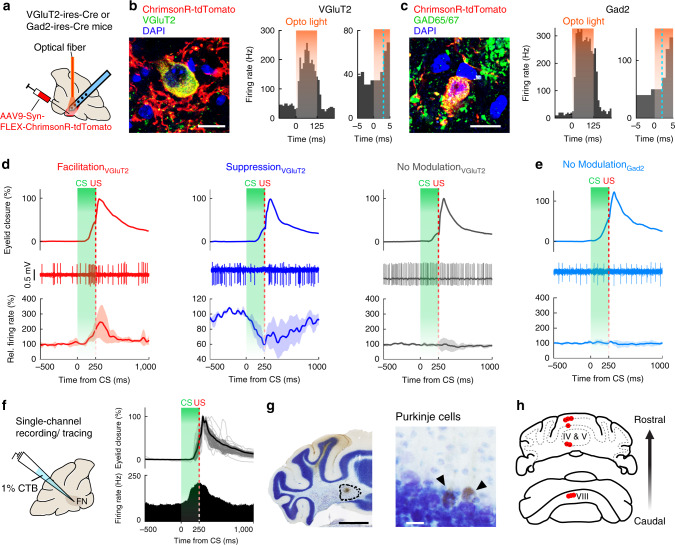
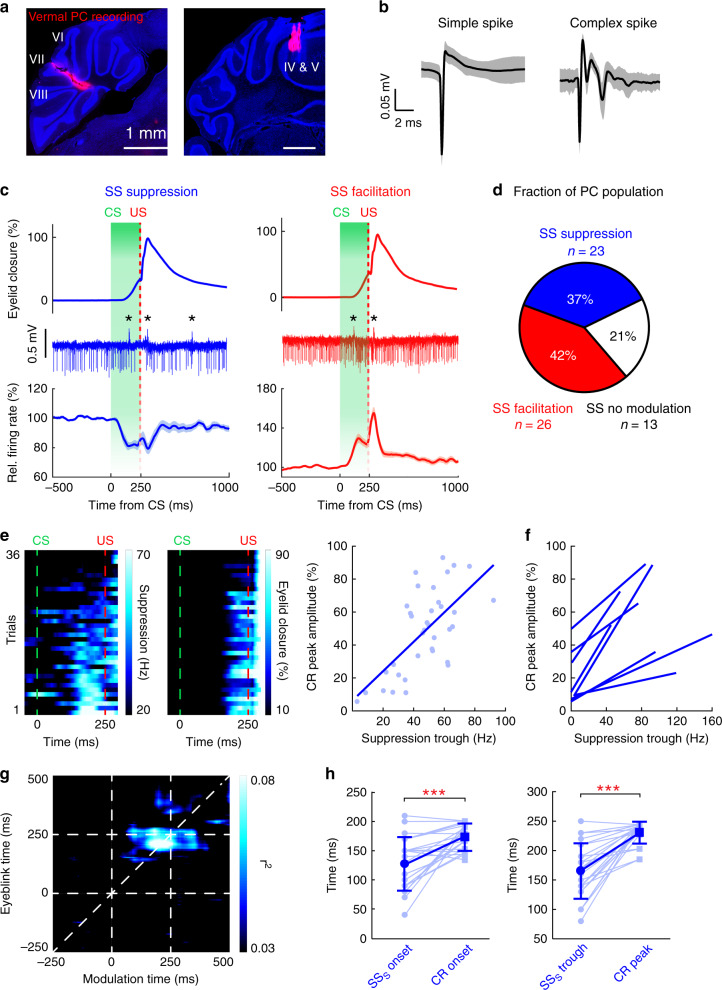
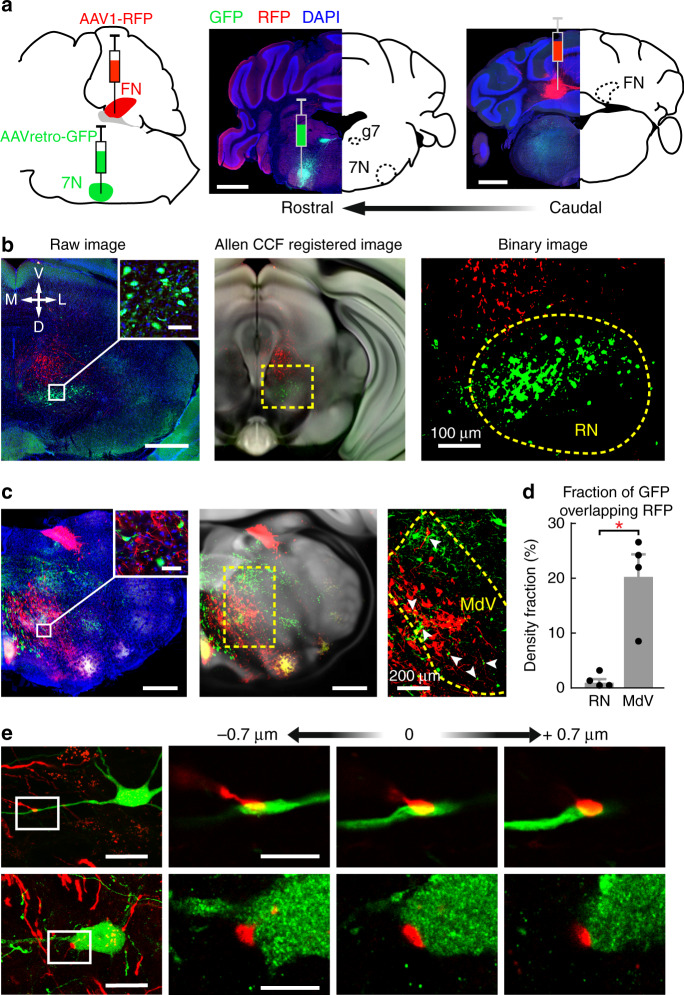
The cerebellum is crucial for various associative sensorimotor behaviors. Delay eyeblink conditioning (DEC) depends on the simplex lobule-interposed nucleus (IN) pathway, yet it is unclear how other cerebellar modules cooperate during this task. Here, we demonstrate the contribution of the vermis-fastigial nucleus (FN) pathway in controlling DEC. We found that task-related modulations in vermal Purkinje cells and FN neurons predict conditioned responses (CRs). Coactivation of the FN and the IN allows for the generation of proper motor commands for CRs, but only FN output fine-tunes unconditioned responses. The vermis-FN pathway launches its signal via the contralateral ventral medullary reticular nucleus, which converges with the command from the simplex-IN pathway onto facial motor neurons. We propose that the IN pathway specifically drives CRs, whereas the FN pathway modulates the amplitudes of eyelid closure during DEC. Thus, associative sensorimotor task optimization requires synergistic modulation of different olivocerebellar modules each provide unique contributions.
小脑对于各种关联的感觉运动行为至关重要。延迟眨眼条件反射 (DEC) 依赖于简单叶-间核 (IN) 通路,但尚不清楚在这项任务中其他小脑模块如何协作。在这里,我们证明了蚓部- fastigial 核 (FN) 通路在控制 DEC 中的贡献。我们发现,蚓部浦肯野细胞和 FN 神经元的与任务相关的调制预测了条件反应 (CR)。FN 和 IN 的共同激活允许为 CR 生成适当的运动命令,但只有 FN 输出微调非条件反应。蚓部-FN 通路通过对侧腹侧延髓网状核发出信号,该信号与来自简单-IN 通路的命令汇聚到面部运动神经元上。我们提出 IN 通路专门驱动 CR,而 FN 通路在 DEC 期间调节闭眼的幅度。因此,关联的感觉运动任务优化需要协同调节不同的橄榄小脑模块,每个模块都提供独特的贡献。