Department of Animal Sciences, Purdue University, West Lafayette IN 47907.
DSM Nutritional Products, 4303 Kaiseraugst, Switzerland.
Poult Sci. 2020 Dec;99(12):6867-6876. doi: 10.1016/j.psj.2020.09.007. Epub 2020 Sep 12.
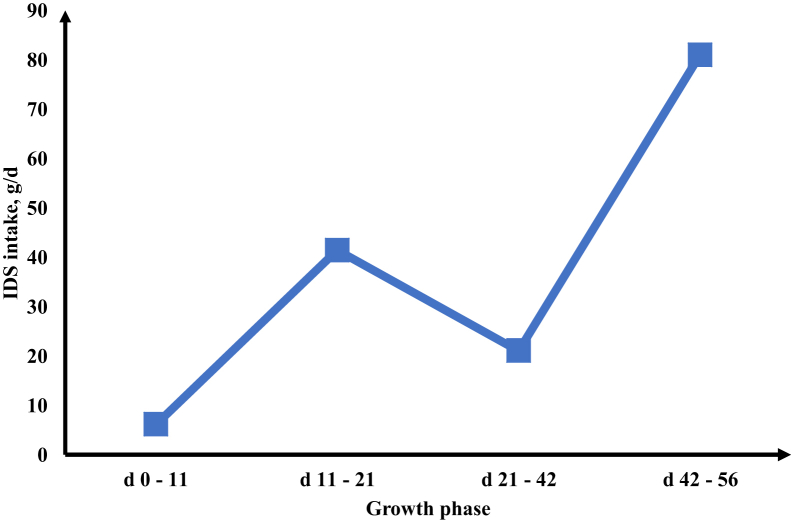
Growth performance, nutrient digestibility, intestinal health, and endogenous enzyme secretion responses to dietary α-amylase supplementation during 4 growth phases of broiler chickens fed corn-soybean meal-based diets were evaluated in the present study. A total of 1,136 male broiler chicks were assigned at day 0 after hatching to 8 treatments in a 2 × 4 factorial arrangement. There were 2 dietary levels of α-amylase supplementation of 0 or 80 kilo-Novo alpha amylase units per kg diet and 4 posthatching growth phases of day 0 to 11, day 11 to 21, day 21 to 42, or day 42 to 56 in a randomized complete block design. Each treatment comprised 8 replicate pens, with either 25 (day 0-11), 20 (day 11-21), 16 (day 21-42), or 10 (day 42-56) birds per pen. Body weight gain and feed efficiency of birds improved (P < 0.01) with α-amylase supplementation. There were main effects of α-amylase, growth phase, and interaction (P < 0.01) on apparent ileal digestibility (AID) of starch. This ranged from 0.8% during day 11 to 21 to 2.8% during day 0 to 11 after hatching. The total tract retention of starch increased (P < 0.05) with amylase supplementation but was not different across growth phases. Amylase supplementation increased (P < 0.05) AID of gross energy, AME (kcal/kg), and AMEn (kcal/kg). Villus height in the jejunal tissue was increased (P < 0.01) by α-amylase supplementation. During day 11 to 21 after hatching, the viscosity of jejunal digesta and pancreatic amylase activity increased (P < 0.01) with amylase supplementation. In conclusion, dietary amylase supplementation improved growth performance, apparent nutrient digestibility, and digestive enzyme activity of broiler chickens fed a corn-soybean diet. The study indicates that the growth phase of birds may affect response to exogenous amylase.
本研究评估了在玉米-豆粕基础日粮中添加α-淀粉酶对肉鸡四个生长阶段的生长性能、养分消化率、肠道健康和内源性酶分泌的影响。试验选用 1136 只 1 日龄雄性肉鸡,采用 2×4 因子完全随机设计,分为 8 个处理,每个处理 8 个重复,每个重复 25(0-11 日龄)、20(11-21 日龄)、16(21-42 日龄)或 10(42-56 日龄)只鸡。日粮中添加 0 或 80 千诺酶活单位/千克α-淀粉酶。日粮中添加α-淀粉酶可提高肉鸡的体重增重和饲料效率(P<0.01)。α-淀粉酶、生长阶段和互作均有主要效应(P<0.01),显著影响淀粉的表观回肠消化率(AID)。从 11-21 日龄的 0.8%到 0-11 日龄的 2.8%不等。添加淀粉酶可提高淀粉在全肠道的保留率(P<0.05),但不同生长阶段之间没有差异。淀粉酶添加提高了粗能、AME(千卡/千克)和 AMEn(千卡/千克)的 AID。α-淀粉酶添加提高了空肠组织绒毛高度(P<0.01)。在 11-21 日龄时,添加淀粉酶可提高空肠食糜的黏度和胰腺淀粉酶活性(P<0.01)。综上所述,在玉米-豆粕日粮中添加淀粉酶可提高肉鸡的生长性能、养分表观消化率和消化酶活性。本研究表明,鸡的生长阶段可能影响对外源淀粉酶的反应。