Luban Jeremy, Sattler Rachel A, Mühlberger Elke, Graci Jason D, Cao Liangxian, Weetall Marla, Trotta Christopher, Colacino Joseph M, Bavari Sina, Strambio-De-Castillia Caterina, Suder Ellen L, Wang Yetao, Soloveva Veronica, Cintron-Lue Katherine, Naryshkin Nikolai A, Pykett Mark, Welch Ellen M, O'Keefe Kylie, Kong Ronald, Goodwin Elizabeth, Jacobson Allan, Paessler Slobodan, Peltz Stuart W
Program in Molecular Medicine, University of Massachusetts Medical School, Worcester, MA, 01605, USA; Department of Biochemistry and Molecular Pharmacology, University of Massachusetts Medical School, Worcester, MA, 01605, USA; Broad Institute of Harvard and MIT, 75 Ames Street, Cambridge, MA, 02142, USA; Massachusetts Consortium on Pathogen Readiness, Boston, MA, 02115, USA.
Department of Pathology, University of Texas Medical Branch at Galveston, Galveston, TX, 77555, USA.
Virus Res. 2021 Jan 15;292:198246. doi: 10.1016/j.virusres.2020.198246. Epub 2020 Nov 26.
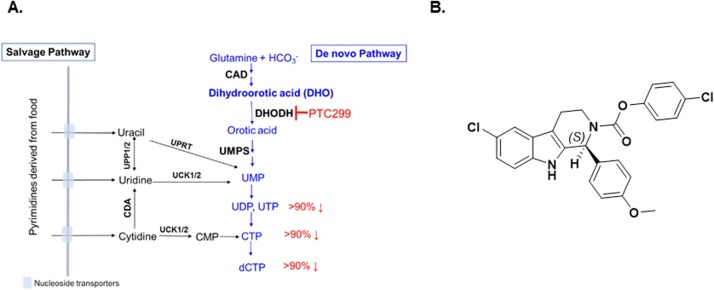
The coronavirus disease 2019 (COVID-19) pandemic has created an urgent need for therapeutics that inhibit the SARS-COV-2 virus and suppress the fulminant inflammation characteristic of advanced illness. Here, we describe the anti-COVID-19 potential of PTC299, an orally bioavailable compound that is a potent inhibitor of dihydroorotate dehydrogenase (DHODH), the rate-limiting enzyme of the de novo pyrimidine nucleotide biosynthesis pathway. In tissue culture, PTC299 manifests robust, dose-dependent, and DHODH-dependent inhibition of SARS-COV-2 replication (EC range, 2.0-31.6 nM) with a selectivity index >3,800. PTC299 also blocked replication of other RNA viruses, including Ebola virus. Consistent with known DHODH requirements for immunomodulatory cytokine production, PTC299 inhibited the production of interleukin (IL)-6, IL-17A (also called IL-17), IL-17 F, and vascular endothelial growth factor (VEGF) in tissue culture models. The combination of anti-SARS-CoV-2 activity, cytokine inhibitory activity, and previously established favorable pharmacokinetic and human safety profiles render PTC299 a promising therapeutic for COVID-19.
2019年冠状病毒病(COVID-19)大流行迫切需要能够抑制严重急性呼吸综合征冠状病毒2(SARS-CoV-2)并抑制重症患者暴发性炎症的治疗药物。在此,我们描述了PTC299的抗COVID-19潜力,PTC299是一种口服生物利用化合物,是从头嘧啶核苷酸生物合成途径的限速酶二氢乳清酸脱氢酶(DHODH)的有效抑制剂。在组织培养中,PTC299对SARS-CoV-2复制表现出强大的、剂量依赖性的和DHODH依赖性抑制作用(有效浓度范围为2.0 - 31.6 nM),选择性指数>3800。PTC299还能阻断包括埃博拉病毒在内的其他RNA病毒的复制。与已知的DHODH对免疫调节细胞因子产生的需求一致,PTC299在组织培养模型中抑制白细胞介素(IL)-6、IL-17A(也称为IL-17)、IL-17F和血管内皮生长因子(VEGF)的产生。抗SARS-CoV-2活性、细胞因子抑制活性以及先前确立的良好药代动力学和人体安全性特征,使PTC299成为一种有前景的COVID-19治疗药物。