Sanmamed Noelia, Alcantara Pino, Cerezo Elena, Gaztañaga Miren, Cabello Noemi, Gómez Sara, Bustos Ana, Doval Anxela, Corona Juan, Rodriguez Gabriel, Duffort Mercedes, Ortuño Francisco, de Castro Javier, Fuentes Manuel Enrique, Sanz Alvaro, López Amanda, Vazquez Manuel
Radiation Oncology Department, Clinico San Carlos Hospital, Madrid, Spain.
Radiation Oncology Department, Clinico San Carlos Hospital, Madrid, Spain; Faculty of Medicine, Complutense University of Madrid, Madrid, Spain.
Int J Radiat Oncol Biol Phys. 2021 Mar 15;109(4):880-885. doi: 10.1016/j.ijrobp.2020.11.049. Epub 2020 Nov 26.
Low-dose radiation therapy (LD-RT) has been shown to have an anti-inflammatory effect, and preliminary results suggest it is feasible to treat patients with coronavirus disease 2019 (COVID-19) pneumonia.
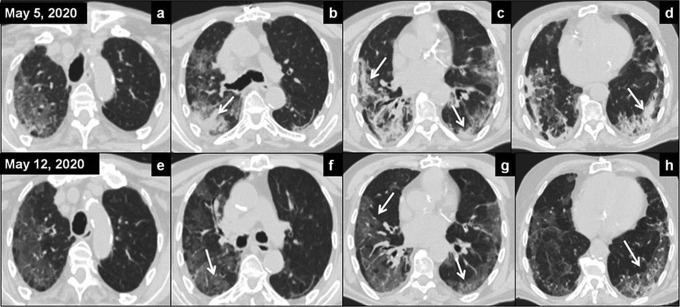
We conducted a prospective, single-arm, phase 1/2 clinical trial enrolling patients aged ≥50 years, who were coronavirus disease 2019 (COVID-19) positive, at phase 2 or 3 with lung involvement at imaging study and oxygen requirement. Patients received 100 cGy to total lungs in a single fraction. Primary outcome was radiologic response using severity and extension score on baseline computed tomography (CT), at days 3 and 7 after LD-RT. Secondary outcomes were toxicity using Common Terminology Criteria for Adverse Events v.5.0, duration of hospitalization, blood work evolution, and oxygen requirements using SatO2/FiO2 index (SAFI), at days 3 and 7 after LD-RT.
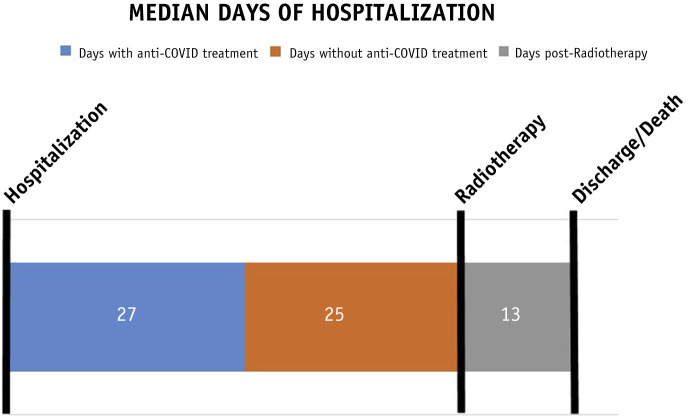
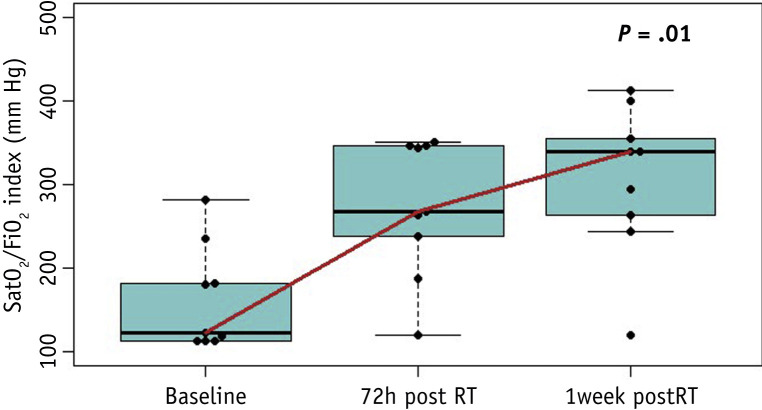
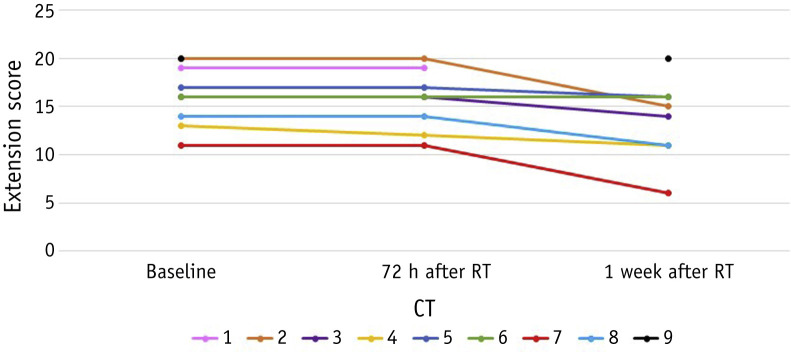
Nine patients were included. Median age was 66 (interquartile range, 57-77). Severity score was stable or decreased in the third CT but was not statistically significant (P = .28); however, there were statistically significant changes in the extension score (P = .03). SAFI index significantly improved 72 hours and 1 week after LD-RT (P = .01). Inflammatory blood parameters decreased 1 week after RT compared with baseline; only lactate dehydrogenase decreased significantly (P = .04). Two patients presented grade 2 lymphopenia after RT and another (with baseline grade 3) worsened to grade 4. Overall, the median number of days of hospitalization was 59 (range, 26-151). After RT the median number of days in the hospital was 13 (range, 4-77). With a median follow-up after RT of 112 days (range, 105-150), 7 patients were discharged and 2 patients died, 1 due to sepsis and the other with severe baseline chronic obstructive pulmonary disease from COVID-19 pneumonia.
Our preliminary results show that LD-RT was a feasible and well-tolerated treatment, with potential clinical improvement. Randomized trials are needed to establish whether LD-RT improves severe pneumonia.
低剂量放射治疗(LD-RT)已被证明具有抗炎作用,初步结果表明,用其治疗2019冠状病毒病(COVID-19)肺炎患者是可行的。
我们开展了一项前瞻性、单臂1/2期临床试验,纳入年龄≥50岁、2019冠状病毒病(COVID-19)检测呈阳性、处于影像学检查显示肺部受累且需要吸氧的2或3期患者。患者单次接受全肺100 cGy照射。主要结局是在基线计算机断层扫描(CT)上以及LD-RT后第3天和第7天使用严重程度和范围评分评估的放射学反应。次要结局是使用《不良事件通用术语标准》第5.0版评估的毒性、住院时间、血液检查结果变化以及在LD-RT后第3天和第7天使用血氧饱和度/吸入氧分数指数(SAFI)评估的吸氧需求。
纳入9例患者。中位年龄为66岁(四分位间距,57 - 77岁)。第三次CT检查时严重程度评分稳定或下降,但差异无统计学意义(P = 0.28);然而,范围评分有统计学显著变化(P = 0.03)。LD-RT后72小时和1周时SAFI指数显著改善(P = 0.01)。放疗后1周与基线相比,炎症血液参数下降;仅乳酸脱氢酶显著下降(P = 0.04)。2例患者放疗后出现2级淋巴细胞减少,另1例(基线为3级)恶化为4级。总体而言,住院天数中位数为59天(范围,26 - 151天)。放疗后住院天数中位数为13天(范围,4 - 77天)。放疗后中位随访112天(范围,105 - 150天),7例患者出院,2例患者死亡,1例死于脓毒症,另1例因COVID-19肺炎合并严重的基线慢性阻塞性肺疾病死亡。
我们的初步结果表明,LD-RT是一种可行且耐受性良好的治疗方法,具有潜在的临床改善效果。需要进行随机试验来确定LD-RT是否能改善重症肺炎。