MRC Centre for Global Infectious Disease Analysis, Imperial College London, London, UK.
Department of Statistics, University of Oxford, Oxford, UK.
PLoS Comput Biol. 2020 Nov 30;16(11):e1008478. doi: 10.1371/journal.pcbi.1008478. eCollection 2020 Nov.
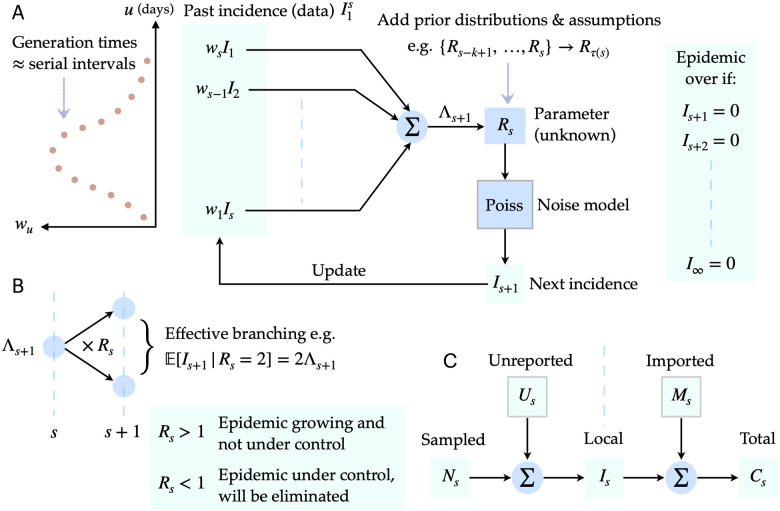
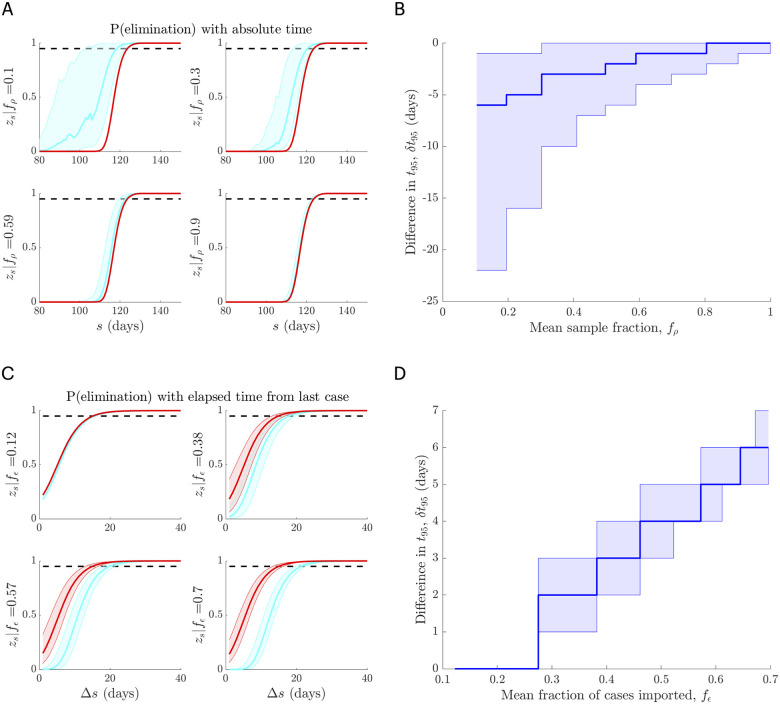
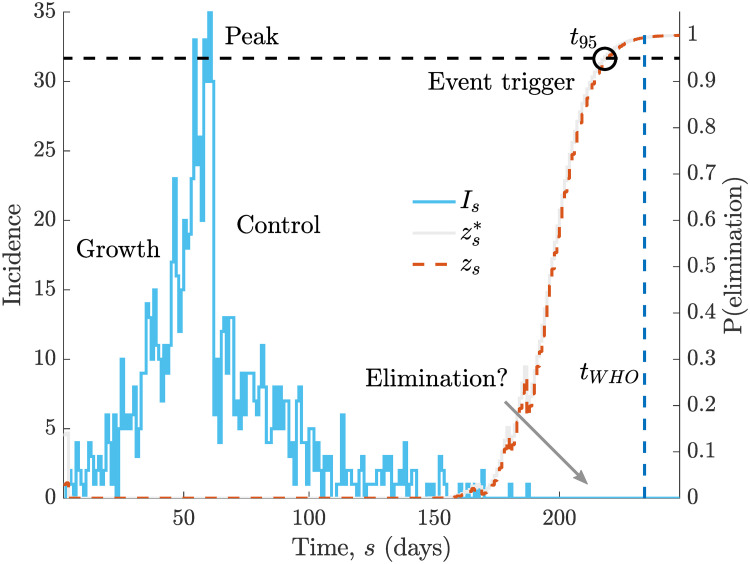
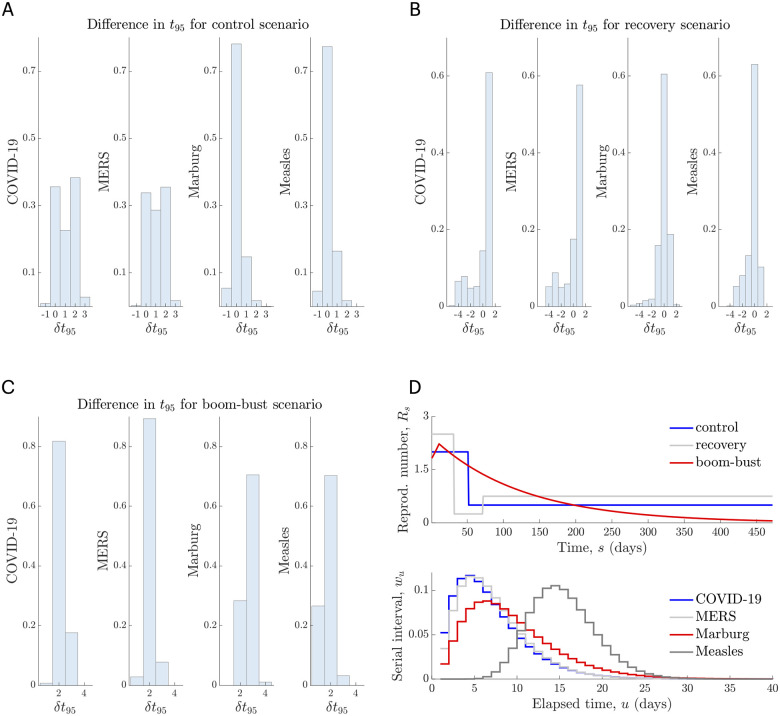
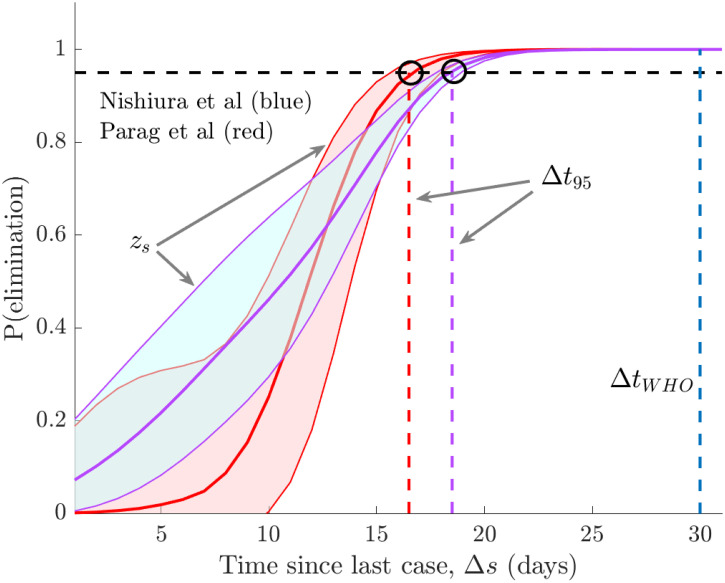
We derive and validate a novel and analytic method for estimating the probability that an epidemic has been eliminated (i.e. that no future local cases will emerge) in real time. When this probability crosses 0.95 an outbreak can be declared over with 95% confidence. Our method is easy to compute, only requires knowledge of the incidence curve and the serial interval distribution, and evaluates the statistical lifetime of the outbreak of interest. Using this approach, we show how the time-varying under-reporting of infected cases will artificially inflate the inferred probability of elimination, leading to premature (false-positive) end-of-epidemic declarations. Contrastingly, we prove that incorrectly identifying imported cases as local will deceptively decrease this probability, resulting in delayed (false-negative) declarations. Failing to sustain intensive surveillance during the later phases of an epidemic can therefore substantially mislead policymakers on when it is safe to remove travel bans or relax quarantine and social distancing advisories. World Health Organisation guidelines recommend fixed (though disease-specific) waiting times for end-of-epidemic declarations that cannot accommodate these variations. Consequently, there is an unequivocal need for more active and specialised metrics for reliably identifying the conclusion of an epidemic.
我们推导出并验证了一种新颖的、分析性的方法,用于实时估计疫情已被消除(即未来不会出现本地病例)的概率。当这个概率超过 0.95 时,可以有 95%的信心宣布疫情结束。我们的方法易于计算,只需要了解发病率曲线和序列间隔分布,并评估相关疫情爆发的统计寿命。通过这种方法,我们展示了受感染病例的时变漏报将如何人为地夸大消除的推断概率,导致过早(假阳性)宣布疫情结束。相反,我们证明将输入病例错误地识别为本地病例会欺骗性地降低这种概率,导致延迟(假阴性)宣布。因此,如果在疫情后期未能维持密集监测,将极大地误导决策者何时可以取消旅行禁令或放宽检疫和社会隔离建议。世界卫生组织的指南建议为疫情结束的声明设定固定(尽管是针对特定疾病的)等待时间,这些时间无法适应这些变化。因此,需要更积极和专门的指标来可靠地确定疫情的结束。