
利用实时建模为刚果民主共和国 2017 年埃博拉疫情应对提供信息。
Using real-time modelling to inform the 2017 Ebola outbreak response in DR Congo.
机构信息
Mathematical Institute, University of Oxford, Oxford, UK.
World Health Organization, Regional Office for Africa, Brazzaville, Democratic Republic of the Congo.
出版信息
Nat Commun. 2024 Jul 6;15(1):5667. doi: 10.1038/s41467-024-49888-5.
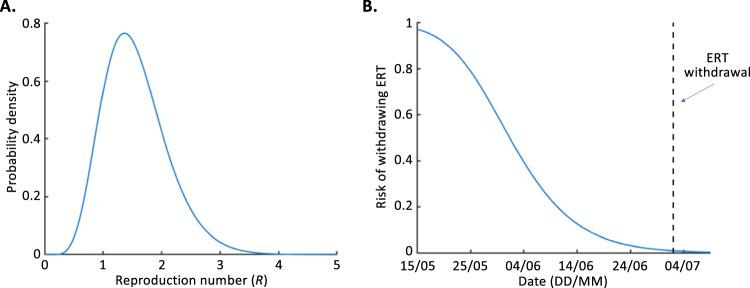
Important policy questions during infections disease outbreaks include: i) How effective are particular interventions?; ii) When can resource-intensive interventions be removed? We used mathematical modelling to address these questions during the 2017 Ebola outbreak in Likati Health Zone, Democratic Republic of the Congo (DRC). Eight cases occurred before 15 May 2017, when the Ebola Response Team (ERT; co-ordinated by the World Health Organisation and DRC Ministry of Health) was deployed to reduce transmission. We used a branching process model to estimate that, pre-ERT arrival, the reproduction number was (95% credible interval ). The risk of further cases occurring without the ERT was estimated to be 0.97 (97%). However, no cases materialised, suggesting that the ERT's measures were effective. We also estimated the risk of withdrawing the ERT in real-time. By the actual ERT withdrawal date (2 July 2017), the risk of future cases without the ERT was only 0.01, indicating that the ERT withdrawal decision was safe. We evaluated the sensitivity of our results to the estimated value and considered different criteria for determining the ERT withdrawal date. This research provides an extensible modelling framework that can be used to guide decisions about when to relax interventions during future outbreaks.
传染病疫情爆发期间的重要政策问题包括
i)特定干预措施的效果如何?;ii)何时可以取消资源密集型干预措施?我们使用数学模型来解决 2017 年刚果民主共和国利卡蒂卫生区埃博拉疫情期间的这些问题。在 2017 年 5 月 15 日埃博拉应对小组(ERT;由世界卫生组织和刚果民主共和国卫生部协调)部署以减少传播之前,发生了 8 例病例。我们使用分支过程模型估计,ERT 到达前,繁殖数为 (95%可信区间 )。如果没有 ERT,进一步发生病例的风险估计为 0.97(97%)。然而,没有病例发生,这表明 ERT 的措施是有效的。我们还实时估计了撤回 ERT 的风险。根据实际的 ERT 撤回日期(2017 年 7 月 2 日),没有 ERT 未来发生病例的风险仅为 0.01,表明 ERT 撤回决定是安全的。我们评估了我们的结果对估计的 值的敏感性,并考虑了确定 ERT 撤回日期的不同标准。这项研究提供了一个可扩展的建模框架,可用于指导未来疫情期间何时放松干预措施的决策。


 Zotero 插件