Department of Obstetrics, Gynecology and Reproductive Medicine, Hospital de Santa Maria, Centro Hospitalar Universitário Lisboa Norte, Lisboa, Portugal.
Rev Bras Ginecol Obstet. 2020 Nov;42(11):712-716. doi: 10.1055/s-0040-1713804. Epub 2020 Nov 30.
To determine whether there was any difference in neonatal and maternal outcomes between breech vaginal delivery and cephalic vaginal delivery.
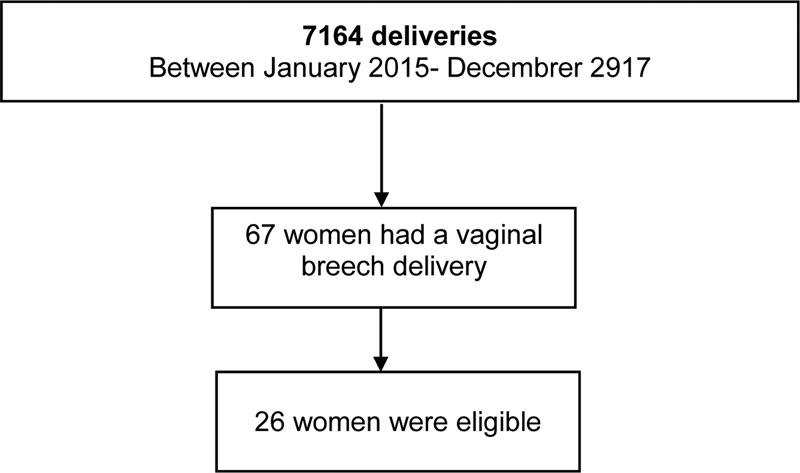
A retrospective, case-control study was conducted between January 2015 and December 2017 in a Portuguese hospital. A total of 26 cases of breech vaginal delivery were considered eligible and 52 pregnant women formed the control group.
Induced labor was more frequent in the breech vaginal delivery group (46% versus 21%, = 0.022). Episiotomy was more common in the breech vaginal delivery group (80% versus 52%, = 0.014), and one woman had a 3 degree perineal laceration. Newborns in the study group had a lower birthweight (2,805 g versus 3,177 g, < 0.001). There was no significant difference in the neonatal outcomes.
The present study showed that breech vaginal delivery at term compared with cephalic presentation was not associated with significant differences in neonatal and maternal morbidity. It also suggests that breech vaginal delivery remains a safe option under strict selection criteria and in the presence of an experienced obstetrician.
比较臀位阴道分娩与头位阴道分娩的新生儿和产妇结局,以明确两者之间是否存在差异。
这是一项回顾性病例对照研究,于 2015 年 1 月至 2017 年 12 月在葡萄牙的一家医院进行。共纳入 26 例臀位阴道分娩病例,将其作为研究组,同期选择 52 例头位阴道分娩的孕妇作为对照组。
研究组中,引产的发生率高于对照组(46%对 21%, = 0.022)。研究组中会阴切开术的发生率高于对照组(80%对 52%, = 0.014),且有 1 例产妇发生 3 度会阴裂伤。研究组新生儿的出生体重较低(2805g 对 3177g, < 0.001)。两组新生儿的结局无显著差异。
本研究表明,与头位分娩相比,足月臀位阴道分娩与新生儿和产妇发病率的增加并无显著相关性。这也提示在严格的选择标准和有经验的产科医生的监护下,臀位阴道分娩仍然是一种安全的选择。