de Clauser Larissa, Luiz Ana P, Santana-Varela Sonia, Wood John N, Sikandar Shafaq
Molecular Nociception Group, Wolfson Institute for Biomedical Research, University College London, London WC1E 6BT, UK.
Wolfson Centre for Age-Related Diseases, Institute of Psychiatry, Psychology and Neuroscience (IoPPN), King's College London, London SE1 1UL, UK.
Cancers (Basel). 2020 Nov 24;12(12):3491. doi: 10.3390/cancers12123491.
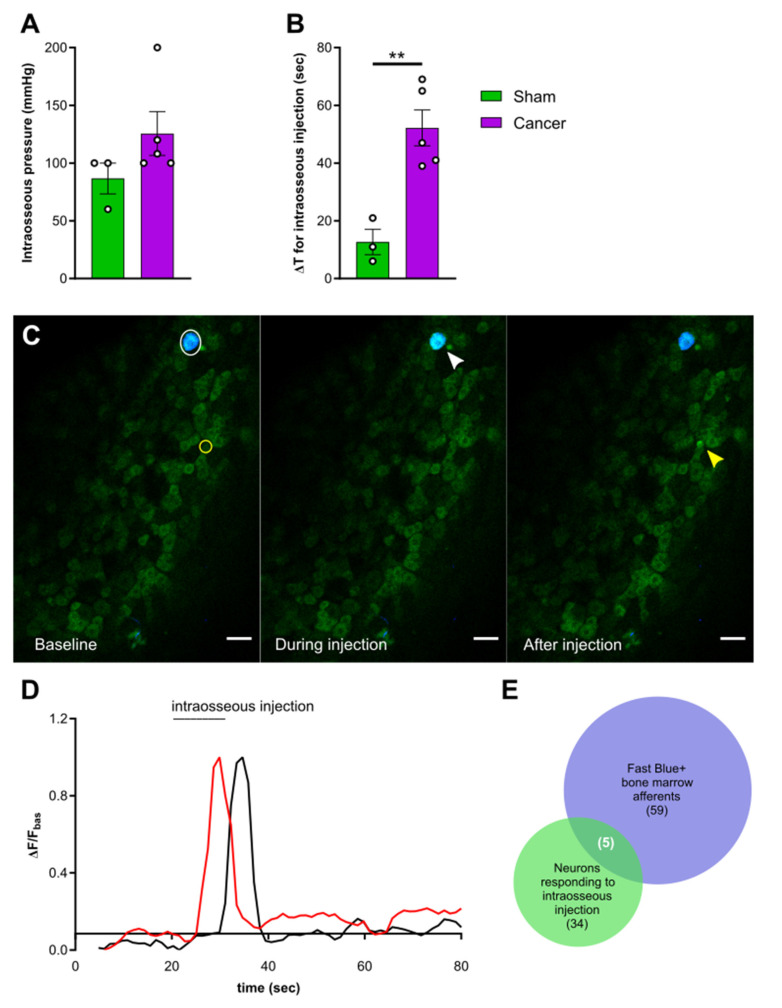
Cancer-induced bone pain (CIBP) is a complex condition, comprising components of inflammatory and neuropathic processes, but changes in the physiological response profiles of bone-innervating and cutaneous afferents remain poorly understood. We used a combination of retrograde labelling and in vivo calcium imaging of bone marrow-innervating dorsal root ganglia (DRG) neurons to determine the contribution of these cells in the maintenance of CIBP. We found a majority of femoral bone afferent cell bodies in L3 dorsal root ganglia (DRG) that also express the sodium channel subtype Na1.8-a marker of nociceptive neurons-and lack expression of parvalbumin-a marker for proprioceptive primary afferents. Surprisingly, the response properties of bone marrow afferents to both increased intraosseous pressure and acid were unchanged by the presence of cancer. On the other hand, we found increased excitability and polymodality of cutaneous afferents innervating the ipsilateral paw in cancer bearing animals, as well as a behavioural phenotype that suggests changes at the level of the DRG contribute to secondary hypersensitivity. This study demonstrates that cutaneous afferents at distant sites from the tumour bearing tissue contribute to mechanical hypersensitivity, highlighting these cells as targets for analgesia.
癌症诱导的骨痛(CIBP)是一种复杂的病症,包括炎症和神经病理性过程的组成部分,但支配骨骼和皮肤传入神经的生理反应特征的变化仍知之甚少。我们结合使用逆行标记和对支配骨髓的背根神经节(DRG)神经元进行体内钙成像,以确定这些细胞在维持CIBP中的作用。我们发现L3背根神经节(DRG)中的大多数股骨传入细胞体也表达钠通道亚型Na1.8(伤害性神经元的标志物),并且不表达小白蛋白(本体感觉初级传入神经的标志物)。令人惊讶的是,癌症的存在并未改变骨髓传入神经对骨内压力增加和酸的反应特性。另一方面,我们发现荷瘤动物中支配同侧爪子的皮肤传入神经的兴奋性增加和多模态性增加,以及一种行为表型,表明DRG水平的变化导致继发性超敏反应。这项研究表明,远离肿瘤组织部位的皮肤传入神经会导致机械性超敏反应,突出了这些细胞作为镇痛靶点的重要性。