Center for Public Health Research, University of Milan-Bicocca, 20900 Monza, Italy.
Value-Based Healthcare Unit, IRCCS Multi Medica, 20099 Sesto San Giovanni, Italy.
Int J Environ Res Public Health. 2020 Nov 24;17(23):8723. doi: 10.3390/ijerph17238723.
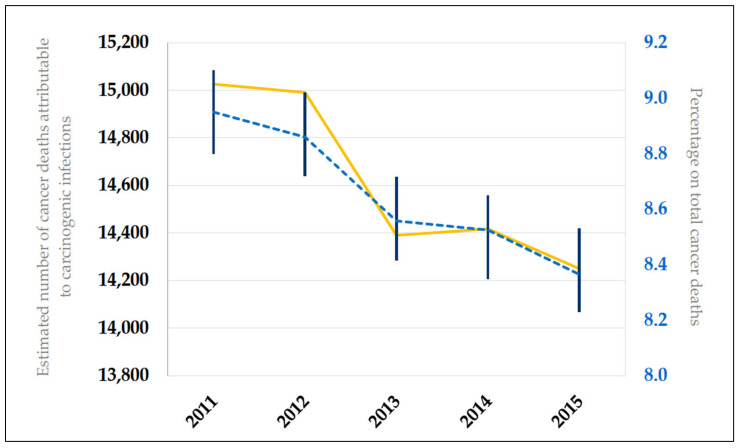
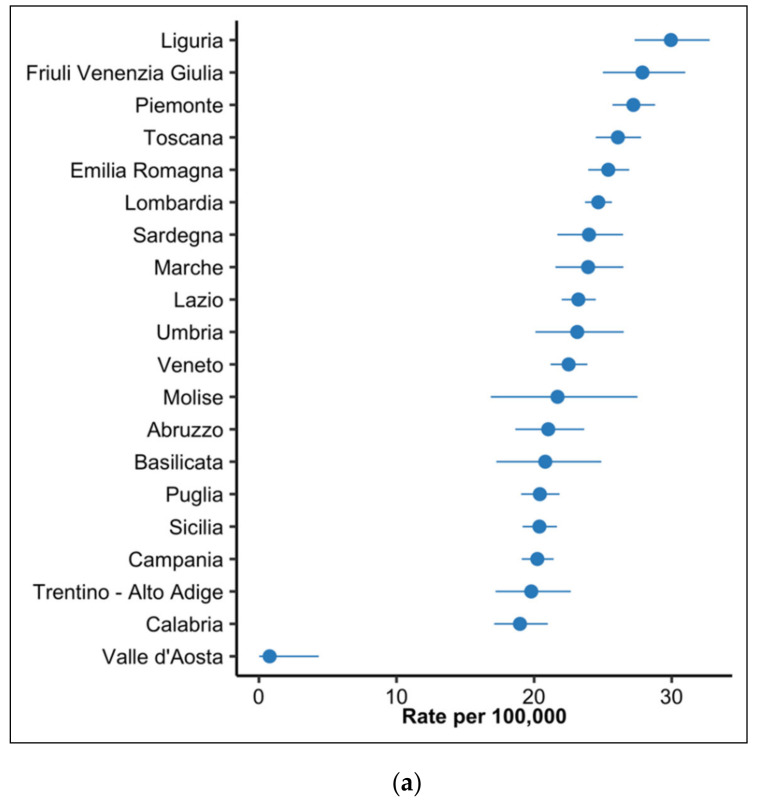
Several infectious agents are ascertained causes of cancer, but the burden of cancer mortality attributable to carcinogenic infections in Italy is still unknown. To tackle this issue, we calculated the rate and regional distribution of cancer deaths due to infections sustained by seven pathogens ranked as group 1 carcinogenic agents in humans by the International Agency for Research on Cancer. Population attributable fractions related to these agents were applied to annual statistics of cancer deaths coded according to the 10th International Classification of Diseases. The estimated burden of cancer mortality attributable to carcinogenic infections in Italy during the period 2011-2015 was 8.7% of all cancer deaths registered yearly, on average. Approximately 60% of deaths occurred in men, and almost the whole burden was due to four infectious agents (, hepatitis C virus, high-risk human papillomavirus, and hepatitis B virus). The analysis of regional distribution showed a higher number of infection-related cancer deaths in the northern regions, where the estimates reached 30 (Liguria) and 28 (Friuli Venezia Giulia) deaths per 100,000 inhabitants in 2015. Since one-twelfth of cancer deaths were attributable to these modifiable risk factors, the implementation of appropriate prevention and treatment interventions may help to reduce the impact of these infections on cancer mortality.
一些传染性病原体已被确定为癌症的致病原因,但意大利因致癌性感染导致的癌症死亡率负担仍不清楚。为了解决这个问题,我们计算了 7 种病原体导致的癌症死亡人数在意大利的比例和地区分布,这些病原体被国际癌症研究机构列为第 1 组致癌物质。将这些病原体的人群归因分数应用于根据第 10 次国际疾病分类编码的每年癌症死亡的统计数据。估计意大利在 2011-2015 年期间因致癌性感染导致的癌症死亡负担占每年登记的所有癌症死亡人数的 8.7%。大约 60%的死亡发生在男性中,几乎所有的负担都归因于 4 种传染病(乙型肝炎病毒、丙型肝炎病毒、高危型人乳头瘤病毒和乙型肝炎病毒)。对地区分布的分析显示,北部地区因感染导致的癌症死亡人数较多,2015 年,该地区每 10 万人中有 30 人(利古里亚)和 28 人(弗留利-威尼斯朱利亚)死于与感染相关的癌症。由于有 1/12 的癌症死亡归因于这些可改变的危险因素,因此实施适当的预防和治疗干预措施可能有助于降低这些感染对癌症死亡率的影响。