Leibniz Institute of Photonic Technology (Leibniz IPHT), Member of Research Alliance "Health Technologies", Albert-Einstein-Straße 9, 07743 Jena, Germany.
Leibniz Institute for Astrophysics Potsdam (AIP), Associated Member of Research Alliance "Health Technologies", An der Sternwarte 16, 14482 Potsdam, Germany.
Sensors (Basel). 2020 Nov 24;20(23):6723. doi: 10.3390/s20236723.
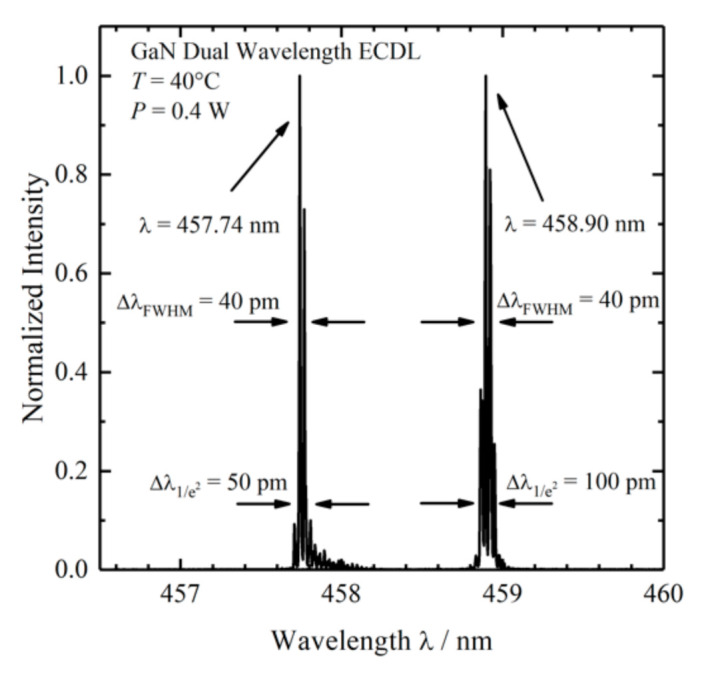
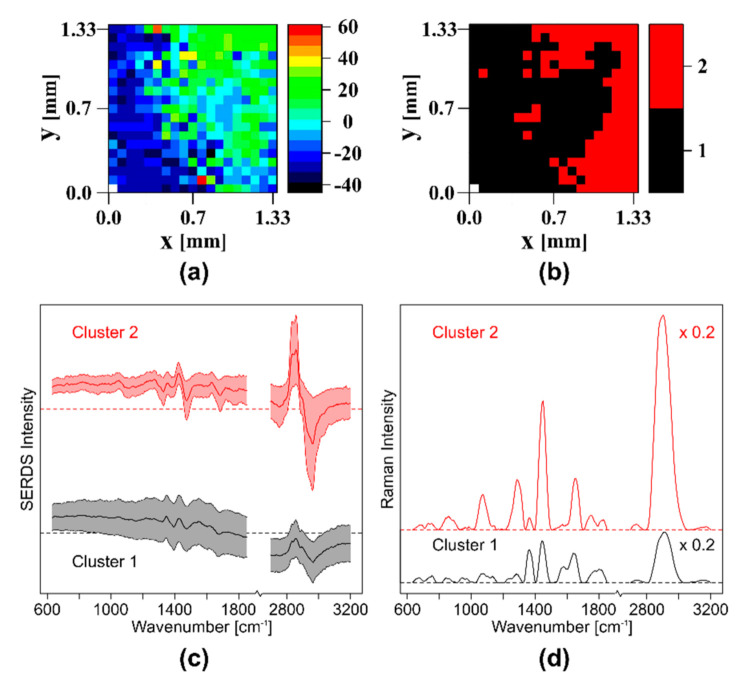
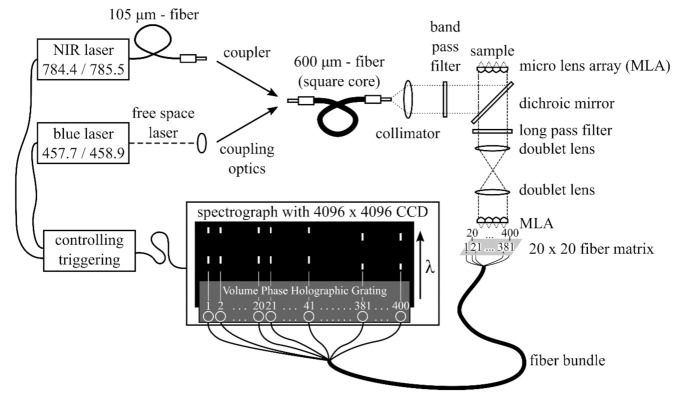
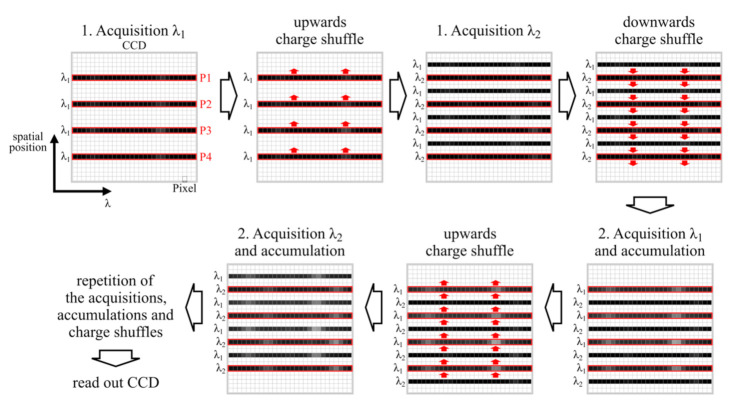
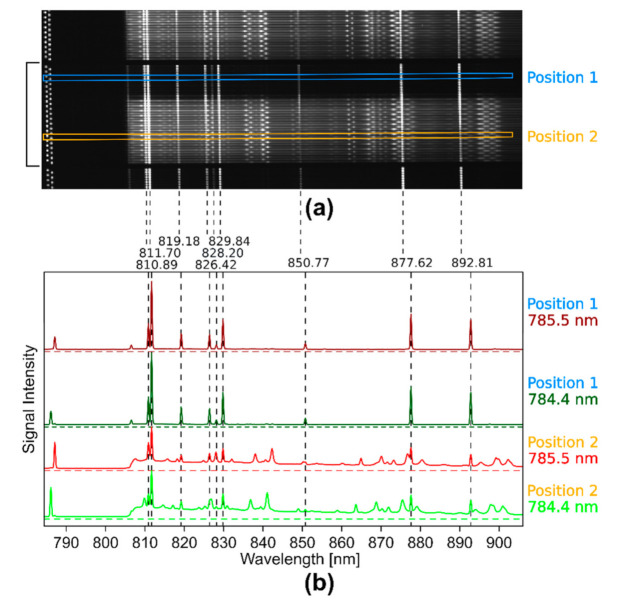
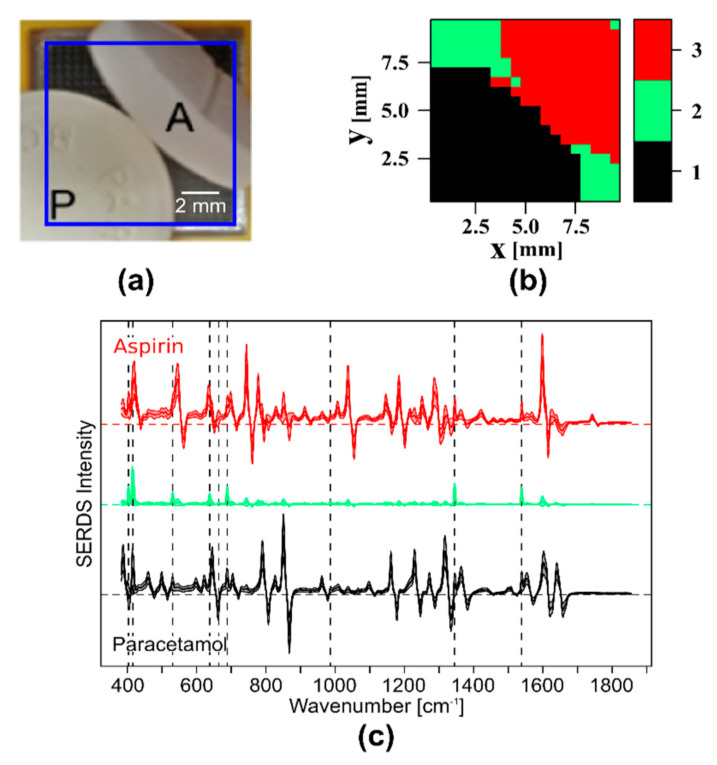
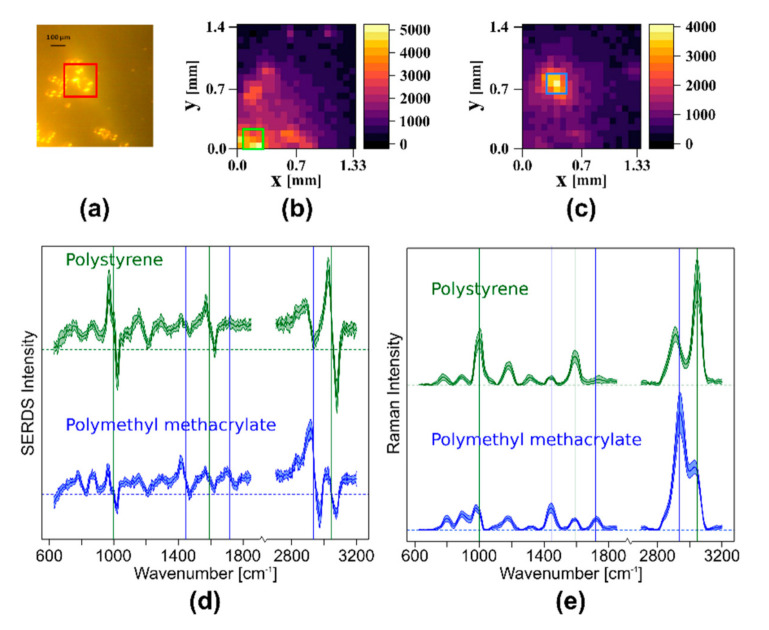
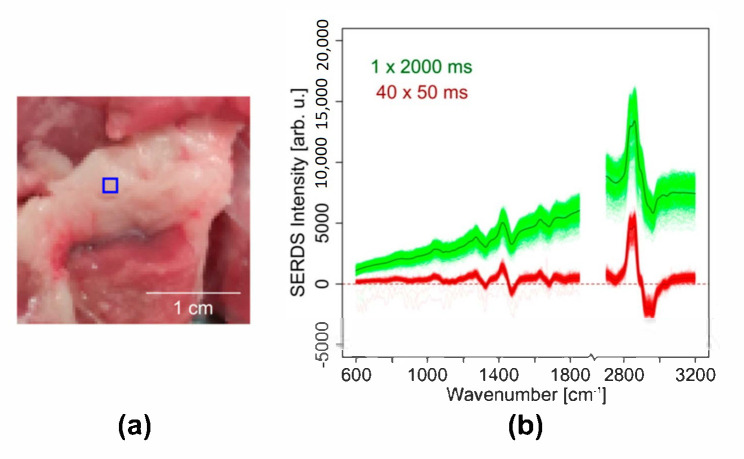
Wide field Raman imaging using the integral field spectroscopy approach was used as a fast, one shot imaging method for the simultaneous collection of all spectra composing a Raman image. For the suppression of autofluorescence and background signals such as room light, shifted excitation Raman difference spectroscopy (SERDS) was applied to remove background artifacts in Raman spectra. To reduce acquisition times in wide field SERDS imaging, we adapted the nod and shuffle technique from astrophysics and implemented it into a wide field SERDS imaging setup. In our adapted version, the nod corresponds to the change in excitation wavelength, whereas the shuffle corresponds to the shifting of charges up and down on a Charge-Coupled Device (CCD) chip synchronous to the change in excitation wavelength. We coupled this improved wide field SERDS imaging setup to diode lasers with 784.4/785.5 and 457.7/458.9 nm excitation and applied it to samples such as paracetamol and aspirin tablets, polystyrene and polymethyl methacrylate beads, as well as pork meat using multiple accumulations with acquisition times in the range of 50 to 200 ms. The results tackle two main challenges of SERDS imaging: gradual photobleaching changes the autofluorescence background, and multiple readouts of CCD detector prolong the acquisition time.
利用积分光谱学方法进行宽场 Raman 成像,作为一种快速的单次成像方法,可同时收集构成 Raman 图像的所有光谱。为了抑制自发荧光和背景信号(如室内光线),应用位移激发 Raman 差谱(SERDS)来去除 Raman 光谱中的背景伪影。为了减少宽场 SERDS 成像中的采集时间,我们从天体物理学中采用了“节”和“混洗”技术,并将其应用于宽场 SERDS 成像设置中。在我们的改编版本中,“节”对应于激发波长的变化,而“混洗”对应于电荷在 CCD 芯片上上下移动,与激发波长的变化同步。我们将这种改进的宽场 SERDS 成像设置与具有 784.4/785.5nm 和 457.7/458.9nm 激发的二极管激光器耦合,并将其应用于扑热息痛和阿司匹林药片、聚苯乙烯和聚甲基丙烯酸甲酯珠以及猪肉等样品,通过多次累积,采集时间在 50 到 200 毫秒之间。结果解决了 SERDS 成像的两个主要挑战:逐渐的光漂白会改变自发荧光背景,而 CCD 探测器的多次读数会延长采集时间。