Professorship Quality of Life, Spirituality and Coping, Faculty of Health, Witten/Herdecke University, 58313, Herdecke, Germany.
IUNCTUS - Competence Center for Christian Spirituality, Philosophical-Theological Academy, 48149, Münster, Germany.
Health Qual Life Outcomes. 2020 Nov 30;18(1):374. doi: 10.1186/s12955-020-01623-6.
During the COVID-19 pandemic, most people had to cope with the restrictions of the lockdown, leaving them to their fears, insecurity and isolation. On the other hand, due to the unexpected 'extra time' there was room for new experiences and for personal reflections on what is essential in life, to perceive nature and relations more consciously etc. We, therefore, intended to analyze perceived changes of attitudes and behaviors during the time of lockdown, and whether these perceptions would contribute to personal wellbeing during the pandemic.
An anonym cross-sectional online survey was performed for data collection, using standardized questionnaires, i.e., the WHO-Five Well-being Index (WHO-5), Brief Multidimensional Life Satisfaction Scale (BMLSS), Awe/Gratitude scale (GrAw-7), and the newly developed Perceived Changes Questionnaire (PCQ).
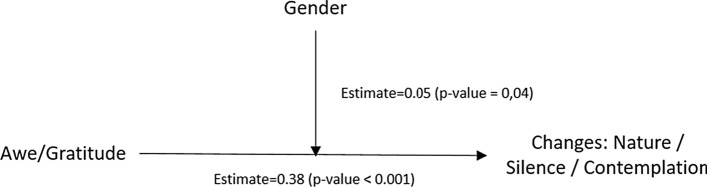
Within the number of respondents (n = 1277), women were predominating (67.5%). Participants' mean age was 50.9 ± 14.9 years. Exploratory factor analyses showed that the 24-item Perceived Changes Questionnaire differentiated five factors that would account for 61% of variance: (1) Nature/Silence/Contemplation (Cronbach's alpha = .87), (2) Spirituality (Cronbach's alpha = .83), (3) Relationships (Cronbach's alpha = .80), (4) Reflection on life (Cronbach's alpha = .74), (5) Digital media usage (Cronbach's alpha = .74). Strongest changes were observed for Relationships and Nature/Silence/Contemplation. Perceived changes were stronger among older persons, among persons with higher wellbeing, and among those who relied on their faith as a resource. These changes were predicted best by a person's perception of wondering awe in distinct situations with subsequent feelings of gratitude. Stepwise regression analyzes revealed that participants' wellbeing was explained best by low perceived burden and high life satisfaction (R = .46). Awe/gratitude, perceived changes in terms of Nature/Silence/Contemplation and low Reflections of live are further variables that would predict a person's wellbeing among the COVID-19 pandemic.
During the Corona pandemic, people tried to find ways to adapt to the outcomes of the restrictions. The perceived changes of attitudes and behaviors can be interpreted in terms of a reappraisal strategy. These can be measured with the extended version of the PCQ which was found to have good quality indices and a plausible factor structure. The reported changes contribute to persons' wellbeing only to some extend, indicating that they represent an independent quality of relevance in peoples' life.
在 COVID-19 大流行期间,大多数人不得不应对封锁的限制,只能任由自己的恐惧、不安全感和孤立感摆布。另一方面,由于意外的“额外时间”,人们有机会获得新的体验,并对生活中的基本要素进行个人反思,更有意识地感知自然和人际关系等。因此,我们旨在分析封锁期间态度和行为的感知变化,以及这些变化是否会对大流行期间的个人幸福感产生影响。
我们进行了一项匿名的横断面在线调查,以收集数据,使用了标准化问卷,即世界卫生组织五维度健康指数(WHO-5)、简要多维生活满意度量表(BMLSS)、敬畏/感激量表(GrAw-7)和新开发的感知变化问卷(PCQ)。
在应答者人数(n=1277)中,女性占主导地位(67.5%)。参与者的平均年龄为 50.9±14.9 岁。探索性因素分析表明,24 项感知变化问卷区分了五个因素,可解释 61%的方差:(1)自然/安静/沉思(Cronbach's alpha=0.87),(2)灵性(Cronbach's alpha=0.83),(3)人际关系(Cronbach's alpha=0.80),(4)对生活的反思(Cronbach's alpha=0.74),(5)数字媒体使用(Cronbach's alpha=0.74)。变化最明显的是人际关系和自然/安静/沉思。幸福感较高、依赖信仰作为资源的老年人感知到的变化更大。这些变化最好地预测了一个人在不同情况下对奇妙敬畏的感知,以及随后的感激之情。逐步回归分析表明,参与者的幸福感最佳由低感知负担和高生活满意度解释(R=0.46)。敬畏/感激、感知到的自然/安静/沉思的变化以及对生活的低反思是预测 COVID-19 大流行期间一个人幸福感的进一步变量。
在冠状病毒大流行期间,人们试图找到适应限制后果的方法。态度和行为的感知变化可以从重新评估策略的角度来解释。这些可以用扩展后的 PCQ 进行测量,该问卷具有良好的质量指标和合理的因素结构。报告的变化仅在一定程度上有助于人们的幸福感,这表明它们代表了人们生活中一个独立的重要质量。