NORMENT, Division of Mental Health and Addiction, Oslo University Hospital & Institute of Clinical Medicine, University of Oslo, Oslo, Norway.
Department of Psychology, Faculty of Social Sciences, University of Oslo, Oslo, Norway.
Transl Psychiatry. 2020 Nov 30;10(1):416. doi: 10.1038/s41398-020-01094-9.
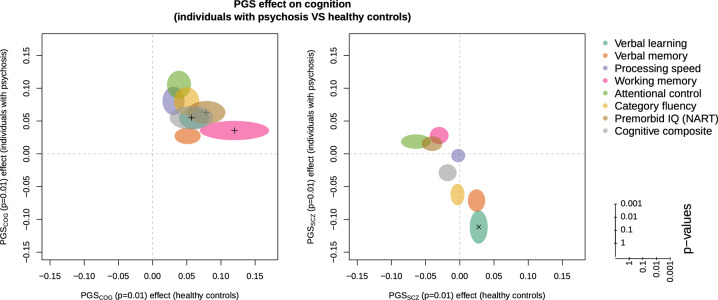
Cognitive impairments are considered core features in schizophrenia and other psychotic disorders. Cognitive impairments are, to a lesser degree, also documented in healthy first-degree relatives. Although recent studies have shown (negative) genetic correlations between schizophrenia and general cognitive ability, the association between polygenic risk for schizophrenia and individual cognitive phenotypes remains unclear. We here investigated the association between a polygenic score for schizophrenia (SCZ) and six well-defined cognitive domains, in addition to a composite measure of cognitive ability and a measure of premorbid intellectual ability in 731 participants with a psychotic disorder and 851 healthy controls. We also investigated the association between a PGS for general cognitive ability (COG) and the same cognitive domains in the same sample. We found no significant associations between the SCZ and any cognitive phenotypes, in either patients with a psychotic disorder or healthy controls. For COG we observed stronger associations with cognitive phenotypes in healthy controls than in participants with psychotic disorders. In healthy controls, the association between COG (at the p value threshold of ≥0.01) and working memory remained significant after Bonferroni correction (β = 0.12, p = 8.6 × 10). Altogether, the lack of associations between SCZ and COG with cognitive performance in participants with psychotic disorders suggests that either environmental factors or unassessed genetic factors play a role in the development of cognitive impairments in psychotic disorders. Working memory should be further studied as an important cognitive phenotype.
认知障碍被认为是精神分裂症和其他精神病性障碍的核心特征。认知障碍在健康的一级亲属中也有一定程度的记录。尽管最近的研究表明精神分裂症和一般认知能力之间存在(负)遗传相关性,但精神分裂症多基因风险与个体认知表型之间的关联仍不清楚。我们在这里调查了精神分裂症多基因评分(SCZ)与六个明确定义的认知领域之间的关联,以及在 731 名精神障碍患者和 851 名健康对照者中认知能力的综合衡量标准和认知前智力能力的衡量标准。我们还调查了一般认知能力多基因评分(COG)与同一样本中相同认知领域之间的关联。我们没有发现 SCZ 与任何认知表型之间存在显著关联,无论是在精神障碍患者还是健康对照者中。对于 COG,我们在健康对照组中观察到与认知表型的关联强于精神障碍患者。在健康对照组中,COG(在 p 值阈值≥0.01)与工作记忆之间的关联在经过 Bonferroni 校正后仍然显著(β=0.12,p=8.6×10)。总之,精神障碍患者中 SCZ 和 COG 与认知表现之间缺乏关联表明,环境因素或未评估的遗传因素在精神障碍中认知障碍的发展中发挥作用。工作记忆应该作为一个重要的认知表型进一步研究。