Department of Genetics, University of Alabama at Birmingham, Birmingham, Alabama, United States of America.
Department of Cell, Developmental and Integrative Biology, University of Alabama at Birmingham, Birmingham, Alabama, United States of America.
PLoS One. 2020 Dec 1;15(12):e0242021. doi: 10.1371/journal.pone.0242021. eCollection 2020.
Oral drugs can have side effects such as diarrhea that indicate the perturbation of the gut microbial community. To further understand the dynamics of perturbation, we have assessed the strain relatedness of samples from previously published data sets from pre and post bowel evacuation, episodes of diarrhea, and administration of oral drugs to treat diabetes and rheumatoid arthritis.
We analyzed a total of published five data sets using our strain-tracking tool called Window-based Single Nucleotide Variant (SNV) Similarity (WSS) to identify related strains from the same individual.
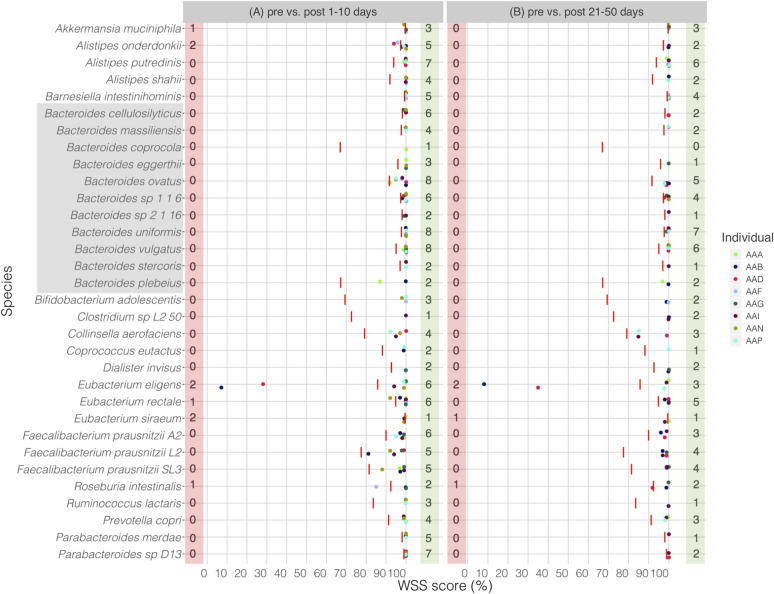
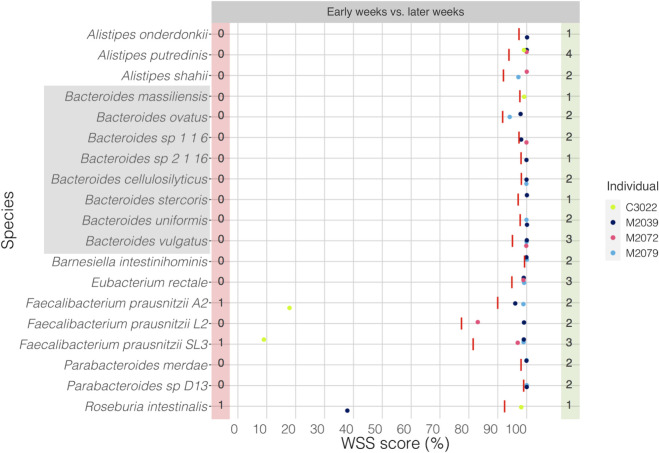
Strain-tracking analysis using the first data set from 8 individuals pre and 21-50 days post iso-osmotic bowel wash revealed almost all microbial strains were related in an individual between pre and post samples. Similarly, in a second study, strain-tracking analysis of 4 individuals pre and post sporadic diarrhea revealed the majority of strains were related over time (up to 44 weeks). In contrast, the analysis of a third data set from 22 individuals pre and post 3-day exposure of oral metformin revealed that no individuals had a related strain. In a fourth study, the data set taken at 2 and 4 months from 38 individuals on placebo or metformin revealed individual specific sharing of pre and post strains. Finally, the data set from 18 individuals with rheumatoid arthritis given disease-modifying antirheumatic drugs methotrexate or glycosides of the traditional Chinese medicinal component Tripterygium wilfordii showed individual specific sharing of pre and post strains up to 16 months.
Oral drugs used to treat chronic disease can result in individual specific microbial strain change for the majority of species. Since the gut community provides essential functions for the host, our study supports personalized monitoring to assess the status of the dominant microbial strains after initiation of oral drugs to treat chronic disease.
口服药物可能会产生腹泻等副作用,表明肠道微生物群落受到了干扰。为了进一步了解扰动的动态,我们评估了先前发表的来自预排便和后排便、腹泻发作以及使用口服药物治疗糖尿病和类风湿关节炎的数据集中的样本的菌株相关性。
我们使用我们的菌株跟踪工具,即基于窗口的单核苷酸变异(SNV)相似性(WSS),分析了总共五个已发表的数据集中的样本,以从同一个体中识别相关菌株。
使用来自 8 个个体的第一个数据集的菌株跟踪分析,这些个体在等渗性肠道冲洗前和 21-50 天后,结果显示在个体中,几乎所有微生物菌株在前后样本之间都是相关的。同样,在第二项研究中,对 4 个个体的菌株跟踪分析显示,在随机腹泻前后,大多数菌株随时间变化(最多 44 周)都是相关的。相比之下,对来自 22 个个体的第三个数据集的分析显示,在 3 天暴露于口服二甲双胍前后,没有个体具有相关的菌株。在第四项研究中,来自 38 个接受安慰剂或二甲双胍的个体的 2 个月和 4 个月的数据显示,个体具有特定的前后菌株共享。最后,来自 18 个接受类风湿关节炎疾病修饰抗风湿药物甲氨蝶呤或中药雷公藤成分糖苷的个体的数据显示,在 16 个月内,个体具有特定的前后菌株共享。
用于治疗慢性疾病的口服药物可能导致大多数物种的个体特异性微生物菌株变化。由于肠道群落为宿主提供了必要的功能,我们的研究支持个性化监测,以评估口服药物治疗慢性疾病后主要微生物菌株的状态。