Department of Genetics Hugh Kaul Personalized Medicine Institute, University of Alabama at Birmingham, Alabama, Birmingham, USA.
Department of Cell, Developmental and Integrative Biology Hugh Kaul Personalized Medicine Institute, University of Alabama at Birmingham, Alabama, Birmingham, USA.
BMC Microbiol. 2021 Sep 20;21(1):251. doi: 10.1186/s12866-021-02312-0.
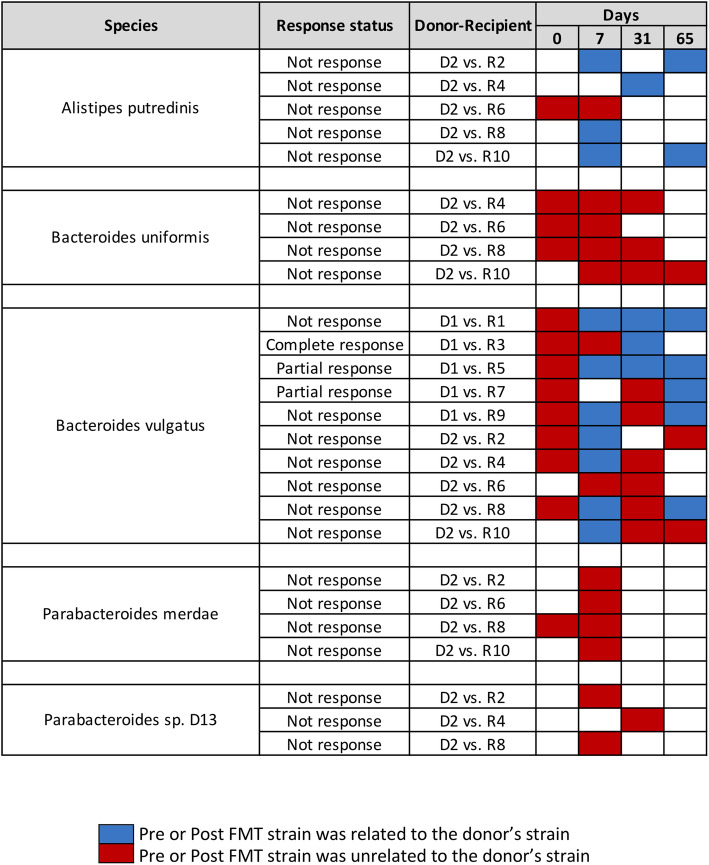
To understand inter-individual variability of fecal microbe transplantation (FMT) to enhance anti-PD-1 immunotherapy (IT) for melanoma, we analyzed the data sets from two recent publications with a microbial strain-tracking tool to determine if donor strains were dominant in the recipient feces following FMT.
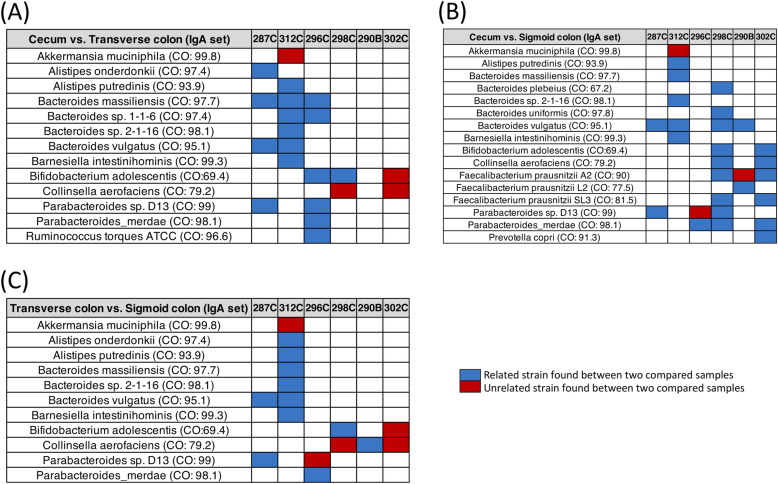
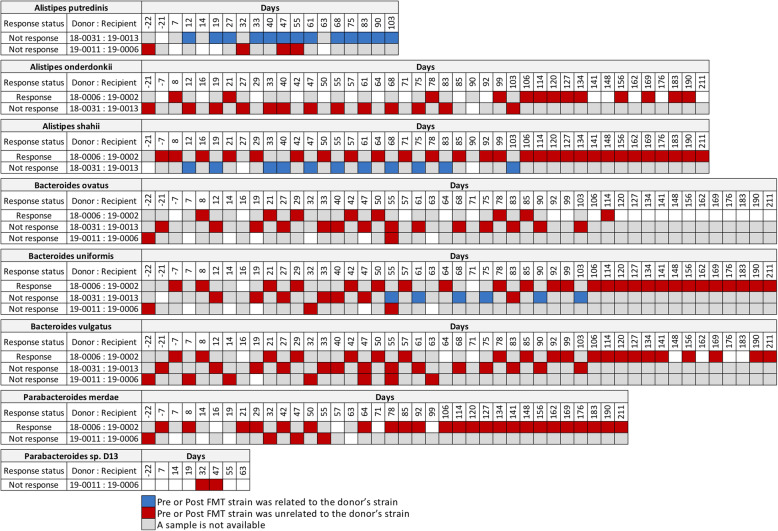
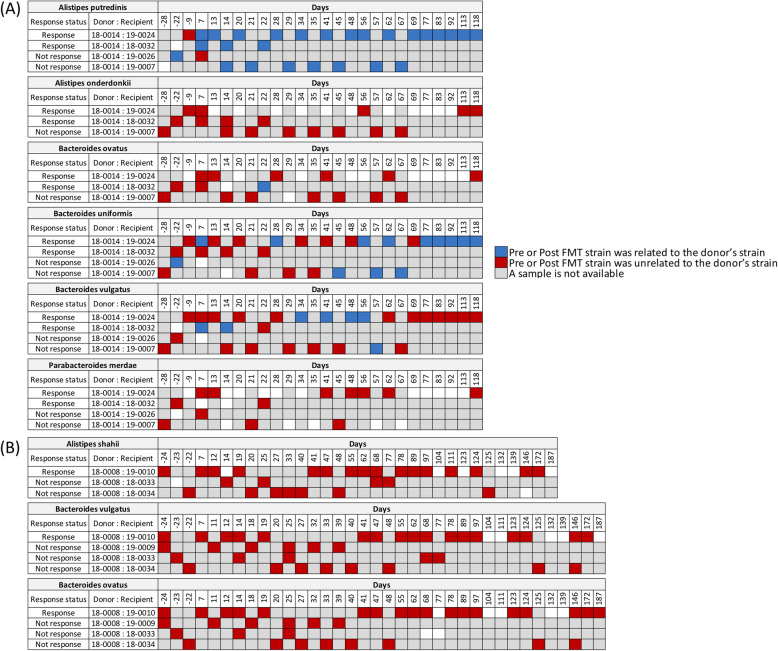
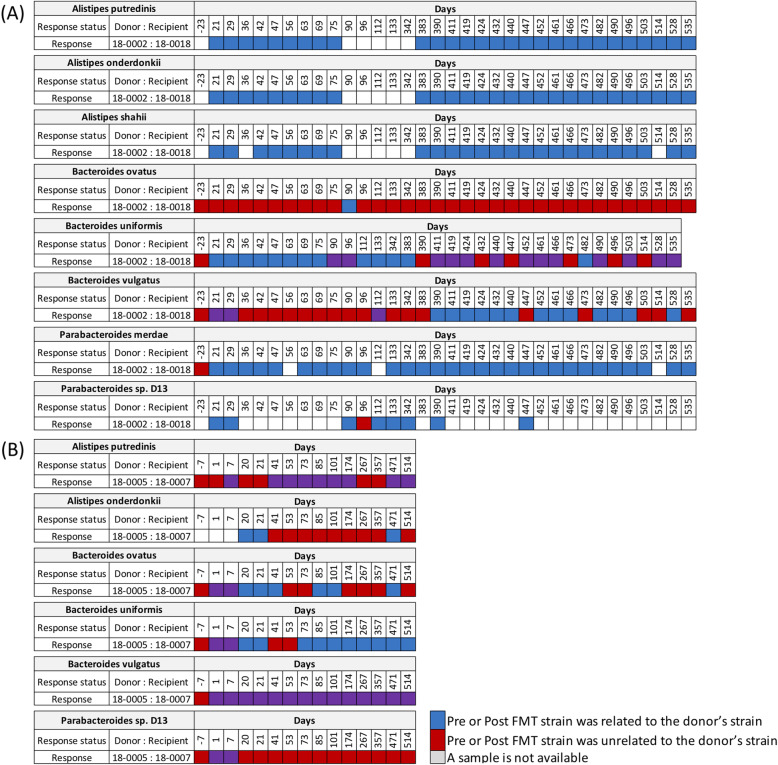
Analysis of the Baruch et al. data set found that the presence of commensal donor microbes in recipient feces post-FMT did not correlate with the patient response to IT. From the Davar et al., data set, we found 4 patients that responded to IT had donor's related strain post-FMT, while 2 patients that did not respond to the IT also had donor's strain post-FMT. Importantly, we identified no donor microbes in the feces in one recipient post-FMT that responded to IT. Furthermore, in depth analysis from two patients who responded to IT revealed both donor and recipient strains at different times post-FMT. Colonization of the gastrointestinal tract niches is important for the interaction with the host immune system. Using a separate data set, we show that mucosa from the cecum, transverse colon, and sigmoid colon share strains, providing a large reservoir of niches containing recipient microbes.
We demonstrated using strain-tracking analysis individual variation with the respect to the presence of fecal dominant donor microbes in the recipient following FMT that did not correlate with the response to anti-PD-1 immunotherapy. The inter-individual differences of FMT to enhance IT might be explained by the variability of the donor microbes to occupy and outcompete recipient microbes for the gastrointestinal niches. The result from our study supports the use of new approaches to clear the niches in the gastrointestinal tract to promote donor colonization to reduce inter-individual variability of IT for melanoma and potentially other cancers.
为了了解粪便微生物移植(FMT)的个体间变异性,以增强抗 PD-1 免疫疗法(IT)治疗黑色素瘤的效果,我们使用一种微生物菌株跟踪工具分析了最近的两项研究的数据,以确定供体菌株在 FMT 后是否在受体粪便中占优势。
对 Baruch 等人的数据集进行分析发现,FMT 后受体粪便中共生供体微生物的存在与 IT 患者的反应无相关性。从 Davar 等人的数据集中,我们发现 4 名对 IT 有反应的患者在 FMT 后有供体相关菌株,而 2 名对 IT 无反应的患者在 FMT 后也有供体菌株。重要的是,我们在一名对 IT 有反应的患者的粪便中未发现供体微生物。此外,对两名对 IT 有反应的患者进行深入分析显示,在 FMT 后不同时间存在供体和受体菌株。胃肠道龛位的定植对于与宿主免疫系统的相互作用很重要。使用另一个数据集,我们表明回肠、横结肠和乙状结肠的黏膜共享菌株,为含有受体微生物的大量龛位提供了储备。
我们使用菌株跟踪分析表明,FMT 后受体粪便中存在占优势的供体微生物的个体间差异与抗 PD-1 免疫疗法的反应无关。FMT 增强 IT 的个体间差异可能是由于供体微生物占据和竞争受体微生物的胃肠道龛位的能力存在差异所致。我们的研究结果支持使用新方法清除胃肠道龛位,以促进供体定植,从而减少黑色素瘤和潜在其他癌症的 IT 个体间变异性。