Cognitive Neuroscience, Institute of Neuroscience and Medicine (INM-3), Research Centre Juelich, Juelich, Germany.
Department of Neurology, Faculty of Medicine and University Hospital Cologne, University of Cologne, Cologne, Germany.
Sci Rep. 2020 Dec 1;10(1):20977. doi: 10.1038/s41598-020-77744-1.
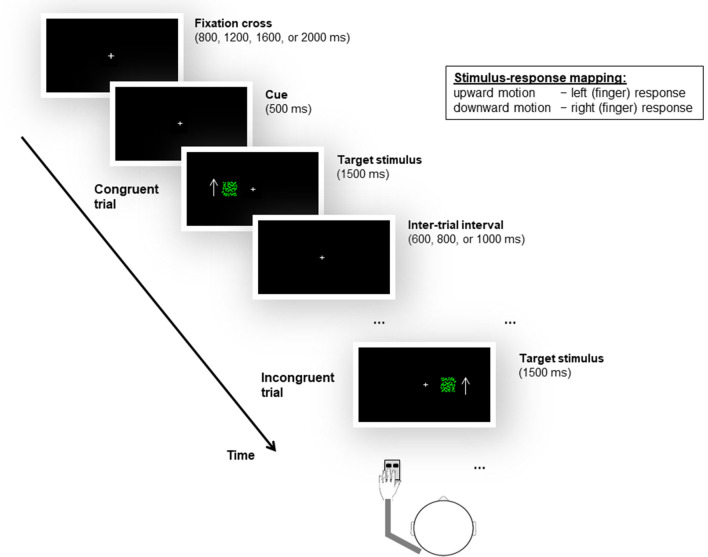
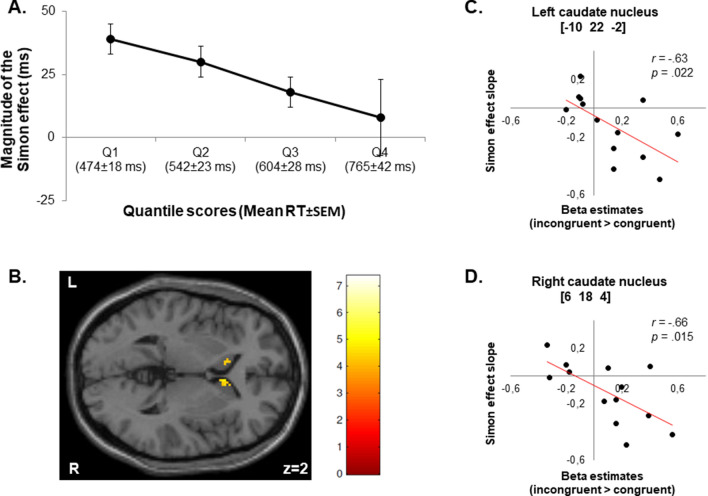
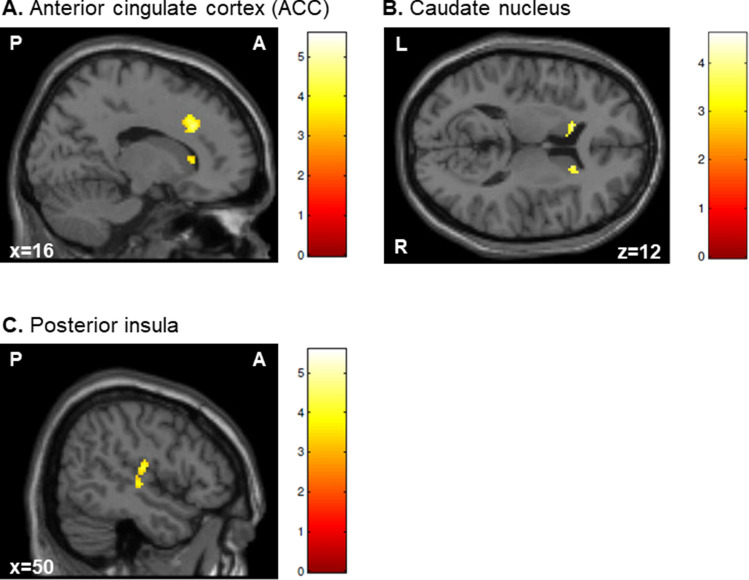
While the role of cortical regions in cognitive control processes is well accepted, the contribution of subcortical structures (e.g., the striatum), especially to the control of response interference, remains controversial. Therefore, the present study aimed to investigate the cortical and particularly subcortical neural mechanisms of response interference control (including selective inhibition). Thirteen healthy young participants underwent event-related functional magnetic resonance imaging while performing a unimanual version of the Simon task. In this task, successful performance required the resolution of stimulus-response conflicts in incongruent trials by selectively inhibiting interfering response tendencies. The behavioral results show an asymmetrical Simon effect that was more pronounced in the contralateral hemifield. Contrasting incongruent trials with congruent trials (i.e., the overall Simon effect) significantly activated clusters in the right anterior cingulate cortex, the right posterior insula, and the caudate nucleus bilaterally. Furthermore, a region of interest analysis based on previous patient studies revealed that activation in the bilateral caudate nucleus significantly co-varied with a parameter of selective inhibition derived from distributional analyses of response times. Our results corroborate the notion that the cognitive control of response interference is supported by a fronto-striatal circuitry, with a functional contribution of the caudate nucleus to the selective inhibition of interfering response tendencies.
虽然皮质区域在认知控制过程中的作用已被广泛接受,但皮质下结构(例如纹状体)的贡献,尤其是对反应干扰的控制,仍然存在争议。因此,本研究旨在探讨反应干扰控制(包括选择性抑制)的皮质,特别是皮质下的神经机制。13 名健康年轻参与者在执行单侧西蒙任务时进行了事件相关功能磁共振成像。在这个任务中,成功的表现需要在不一致的试验中通过选择性地抑制干扰反应倾向来解决刺激反应冲突。行为结果显示出一种非对称的西蒙效应,在对侧视野中更为明显。与一致试验相比,不一致试验(即总体西蒙效应)显著激活了右侧前扣带皮层、右侧后岛叶和双侧尾状核的簇。此外,基于先前的患者研究的感兴趣区域分析表明,双侧尾状核的激活与从反应时间分布分析得出的选择性抑制参数显著相关。我们的结果证实了这样一种观点,即反应干扰的认知控制是由额纹状体回路支持的,尾状核对干扰反应倾向的选择性抑制具有功能贡献。