School of Health and Social Care, London South Bank University, 103 Borough Road, London, SE1 OAA, UK.
Stroke Research Centre, UCL Institute of Neurology, First Floor, Russell Square House, 10-12 Russell Square, London, WC1B 5EH, UK.
Neurocrit Care. 2021 Aug;35(1):162-171. doi: 10.1007/s12028-020-01145-5. Epub 2020 Dec 2.
Clinicians working in intensive care frequently report perceptions of inappropriate care (PIC) situations. Intracerebral haemorrhage (ICH) is associated with high rates of mortality and morbidity. Prognosticating after ICH is complex and may be influenced by clinicians' subjective impressions and biases, which may, in turn, influence decision making regarding the level of care provided. The aim of this study was to qualitatively explore perceptions of neurocritical care in relation to the expected functional outcome for ICH patients.
Qualitative study using semi-structured interviews with neurocritical care doctors and nurses.
Neurocritical care (NCC) department in a UK neuroscience tertiary referral center.
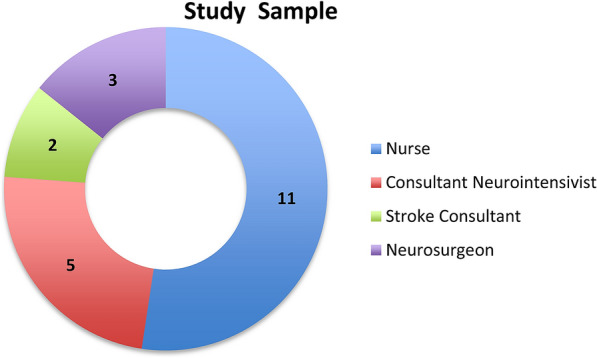
Eleven neurocritical care nurses, five consultant neurointensivists, two stroke physicians, three neurosurgeons.
None.
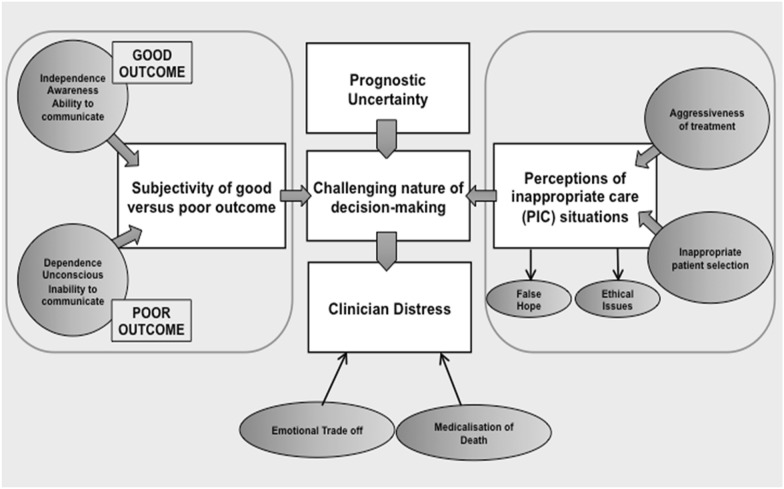
We conducted 21 semi-structured interviews and identified five key themes: (1) prognostic uncertainty (2) subjectivity of good versus poor outcome (3) perceived inappropriate care (PIC) situations (including for frail elderly patients) (4) challenging nature of decision-making (5) clinician distress.
Caring for severely affected ICH patients in need of neurocritical care is challenging, particularly with frail elderly patients. Awareness of the challenges could facilitate interventions to improve decision-making for this group of stroke patients and their families, as well as measures to reduce the distress on clinicians who care for this patient group. Our findings highlight the need for effective interdisciplinary shared decision making involving the family, taking into account patients' previously expressed values and preferences and incorporating these into bespoke care planning.
在重症监护病房工作的临床医生经常报告存在不当护理(PIC)情况的感知。脑出血(ICH)与高死亡率和高发病率相关。ICH 后的预后评估复杂,可能受到临床医生主观印象和偏见的影响,而这些偏见又可能影响提供护理水平的决策。本研究旨在从定性角度探讨神经重症监护与 ICH 患者预期功能结果的关系。
使用神经重症监护医生和护士的半结构式访谈进行定性研究。
英国神经科学三级转诊中心的神经重症监护病房(NCC)。
11 名神经重症监护护士、5 名顾问神经科医生、2 名中风医生、3 名神经外科医生。
无。
我们进行了 21 次半结构式访谈,确定了五个关键主题:(1)预后不确定性;(2)良好与不良结局的主观性;(3)感知到的不当护理(PIC)情况(包括体弱的老年患者);(4)决策的挑战性;(5)临床医生的困扰。
为需要神经重症监护的重症 ICH 患者提供护理具有挑战性,尤其是对于体弱的老年患者。意识到这些挑战可以促进干预措施,以改善这组中风患者及其家属的决策,并采取措施减轻照顾这群患者的临床医生的困扰。我们的研究结果强调了需要有效的跨学科共同决策,包括患者家属,同时考虑到患者之前表达的价值观和偏好,并将这些纳入定制的护理计划中。