Inria, Paris, France.
HeartFlow Inc., Redwood City, USA.
Ann Biomed Eng. 2021 May;49(5):1432-1447. doi: 10.1007/s10439-020-02681-z. Epub 2020 Dec 1.
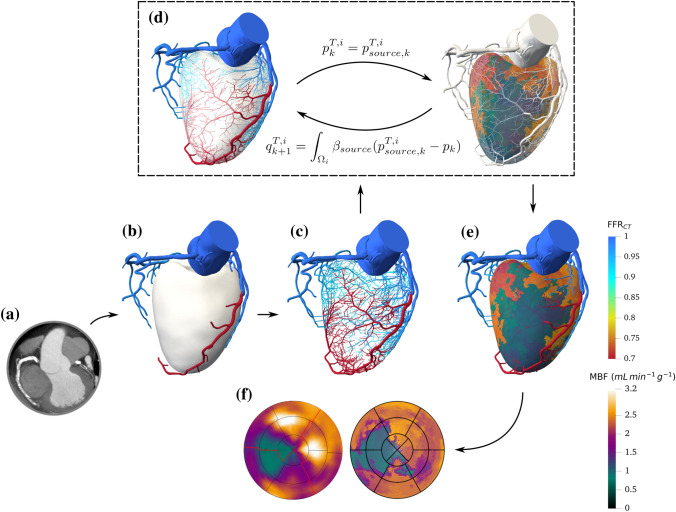
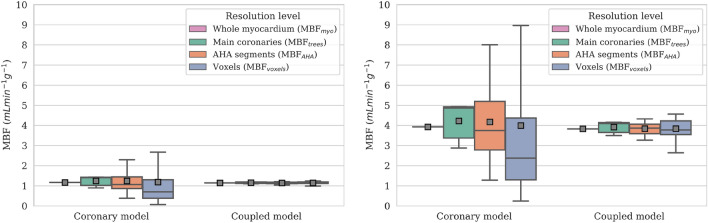
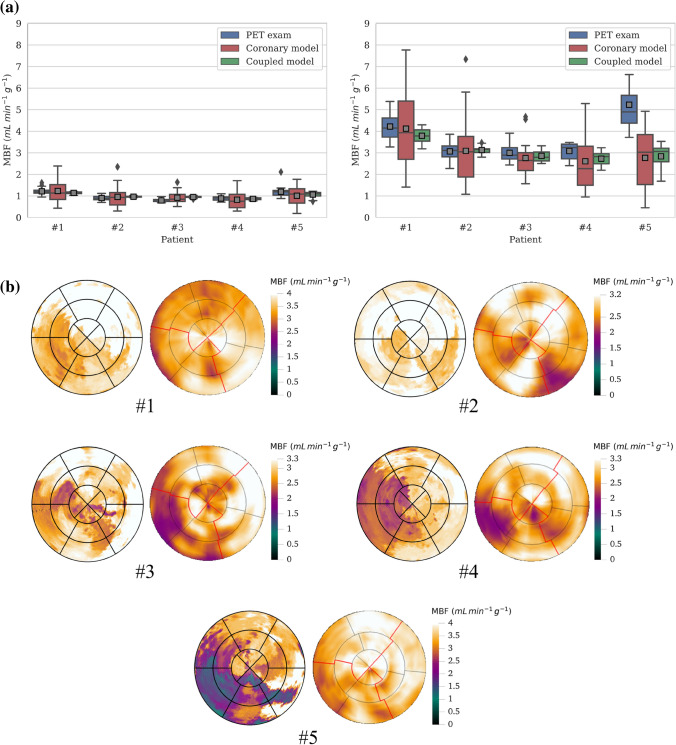
Patient-specific models of blood flow are being used clinically to diagnose and plan treatment for coronary artery disease. A remaining challenge is bridging scales from flow in arteries to the micro-circulation supplying the myocardium. Previously proposed models are descriptive rather than predictive and have not been applied to human data. The goal here is to develop a multiscale patient-specific model enabling blood flow simulation from large coronary arteries to myocardial tissue. Patient vasculatures are segmented from coronary computed tomography angiography data and extended from the image-based model down to the arteriole level using a space-filling forest of synthetic trees. Blood flow is modeled by coupling a 1D model of the coronary arteries to a single-compartment Darcy myocardium model. Simulated results on five patients with non-obstructive coronary artery disease compare overall well to [[Formula: see text]O][Formula: see text]O PET exam data for both resting and hyperemic conditions. Results on a patient with severe obstructive disease link coronary artery narrowing with impaired myocardial blood flow, demonstrating the model's ability to predict myocardial regions with perfusion deficit. This is the first report of a computational model for simulating blood flow from the epicardial coronary arteries to the left ventricle myocardium applied to and validated on human data.
目前临床上正在使用针对血流的患者特定模型来诊断和计划治疗冠状动脉疾病。但仍存在一个挑战,即需要在从动脉内的血流到为心肌供血的微循环之间进行尺度转换。以前提出的模型具有描述性而不是预测性,并且尚未应用于人体数据。本研究旨在开发一种多尺度的患者特定模型,以便能够从大冠状动脉模拟血流到心肌组织。通过使用合成树的空间填充森林,从冠状动脉 CT 血管造影数据中分割患者的脉管系统,并将其从基于图像的模型向下扩展到小动脉水平。通过将冠状动脉的 1D 模型与单室达西心肌模型耦合来模拟血流。对五名非阻塞性冠状动脉疾病患者的模拟结果与[[Formula: see text]O][Formula: see text]O PET 检查在休息和充血状态下的总体数据吻合良好。对一名严重阻塞性疾病患者的结果将冠状动脉狭窄与受损的心肌血流联系起来,证明了该模型预测存在灌注不足的心肌区域的能力。这是首例将模拟从心外膜冠状动脉到左心室心肌血流的计算模型应用于并验证人体数据的报告。