Department of Mathematics, Applied Mathematics and Statistics, Case Western Reserve University, Cleveland, Ohio, USA.
Center for Global Health and Diseases, School of Medicine, Case Western Reserve University, Cleveland, Ohio, USA.
J Infect Dis. 2022 Mar 15;225(6):1050-1061. doi: 10.1093/infdis/jiaa746.
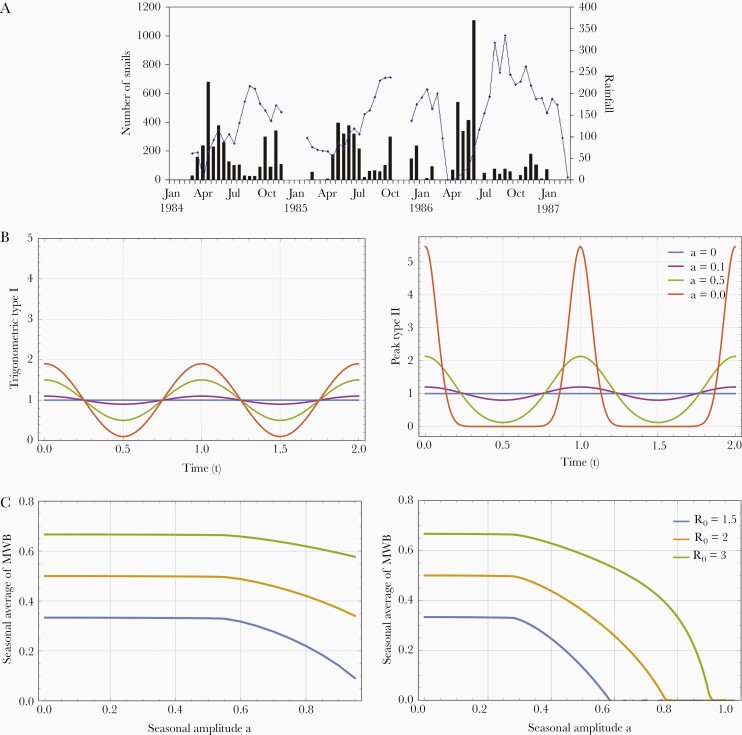
A seasonal transmission environment including seasonal variation of snail population density and human-snail contact patterns can affect the dynamics of Schistosoma infection and the success of control interventions. In projecting control outcomes, conventional modeling approaches have often ignored seasonality by using simplified intermediate-host modeling, or by restricting seasonal effects through use of yearly averaging.
We used mathematical analysis and numerical simulation to estimate the impact of seasonality on disease dynamics and control outcomes, and to evaluate whether seasonal averaging or intermediate-host reduction can provide reliable predictions of control outcomes. We also examined whether seasonality could be used as leverage in creation of effective control strategies.
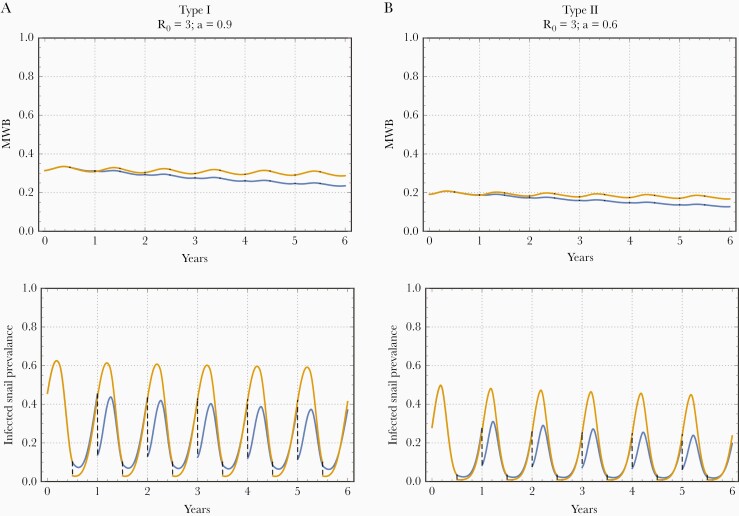
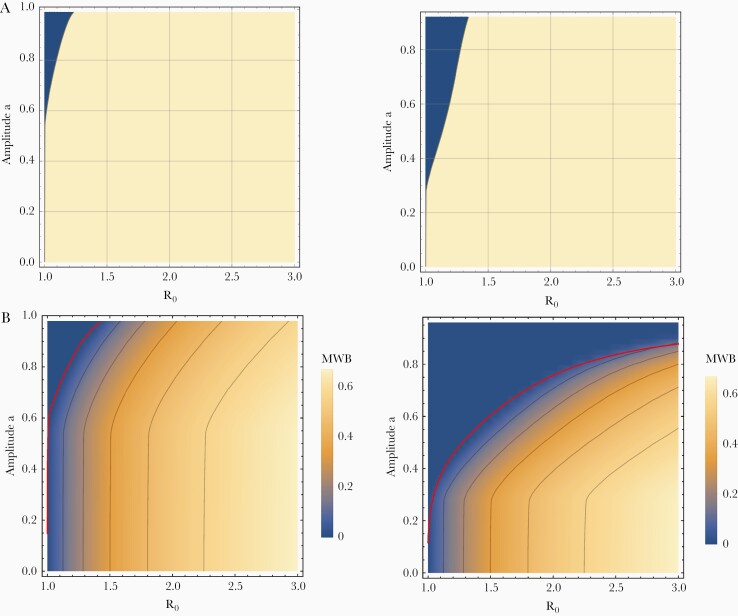
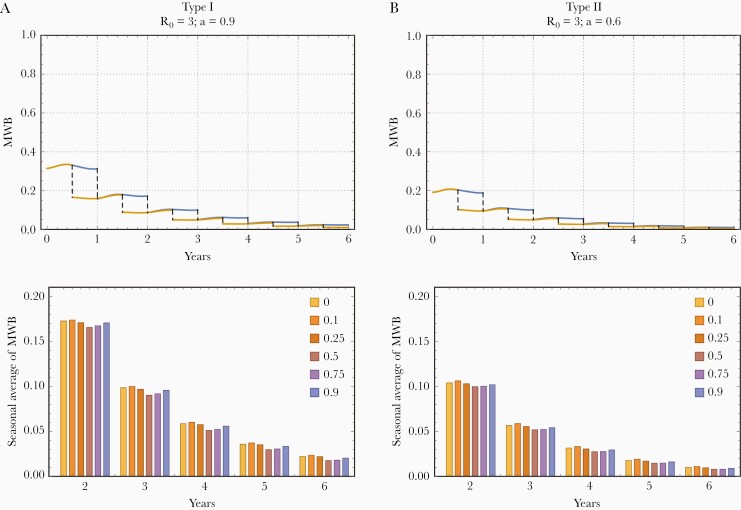
We found models that used seasonal averaging could grossly overestimate infection burden and underestimate control outcomes in highly seasonal environments. We showed that proper intraseasonal timing of control measures could make marked improvement on the long-term burden reduction for Schistosoma transmission control, and we identified the optimal timing for each intervention. Seasonal snail control, implemented alone, was less effective than mass drug administration, but could provide additive impact in reaching control and elimination targets.
Seasonal variation makes Schistosoma transmission less sustainable and easier to control than predicted by earlier modeling studies.
包括钉螺种群密度和人与钉螺接触模式季节性变化的季节性传播环境会影响血吸虫感染的动态和控制干预的成功。在预测控制结果时,传统的建模方法通常通过使用简化的中间宿主模型来忽略季节性,或者通过使用年平均值来限制季节性影响。
我们使用数学分析和数值模拟来估计季节性对疾病动态和控制结果的影响,并评估季节性平均或中间宿主减少是否可以提供控制结果的可靠预测。我们还研究了季节性是否可以用作制定有效控制策略的手段。
我们发现,使用季节性平均的模型可能会严重高估感染负担,并低估高度季节性环境中的控制结果。我们表明,在控制措施的适当的季节内定时可以显著改善血吸虫传播控制的长期负担减轻,并且我们确定了每种干预措施的最佳时机。单独实施季节性钉螺控制的效果不如大规模药物治疗,但可以在达到控制和消除目标方面提供附加影响。
季节性变化使血吸虫传播的可持续性降低,比早期建模研究预测的更容易控制。