Departamento de Agronomia, Universidade Federal de Viçosa, Viçosa, Minas Gerais, Brazil.
Departamento de Biologia Geral, Universidade Federal de Viçosa, Viçosa, Minas Gerais, Brazil.
PLoS One. 2020 Dec 2;15(12):e0233200. doi: 10.1371/journal.pone.0233200. eCollection 2020.
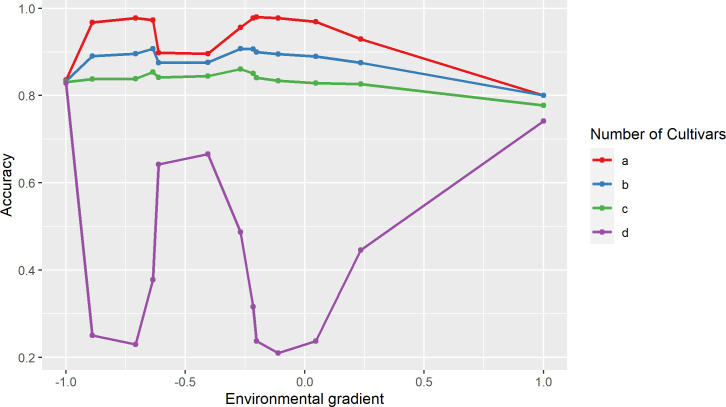
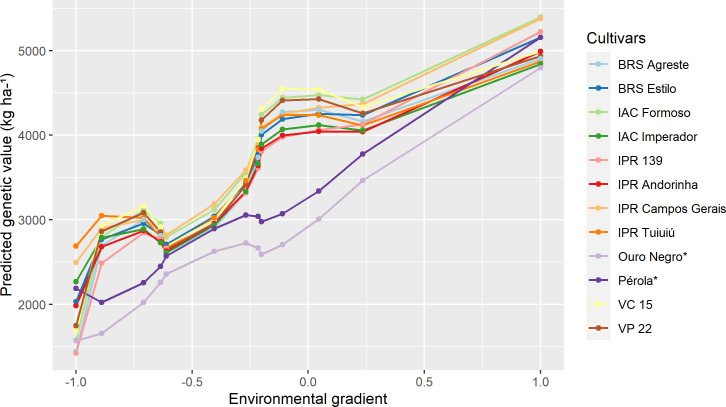
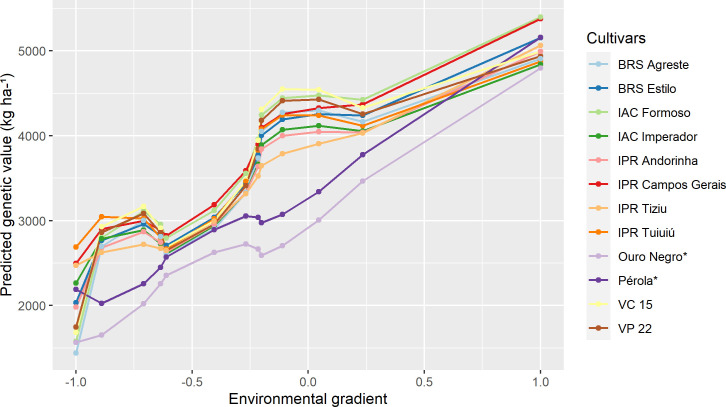
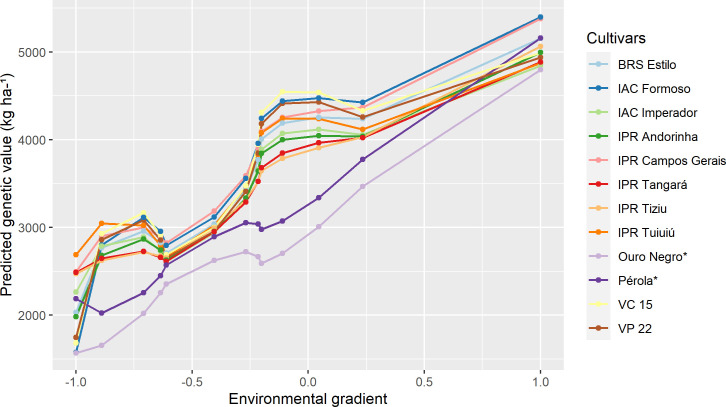
The evaluation of cultivars using multi-environment trials (MET) is an important step in plant breeding programs. One of the objectives of these evaluations is to understand the genotype by environment interaction (GEI). A method of determining the effect of GEI on the performance of cultivars is based on studies of adaptability and stability. Initial studies were based on linear regression; however, these methodologies have limitations, mainly in trials with genetic or statistical unbalanced, heterogeneity of residual variances, and genetic covariance. An alternative would be the use of random regression models (RRM), in which the behavior of the genotypes is characterized as a reaction norm using longitudinal data or repeated measurements and information regarding a covariance function. The objective of this work was the application of RRM in the study of the behavior of common bean cultivars using a MET, based on Legendre polynomials and genotype-ideotype distances. We used a set of 13 trials, which were classified as unfavorable or favorable environments. The results revealed that RRM enables the prediction of the genotypic values of cultivars in environments where they were not evaluated with high accuracy values, thereby circumventing the unbalanced of the experiments. From these values, it was possible to measure the genotypic adaptability according to ideotypes, according to their reaction norms. In addition, the stability of the cultivars can be interpreted as variation in the behavior of the ideotype. The use of ideotypes based on real data allowed a better comparison of the performance of cultivars across environments. The use of RRM in plant breeding is a good alternative to understand the behavior of cultivars in a MET, especially when we want to quantify the adaptability and stability of genotypes.
利用多环境试验(MET)对品种进行评估是植物育种计划的重要步骤。这些评估的目的之一是了解基因型与环境互作(GEI)。确定 GEI 对品种表现影响的方法基于适应性和稳定性研究。最初的研究基于线性回归;然而,这些方法存在局限性,主要在遗传或统计不平衡、剩余方差异质性和遗传协方差的试验中。另一种方法是使用随机回归模型(RRM),其中基因型的行为通过纵向数据或重复测量以及关于协方差函数的信息来表征为反应规范。这项工作的目的是应用 RRM 研究基于勒让德多项式和基因型-理想型距离的 MET 中普通菜豆品种的行为。我们使用了一组 13 个试验,这些试验被分类为不利或有利的环境。结果表明,RRM 能够以高精度值准确预测未在环境中评估的品种的基因型值,从而避免了实验的不平衡。从这些值中,可以根据反应规范,根据理想型测量基因型的适应性。此外,品种的稳定性可以解释为理想型行为的变化。基于实际数据的理想型的使用允许更好地比较品种在不同环境下的表现。在植物育种中使用 RRM 是了解 MET 中品种行为的一种很好的选择,特别是当我们想要量化基因型的适应性和稳定性时。