Faculty of Sport Sciences, Manisa Celal Bayar University, Manisa, Turkey.
Faculty of Sport Sciences, Sakarya University of Applied Sciences, Sakarya, Turkey.
J Musculoskelet Neuronal Interact. 2020 Dec 1;20(4):498-504.
The purpose of this study was to evaluate the effects of static stretching and the application of massage on flexibility and jump performance.
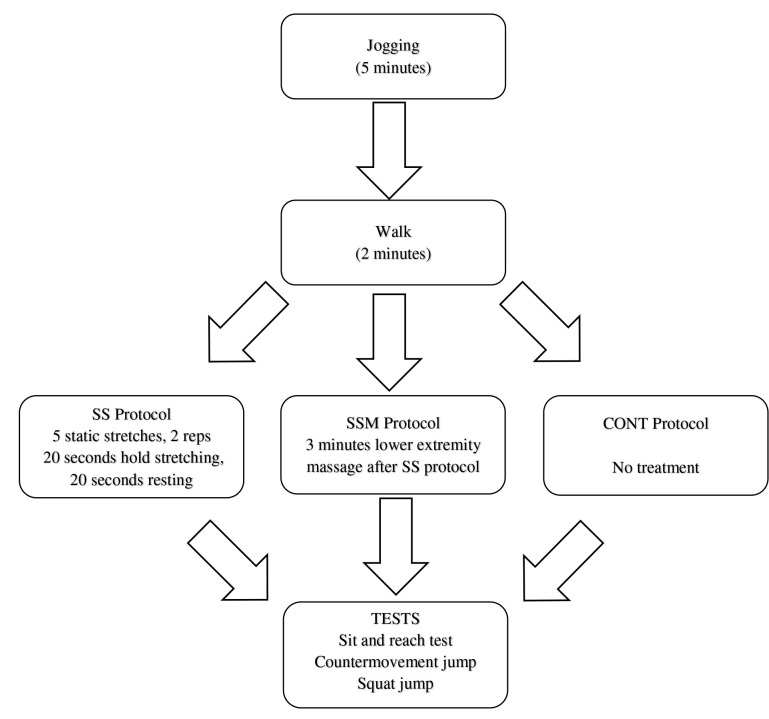
Thirty-five athletes studying Physical Education at University (mean age 23.6±1.3 years, mean height 177.8±6.3 cm and mean weight 72.2±6.7 kg) performed one of three different warm-up protocols on non-consecutive days. Protocols included static stretching [SS], combined static stretching and massage [SSM], and neither stretching nor massage [CONT]. The athletes performed flexibility, countermovement jump (CMJ) and squat jump (SJ) tests.
SS and SSM protocols demonstrated 12% (p<0.05) and 16% (p<0.05) respectively greater flexibility than the CONT protocol. SJ and CMJ performances were significantly decreased 10.4% (p<0.05) and 5.5% (p<0.05) respectively after the SS protocol. There was no significant difference between SSM and CONT protocol in terms of SJ and CMJ performance.
This research indicates that whereas static stretching increases the flexibility it decreases the jumping performance of the athletes. On the other hand, the application of massage immediately following static stretching increases flexibility but does not reduce jumping performance. Considering the known negative acute effects of static stretching on performance, the application of massage is thought to be beneficial in alleviating such effects.
本研究旨在评估静态拉伸和按摩对柔韧性和跳跃表现的影响。
35 名在大学学习体育教育的运动员(平均年龄 23.6±1.3 岁,平均身高 177.8±6.3cm,平均体重 72.2±6.7kg)在非连续的几天内进行了三种不同热身方案中的一种。方案包括静态拉伸[SS]、静态拉伸和按摩相结合[SSM],以及既不拉伸也不按摩[CONT]。运动员进行了柔韧性、反跳式跳跃(CMJ)和深蹲跳跃(SJ)测试。
SS 和 SSM 方案的柔韧性比 CONT 方案分别提高了 12%(p<0.05)和 16%(p<0.05)。SS 方案后,SJ 和 CMJ 性能分别显著下降了 10.4%(p<0.05)和 5.5%(p<0.05)。SSM 和 CONT 方案在 SJ 和 CMJ 性能方面没有显著差异。
本研究表明,虽然静态拉伸可以增加柔韧性,但会降低运动员的跳跃表现。另一方面,在静态拉伸后立即应用按摩会增加柔韧性,但不会降低跳跃表现。考虑到静态拉伸对性能的已知急性负面影响,应用按摩被认为可以缓解这种影响。