Vlysidis Michail, Kaznessis Yiannis N
Department of Chemical Engineering and Materials Science, University of Minnesota, Minneapolis, MN 55455, USA.
Entropy (Basel). 2018 Sep 12;20(9):700. doi: 10.3390/e20090700.
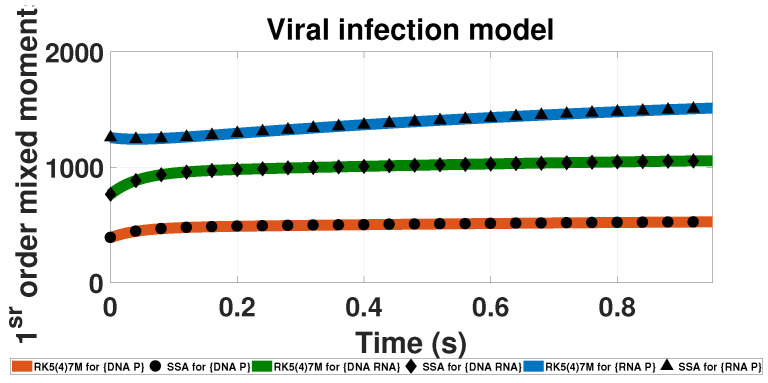
The time evolution of stochastic reaction networks can be modeled with the chemical master equation of the probability distribution. Alternatively, the numerical problem can be reformulated in terms of probability moment equations. Herein we present a new alternative method for numerically solving the time evolution of stochastic reaction networks. Based on the assumption that the entropy of the reaction network is maximum, Lagrange multipliers are introduced. The proposed method derives equations that model the time derivatives of these Lagrange multipliers. We present detailed steps to transform moment equations to Lagrange multiplier equations. In order to demonstrate the method, we present examples of non-linear stochastic reaction networks of varying degrees of complexity, including multistable and oscillatory systems. We find that the new approach is as accurate and significantly more efficient than Gillespie's original exact algorithm for systems with small number of interacting species. This work is a step towards solving stochastic reaction networks accurately and efficiently.
随机反应网络的时间演化可以用概率分布的化学主方程来建模。或者,数值问题可以根据概率矩方程重新表述。在此,我们提出一种新的替代方法,用于数值求解随机反应网络的时间演化。基于反应网络的熵最大的假设,引入了拉格朗日乘数。所提出的方法推导了对这些拉格朗日乘数的时间导数进行建模的方程。我们给出了将矩方程转换为拉格朗日乘数方程的详细步骤。为了演示该方法,我们给出了不同复杂程度的非线性随机反应网络的示例,包括多稳态和振荡系统。我们发现,对于具有少量相互作用物种的系统,新方法与吉莱斯皮的原始精确算法一样准确,且效率显著更高。这项工作是朝着准确高效地求解随机反应网络迈出的一步。