Ashfaq Aiysha, Clochard Marie-Claude, Coqueret Xavier, Dispenza Clelia, Driscoll Mark S, Ulański Piotr, Al-Sheikhly Mohamad
Department of Chemistry and Biochemistry, University of Maryland, College Park, MD 20742, USA.
Laboratoire des Solides Irradiés, CEA/DRF/IRAMIS-CNRS- Ecole Polytechnique UMR 7642, Institut Polytechnique de Paris, 91128 Palaiseau, France.
Polymers (Basel). 2020 Nov 30;12(12):2877. doi: 10.3390/polym12122877.
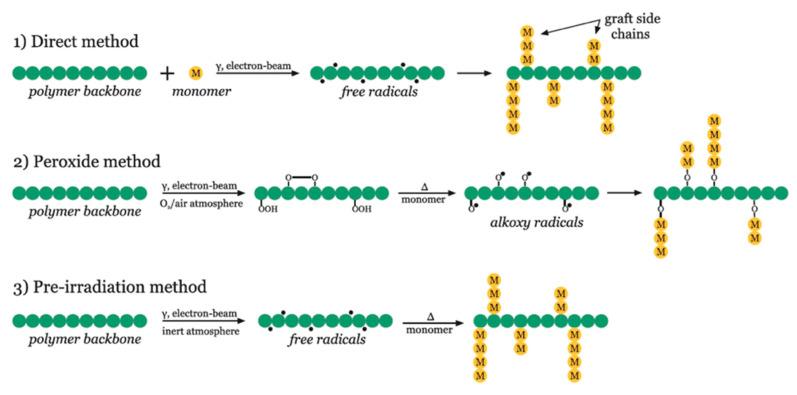
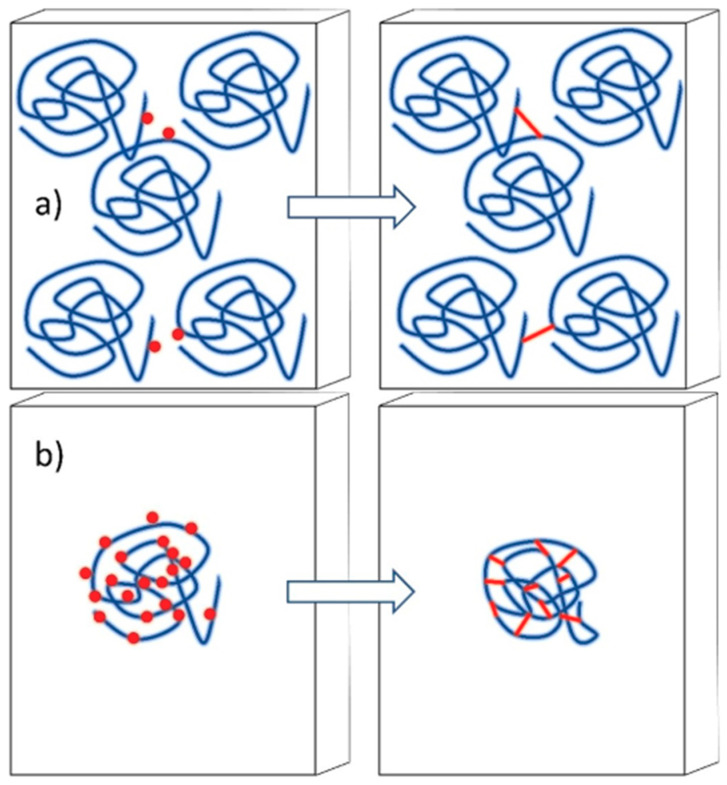
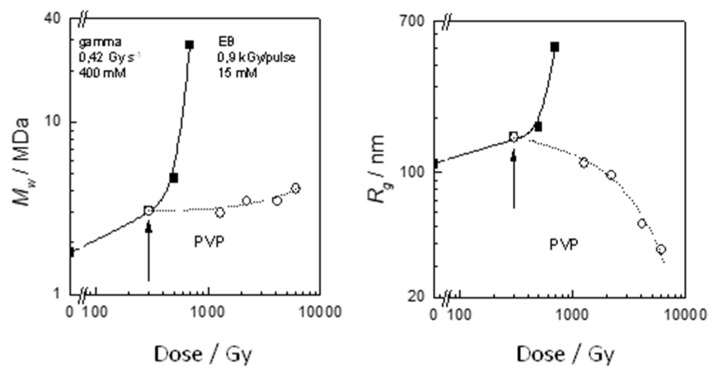
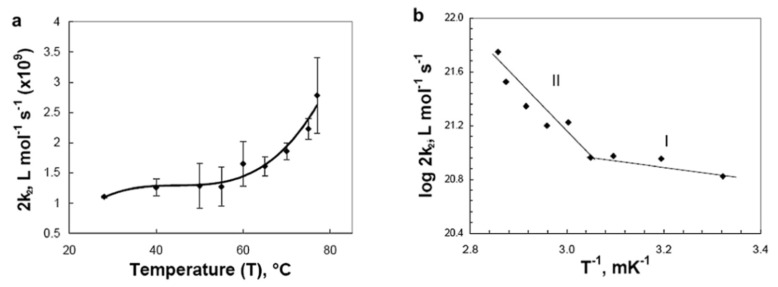
Ionizing radiation has become the most effective way to modify natural and synthetic polymers through crosslinking, degradation, and graft polymerization. This review will include an in-depth analysis of radiation chemistry mechanisms and the kinetics of the radiation-induced C-centered free radical, anion, and cation polymerization, and grafting. It also presents sections on radiation modifications of synthetic and natural polymers. For decades, low linear energy transfer (LLET) ionizing radiation, such as gamma rays, X-rays, and up to 10 MeV electron beams, has been the primary tool to produce many products through polymerization reactions. Photons and electrons interaction with polymers display various mechanisms. While the interactions of gamma ray and X-ray photons are mainly through the photoelectric effect, Compton scattering, and pair-production, the interactions of the high-energy electrons take place through coulombic interactions. Despite the type of radiation used on materials, photons or high energy electrons, in both cases ions and electrons are produced. The interactions between electrons and monomers takes place within less than a nanosecond. Depending on the dose rate (dose is defined as the absorbed radiation energy per unit mass), the kinetic chain length of the propagation can be controlled, hence allowing for some control over the degree of polymerization. When polymers are submitted to high-energy radiation in the bulk, contrasting behaviors are observed with a dominant effect of cross-linking or chain scission, depending on the chemical nature and physical characteristics of the material. Polymers in solution are subject to indirect effects resulting from the radiolysis of the medium. Likewise, for radiation-induced polymerization, depending on the dose rate, the free radicals generated on polymer chains can undergo various reactions, such as inter/intramolecular combination or inter/intramolecular disproportionation, b-scission. These reactions lead to structural or functional polymer modifications. In the presence of oxygen, playing on irradiation dose-rates, one can favor crosslinking reactions or promotes degradations through oxidations. The competition between the crosslinking reactions of C-centered free radicals and their reactions with oxygen is described through fundamental mechanism formalisms. The fundamentals of polymerization reactions are herein presented to meet industrial needs for various polymer materials produced or degraded by irradiation. Notably, the medical and industrial applications of polymers are endless and thus it is vital to investigate the effects of sterilization dose and dose rate on various polymers and copolymers with different molecular structures and morphologies. The presence or absence of various functional groups, degree of crystallinity, irradiation temperature, etc. all greatly affect the radiation chemistry of the irradiated polymers. Over the past decade, grafting new chemical functionalities on solid polymers by radiation-induced polymerization (also called RIG for Radiation-Induced Grafting) has been widely exploited to develop innovative materials in coherence with actual societal expectations. These novel materials respond not only to health emergencies but also to carbon-free energy needs (e.g., hydrogen fuel cells, piezoelectricity, etc.) and environmental concerns with the development of numerous specific adsorbents of chemical hazards and pollutants. The modification of polymers through RIG is durable as it covalently bonds the functional monomers. As radiation penetration depths can be varied, this technique can be used to modify polymer surface or bulk. The many parameters influencing RIG that control the yield of the grafting process are discussed in this review. These include monomer reactivity, irradiation dose, solvent, presence of inhibitor of homopolymerization, grafting temperature, etc. Today, the general knowledge of RIG can be applied to any solid polymer and may predict, to some extent, the grafting location. A special focus is on how ionizing radiation sources (ion and electron beams, UVs) may be chosen or mixed to combine both solid polymer nanostructuration and RIG. LLET ionizing radiation has also been extensively used to synthesize hydrogel and nanogel for drug delivery systems and other advanced applications. In particular, nanogels can either be produced by radiation-induced polymerization and simultaneous crosslinking of hydrophilic monomers in "nanocompartments", i.e., within the aqueous phase of inverse micelles, or by intramolecular crosslinking of suitable water-soluble polymers. The radiolytically produced oxidizing species from water, •OH radicals, can easily abstract H-atoms from the backbone of the dissolved polymers (or can add to the unsaturated bonds) leading to the formation of C-centered radicals. These C-centered free radicals can undergo two main competitive reactions; intramolecular and intermolecular crosslinking. When produced by electron beam irradiation, higher temperatures, dose rates within the pulse, and pulse repetition rates favour intramolecular crosslinking over intermolecular crosslinking, thus enabling a better control of particle size and size distribution. For other water-soluble biopolymers such as polysaccharides, proteins, DNA and RNA, the abstraction of H atoms or the addition to the unsaturation by •OH can lead to the direct scission of the backbone, double, or single strand breaks of these polymers.
电离辐射已成为通过交联、降解和接枝聚合来改性天然和合成聚合物的最有效方法。本综述将深入分析辐射化学机理以及辐射诱导的以碳为中心的自由基、阴离子和阳离子聚合及接枝的动力学。它还介绍了合成聚合物和天然聚合物的辐射改性部分。几十年来,低线性能量传递(LLET)电离辐射,如γ射线、X射线和高达10 MeV的电子束,一直是通过聚合反应生产许多产品的主要工具。光子和电子与聚合物的相互作用表现出各种机制。γ射线和X射线光子的相互作用主要通过光电效应、康普顿散射和电子对产生,而高能电子的相互作用则通过库仑相互作用发生。无论材料上使用何种辐射类型,光子或高能电子,在这两种情况下都会产生离子和电子。电子与单体之间的相互作用在不到一纳秒的时间内发生。根据剂量率(剂量定义为单位质量吸收的辐射能量),可以控制链增长的动力学链长,从而对聚合度进行一定程度的控制。当聚合物在本体中受到高能辐射时,根据材料的化学性质和物理特性,会观察到交联或链断裂的主导效应等相反的行为。溶液中的聚合物会受到介质辐射分解产生的间接影响。同样,对于辐射诱导聚合,根据剂量率,聚合物链上产生的自由基会经历各种反应,如分子间/分子内结合或分子间/分子内歧化、β-断裂。这些反应会导致聚合物的结构或功能改性。在有氧气存在的情况下,通过控制辐照剂量率,可以促进交联反应或通过氧化促进降解。通过基本机制形式描述了以碳为中心的自由基的交联反应与其与氧气反应之间的竞争。本文介绍聚合反应的基本原理,以满足通过辐照生产或降解的各种聚合物材料的工业需求。值得注意的是,聚合物的医学和工业应用是无穷无尽的,因此研究灭菌剂量和剂量率对具有不同分子结构和形态的各种聚合物和共聚物的影响至关重要。各种官能团的存在与否、结晶度、辐照温度等都会极大地影响辐照聚合物的辐射化学。在过去十年中,通过辐射诱导聚合(也称为辐射诱导接枝,RIG)在固体聚合物上接枝新的化学官能团已被广泛用于开发符合实际社会期望的创新材料。这些新型材料不仅能应对健康紧急情况,还能满足无碳能源需求(如氢燃料电池、压电性等)以及环境问题,开发出众多化学危害和污染物的特定吸附剂。通过RIG对聚合物的改性是持久的,因为它将功能单体共价键合。由于辐射穿透深度可以变化,该技术可用于改性聚合物表面或本体。本综述讨论了影响RIG并控制接枝过程产率的许多参数。这些参数包括单体反应性、辐照剂量、溶剂、均聚抑制剂的存在、接枝温度等。如今,RIG的一般知识可应用于任何固体聚合物,并在一定程度上可以预测接枝位置。特别关注如何选择或混合电离辐射源(离子束和电子束、紫外线)以结合固体聚合物纳米结构化和RIG。LLET电离辐射也已广泛用于合成用于药物递送系统和其他先进应用的水凝胶和纳米凝胶。特别是,纳米凝胶可以通过辐射诱导聚合并在“纳米隔室”(即在反胶束的水相中)中同时交联亲水性单体来制备,或者通过合适的水溶性聚合物的分子内交联来制备。水中辐射分解产生的氧化物种•OH自由基可以很容易地从溶解聚合物的主链上夺取氢原子(或可以加成到不饱和键上),导致形成以碳为中心的自由基。这些以碳为中心的自由基可以经历两种主要的竞争反应;分子内和分子间交联。当通过电子束辐照产生时,较高的温度、脉冲内的剂量率和脉冲重复率有利于分子内交联而非分子间交联,从而能够更好地控制粒径和粒径分布。对于其他水溶性生物聚合物如多糖、蛋白质、DNA和RNA,•OH夺取氢原子或加成到不饱和度上会导致这些聚合物的主链直接断裂、双链或单链断裂。