Department of Health Ecology, Teaching Institute of Public Health of Primorsko-goranska County, Krešimirova 52a, 51000 Rijeka, Croatia.
Department of Physiology, Immunology and Pathophysiology, Faculty of Medicine, University of Rijeka, Braće Branchetta 20/1, 51000 Rijeka, Croatia.
Nutrients. 2020 Nov 22;12(11):3583. doi: 10.3390/nu12113583.
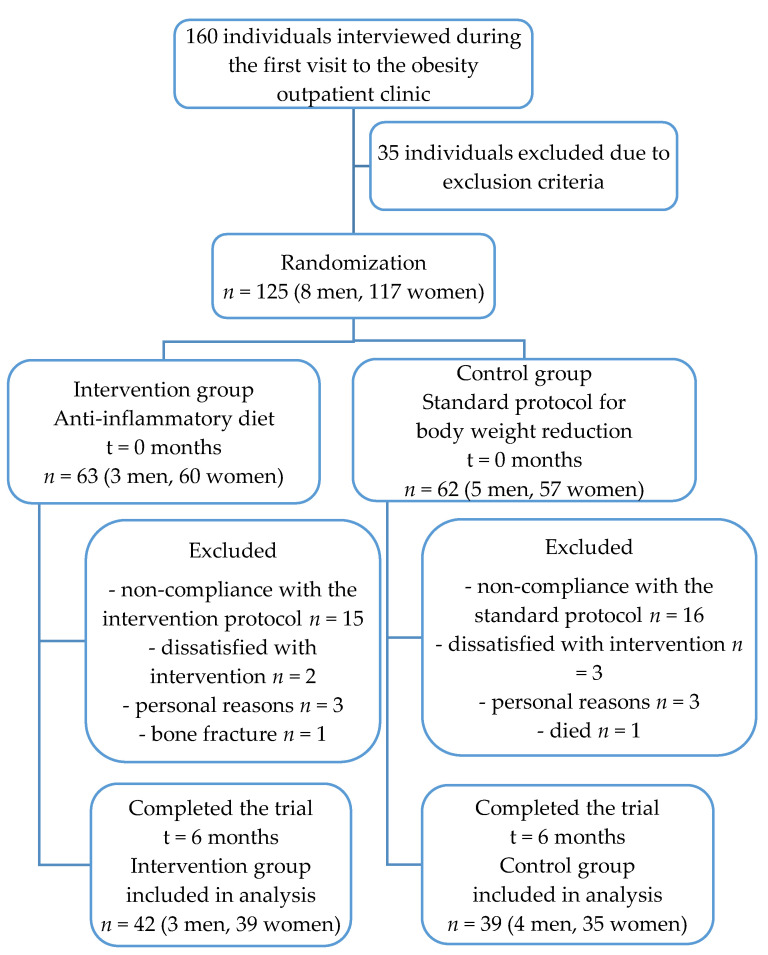
There is growing evidence of the dietary impact on obesity-induced low-grade chronic inflammation and the associated chronic non-communicable diseases modification. We determined changes in body composition and cardiometabolic and inflammatory status of participants with obesity after 24 weeks of a dietary intervention based on an energy-reduced anti-inflammatory diet and examined the relationship of these changes with changes in the inflammatory potential of the diet. The anthropometric and body composition parameters of 81 participants (average age of 43 years, 74 women) were assessed. Metabolic status was determined using the glycemic and lipid statuses, and the cardiometabolic index and inflammatory status were determined using the concentration of high-sensitivity C-reactive protein (hs-CRP), interleukin 6 (IL-6), and tumor necrosis factor α (TNF-α). The inflammatory potential of the diet was assessed using the Dietary Inflammatory Index (DII). Intervention with an anti-inflammatory diet resulted in a significant reduction in body weight and visceral adipose tissue and caused improvements in the participants' cardiometabolic and inflammatory statuses. The anti-inflammatory diet was shown to be effective regarding obesity management. The study data could advance current scientific knowledge in the field of inflammation and diet, provide guidelines for obesity management, and find its application in routine clinical practice.
越来越多的证据表明,饮食对肥胖引起的低度慢性炎症和相关的慢性非传染性疾病的改变有影响。我们通过对基于能量减少的抗炎饮食的干预,确定了肥胖参与者在 24 周后身体成分、心脏代谢和炎症状态的变化,并研究了这些变化与饮食炎症潜力变化之间的关系。对 81 名参与者(平均年龄 43 岁,74 名女性)的人体测量和身体成分参数进行了评估。使用血糖和血脂状态来确定代谢状态,使用高敏 C 反应蛋白(hs-CRP)、白细胞介素 6(IL-6)和肿瘤坏死因子 α(TNF-α)的浓度来确定心脏代谢和炎症状态。使用饮食炎症指数(DII)评估饮食的炎症潜力。抗炎饮食干预导致体重和内脏脂肪组织显著减少,并改善了参与者的心脏代谢和炎症状态。抗炎饮食在肥胖管理方面是有效的。研究数据可以推动炎症和饮食领域的现有科学知识,为肥胖管理提供指导,并在常规临床实践中找到应用。